A workflow editor sends a code component to a validation endpoint before saving the flow. The endpoint intends to check syntax, but its implementation evaluates the snippet inside the same network-connected process that holds connector credentials. An automatic-login route supplies a privileged session to an unauthenticated client. Neither feature was designed as a public shell; chained together, they create one.
A 2026 vulnerability in an AI workflow platform exposed this exact class of boundary failure. The useful lesson is the path, not the product name: permissive identity bootstrap reached a validator with execution semantics, and the resulting process had valuable network and credential access. Fixing only the first visible endpoint would leave the underlying execution surface available to another route.
Agent builders, low-code automation systems, notebooks, and internal AI workbenches should be reviewed as development environments. Trace every prompt, flow import, plugin, file, and validation request that can become behavior. Record which identity authorizes the transition and what the worker can reach after code starts.
Key Takeaways
- AI workflow platforms should be threat-modeled as code-execution systems whenever they support custom components, expressions, scripts, generated code, plugins, or tools with side effects.
- The most serious failures are often chains. An exposed authentication shortcut may provide reachability, while an unsafe validator or runtime provides execution.
- Validation must be side-effect-free. Parsing, importing, decorating, compiling, instantiating, or evaluating untrusted code is execution, even when the feature is labeled a validator.
- Authentication, authorization, sandboxing, least privilege, network isolation, and secret separation are independent controls. No single one should carry the entire security claim.
- Patching the vulnerable package is necessary but not sufficient after suspected exploitation. Teams must investigate sessions, keys, connected services, host activity, persistence, and downstream data access.
- Continuous regression tests should verify the whole boundary: anonymous reachability, privilege issuance, protected endpoint access, code interpretation, egress, filesystem access, and cross-tenant isolation.
Why AI Workflow Builders Have an Unusually Dense Attack Surface
Traditional web applications generally process data according to code chosen by the developer. AI workflow builders intentionally move part of that choice closer to the user. A user may select components, connect tools, provide templates, upload files, define expressions, install packages, enter secrets, or ask a model to generate a custom component. The platform then decides how to represent and run that workflow.
This does not make the product insecure by definition. It does make the trust model more demanding. The same interface may serve several roles at once:
- A design surface where users create logic.
- A credential broker for model providers, databases, SaaS APIs, and cloud services.
- An execution engine that runs components and tools.
- A storage layer for flows, prompts, files, vector data, and conversation history.
- An API server that exposes workflows to other applications.
- A collaboration environment shared by developers, analysts, and business users.
- An agent host that lets model output select actions dynamically.
Each role introduces a boundary, but many deployments place them in one service account, one container, one network segment, and one administrative domain. A compromise in the authoring interface can therefore reach runtime secrets. A flaw in a public workflow endpoint can reach development functionality. A weak authorization check can expose another user's flow, and that flow may contain credentials or executable components. A code-execution primitive can inherit all the permissions accumulated for legitimate integrations.
The security question is not simply whether the platform has authentication. It is whether every transition from data to behavior is independently constrained.
The 2026 RCE Chain: What Was Actually Proven
The relevant 2026 bulletin described CVE-2026-9198, affecting Langflow OSS versions 1.0.0 through 1.10.0. The stated remediation baseline for that vulnerability was 1.10.1, while later security fixes raised the practical upgrade target further. As of this article's review date, 1.11.1 was the newest listed release. Operators should use a currently supported version that includes the relevant fixes rather than treating the minimum patched build as a permanent destination.
The reported attack depended on two distinct behaviors:
- An automatic-login endpoint could issue a superuser bearer token to a network caller in affected default deployments.
- A code-validation endpoint used Python evaluation behavior that could execute attacker-controlled constructs.
An external attacker did not need to defeat a password algorithm or steal an existing administrator's cookie. The first step supplied the authority required by the second. The validation feature then supplied execution. The issue was subsequently listed as known exploited, which changes its operational priority from a theoretical software defect to an exposure that defenders should assume attackers understand.
Several boundaries are important for accuracy. The case does not prove that every AI workflow deployment was reachable, affected, or compromised. Network exposure, version, packaging, configuration, and surrounding controls still matter. It also does not mean every code-generation feature is inherently vulnerable. The proven problem was a specific chain in which privileged access was available too easily and validation crossed into unsafe execution.
That distinction is essential for responsible vulnerability analysis. We should neither minimize a known-exploited RCE nor turn it into a claim that all AI tooling is unsafe.
The Attack Path as a Trust-Boundary Failure
| Stage | Security Expectation | Boundary Failure | Potential Consequence |
|---|---|---|---|
| Internet reachability | Development controls should not be anonymously reachable | Service or sensitive routes are exposed to untrusted networks | Attackers can enumerate features and test configuration assumptions |
| Identity issuance | Privileged tokens require verified credentials and explicit policy | Automatic login provides a high-authority identity | Anonymous traffic gains authenticated reachability |
| Endpoint authorization | Sensitive development functions require narrowly scoped permissions | A broad token can call code-validation functionality | Authentication becomes equivalent to administrative execution rights |
| Validation | Candidate code is inspected without side effects | Validation evaluates executable language constructs | Attacker-controlled input runs in the server process |
| Runtime containment | A compromised component has minimal local authority | Process can read files, environment variables, or writable paths | Secrets, configuration, and application data may be exposed or changed |
| Network containment | Runtime can reach only approved destinations | Broad egress or internal network access remains available | The attacker may reach internal APIs, metadata services, or data stores |
| Recovery | Upgrade removes risk | Tokens, secrets, and persistence are left untouched | Access obtained before patching may survive remediation |
This table shows why vulnerability chains should be reviewed end to end. Fixing only the validation function would remove the documented execution sink, but leaving privileged automatic login exposed would still be an unacceptable control failure. Disabling automatic login would break the reported unauthenticated chain, but an authorized low-privilege user might still reach an unsafe execution feature if authorization remained broad. Defense depends on eliminating each unjustified trust transition.
"Validation" Is Not Safe If It Runs the Thing Being Validated
The word validation creates false comfort. Developers may intend to check syntax, confirm that a class follows an interface, inspect metadata, or show a preview. Yet language runtimes can execute behavior earlier than expected.
In Python and similar dynamic environments, execution is not limited to an obvious call to a user-defined function. Importing a module can run top-level statements. Class bodies can execute while the class is created. Decorators can invoke functions. Default argument expressions can be evaluated when a function is defined. Type annotations may be evaluated depending on language version and implementation choices. Descriptors, metaclasses, constructors, and serialization hooks can introduce additional side effects.
That creates a simple rule: if untrusted source text reaches the language interpreter, compiler, importer, object loader, template engine, or plugin loader inside the privileged application process, the team should presume code execution until it can prove otherwise.
Safer Validation Patterns
Static parsing can reduce risk when the accepted language is deliberately limited. A parser can build an abstract syntax tree and reject forbidden nodes without importing or running the submitted module. A schema can restrict components to declarative fields and known operations. A capability registry can map user choices to pre-reviewed functions instead of accepting arbitrary source. Signed packages can be installed through a controlled build process rather than during a live request.
Static validation is not automatically perfect. Parsers can have vulnerabilities, allowed constructs can compose into unsafe behavior, and a later runtime may interpret the same data differently. The purpose is to keep validation and execution as separate phases with separate authority.
When dynamic execution is a legitimate product requirement, the execution environment should be treated as hostile:
- Run it outside the control-plane process.
- Use a short-lived sandbox with no inherited host credentials.
- Mount a minimal, read-only filesystem.
- Deny network access by default and allow only explicit destinations.
- Apply CPU, memory, process, and execution-time limits.
- Remove package installation unless the package set is pre-approved and pinned.
- Prevent access to container orchestrator sockets and cloud metadata endpoints.
- Destroy the environment after the task and retain an auditable execution record.
A sandbox is not a replacement for authorization. It is a containment layer for the possibility that authorized inputs are malicious, compromised, or generated incorrectly.
The AI Label Can Hide a Conventional Security Failure
It is tempting to classify this class of incident as an exotic AI vulnerability. The model may be involved in generating code, but the decisive controls are familiar application-security controls: secure defaults, authentication, authorization, input handling, interpreter isolation, secret management, and network segmentation.
This observation matters because teams sometimes apply AI safety controls to the prompt while ignoring the application around it. A prompt-injection filter cannot repair a public administrative endpoint. Content moderation cannot make exec() safe. A model evaluation cannot establish tenant isolation. A guardrail prompt cannot revoke a cloud credential inherited by the runtime.
AI-specific risk still matters. Model output is probabilistic and may be influenced by direct prompts, retrieved documents, tool results, or another agent. A workflow builder may execute code that neither the end user nor the platform developer wrote directly. That expands the set of untrusted authors. But the defensive response should connect AI governance to established engineering controls rather than inventing a parallel security universe.
We can express the combined model as four questions:
- Input integrity: Who or what can influence the generated workflow, component, expression, or tool call?
- Decision authority: Which identity decides that the input is allowed to proceed?
- Execution authority: What privileges does the runtime possess when the action occurs?
- Impact containment: Which systems, data, tenants, and networks can the runtime affect?
Any answer of "the default superuser" or "the same process as the control plane" deserves immediate review.
Threat Modeling the Full Workflow Platform
A useful threat model follows data and authority rather than product screens. Start with every input channel that can affect a workflow:
- Direct prompts and chat messages.
- Imported flow definitions and templates.
- Custom code components.
- Uploaded files and archives.
- Repository content.
- Webhook bodies.
- MCP or plugin responses.
- Retrieved documents and vector-store content.
- Environment variables and deployment configuration.
- Administrative APIs.
- Model-generated code, queries, and tool arguments.
Then map every interpreter and side-effect engine:
- Python, JavaScript, shell, SQL, and template evaluation.
- Package or plugin installation.
- Deserialization and object reconstruction.
- Notebook or job execution.
- HTTP requests and webhook delivery.
- File read, write, export, and archive handling.
- Database queries and migration tools.
- Cloud SDK and infrastructure operations.
- Email, messaging, ticketing, or deployment actions.
Finally, attach identities and assets. Record which user initiates the operation, which service account executes it, which credentials are available, and which tenant owns the resulting data. This often exposes the real problem before a scanner does. A feature may have an authorization check at the UI while its backend worker uses a shared superuser credential. A public API may run a flow owned by an administrator. A tenant-specific action may execute in a process with access to all tenants' storage.
A Practical Trust-Boundary Inventory
| Boundary | Questions to Ask | Evidence to Collect |
|---|---|---|
| Public network to control plane | Which routes are reachable without a trusted gateway? Are development endpoints exposed? | Route inventory, ingress rules, gateway policy, anonymous request tests |
| User to privileged identity | Can any feature mint, inherit, or exchange a higher-privilege token? | Authentication flows, token claims, issuance logs, default configuration |
| Tenant to tenant | Are object lookups scoped by tenant and owner at the data layer? | Authorization tests across equivalent users, query filters, audit records |
| Data to code | Which inputs reach interpreters, templates, imports, or plugins? | Data-flow trace, source review, runtime instrumentation |
| Control plane to worker | Are code execution and administrative services separated? | Process model, service accounts, queues, network policy |
| Worker to secrets | Which environment variables, files, vault paths, and mounted tokens are readable? | Deployment manifest, secret references, filesystem permissions |
| Worker to network | Can the runtime reach the internet, metadata services, or private control planes? | Egress policy, DNS policy, network flow logs, controlled canary tests |
| Patch to recovery | What access may survive an upgrade? | Session inventory, key rotation plan, persistence review, downstream logs |
How to Test AI Workflow RCE Safely
Testing must be explicitly authorized. An RCE hypothesis is not permission to execute arbitrary commands on an internet service, and a public endpoint is not an invitation. The goal of a professional assessment is to prove the security property with the smallest controlled effect.
Phase 1: Establish Scope and Safety Conditions
Document the exact hostnames, versions, tenants, accounts, routes, time window, and allowed techniques. Define whether the target is a disposable laboratory, staging system, or production service. Production testing should prohibit destructive payloads, persistence, uncontrolled egress, access to real secrets, and lateral movement unless separately approved.
Agree on stop conditions. Unexpected data access, service instability, cross-tenant reachability, or evidence of an existing compromise should pause the test and trigger the incident path. Provide a named contact who can disable the service or revoke credentials immediately.
Phase 2: Verify Exposure Without Execution
Begin with deployment inventory and passive evidence. Confirm package and image versions, enabled features, ingress paths, reverse-proxy rules, authentication settings, and whether development interfaces are reachable. Compare the running artifact with the vendor's affected and fixed ranges. Do not infer safety from a UI version string alone; verify the deployed package or image digest.
Test anonymous access using harmless requests. Determine whether a caller can obtain a session, API key, or token without presenting a credential. Inspect the resulting claims and scope without using them to access sensitive data. Confirm whether the gateway and application agree about which routes require authentication.
Phase 3: Test Authorization as a Separate Property
Use purpose-built low-privilege accounts. Check whether they can reach component validation, flow import, plugin management, secret configuration, public sharing, or administrative APIs. Repeat tests across two isolated tenants to detect object-level authorization failures. Record request and response evidence while avoiding real customer objects.
Authentication success should never be treated as authorization success. A token can be valid and still be inappropriate for the requested action.
Phase 4: Prove Unsafe Interpretation with a Benign Canary
In an isolated environment, use a non-destructive canary approved in the rules of engagement. The canary should create a unique, temporary observation that proves evaluation occurred without reading sensitive files, opening a shell, changing business data, or contacting an uncontrolled server. Examples include a marker written to a dedicated temporary volume or a callback to a tester-controlled sink inside the laboratory network.
Capture the exact input, application response, worker identity, process event, and canary observation. Then remove the marker and destroy the sandbox. A finding should explain why the proof demonstrates code execution, not merely that an error message changed.
Phase 5: Measure Containment Without Expanding Impact
Use configuration and controlled probes to determine what the worker could access. Review mounted service-account tokens, environment-secret references, filesystem modes, container capabilities, egress rules, and cloud identity assignments. Do not retrieve real secret values simply to prove they exist. A readable canary secret created for the test can establish the boundary safely.
The final finding should separate confirmed impact from potential impact. "Code executed as the worker identity" is confirmed when evidenced. "Could compromise all cloud accounts" is not confirmed unless the relevant permissions and reachable paths were safely demonstrated.
Phase 6: Build a Regression Suite
After remediation, replay the entire chain:
- Anonymous callers cannot obtain privileged identity material.
- Low-privilege users cannot reach code-management functions.
- Validation rejects unsafe constructs without executing them.
- Approved execution occurs only in the isolated worker.
- The worker cannot access control-plane secrets or other tenants.
- Default egress denies unapproved destinations.
- Audit records connect the user, input, decision, worker, and result.
Testing only the original endpoint can miss an equivalent route, a new import feature, or a second code path that uses the same vulnerable helper.
Engineering Controls That Break the Attack Chain
| Control Area | Minimum Requirement | Stronger Design | Validation Method |
|---|---|---|---|
| Deployment defaults | Authentication enabled for every non-local deployment | Refuse startup on shared interfaces with development authentication modes | Configuration policy and anonymous integration tests |
| Privileged identity | No automatic issuance of administrator tokens to network callers | Short-lived, audience-restricted tokens with explicit user and device context | Token-claim review and unauthorized issuance tests |
| Endpoint authorization | Code features limited to dedicated roles | Per-action policy with tenant, environment, and approval context | Role matrix and negative authorization tests |
| Code validation | Parse and inspect without imports or evaluation | Declarative component schema and allowlisted capabilities | Side-effect canary tests and source review |
| Runtime isolation | Execution outside the control plane | Ephemeral sandbox per task or tenant | Process, namespace, and escape-resistance review |
| Filesystem | Minimal read-only image and isolated scratch space | Per-task encrypted volume destroyed after use | Mount and permission inspection |
| Secrets | No broad secrets inherited by the worker | Just-in-time scoped credentials delivered for one action | Canary-secret and credential-lifetime tests |
| Network | Default-deny egress with explicit destinations | Per-tool, per-tenant, and per-task network policy | Flow-log review and denied-destination tests |
| Packages | No arbitrary installation in live workers | Signed, pinned, scanned artifact promoted through CI | Dependency policy and artifact provenance checks |
| Auditability | Log user, tenant, route, action, worker, and result | Tamper-resistant traces linking model decision to tool effect | End-to-end trace reconstruction |
| Human control | Approval for high-impact or unusual actions | Risk-based approval enforced outside model control | Attempted approval-bypass tests |
The strongest architecture uses multiple independent controls. If authorization fails, sandboxing limits impact. If sandboxing fails, least privilege and egress policy reduce reach. If a credential is exposed, short lifetime and narrow audience reduce reuse. If prevention fails, high-quality telemetry supports rapid detection and response.
Patch Management Is Only the First Response Step
For an unexposed laboratory instance, upgrading and verifying configuration may be enough. For an internet-reachable affected system, especially one associated with known exploitation, teams should treat remediation as a potential incident until evidence supports a lower-risk conclusion.
Immediate Containment
- Restrict network access before beginning a lengthy investigation.
- Preserve relevant application, gateway, container, identity, and network logs.
- Upgrade to a supported release containing all applicable fixes.
- Disable automatic login and any unnecessary public development features.
- Revoke active sessions, API keys, refresh tokens, and administrative tokens that may have been issued.
- Isolate or rebuild workers rather than trusting a process that may have executed attacker code.
Credential and Dependency Review
Inventory everything the service could read or call: model-provider keys, database credentials, object-storage tokens, source-control tokens, webhook secrets, cloud identities, MCP credentials, and internal API keys. Rotate based on reachability and evidence, not merely on where a secret was intended to be used. A credential stored in an environment variable may be exposed to any code running in that process.
Review downstream systems for unusual activity beginning before the first known probing event. Token use, repository access, new API keys, data exports, modified workflows, scheduled jobs, and outbound connections may reveal impact that the application logs alone do not show.
Persistence and Integrity Review
Remote code execution can modify more than the running process. Check writable volumes, startup files, installed packages, workflow definitions, user accounts, API keys, scheduled tasks, container images, and deployment manifests. If the service can publish artifacts or modify automation, verify those outputs independently.
Rebuilding from a known-good image is usually more defensible than cleaning an unknown runtime in place. Restore only reviewed configuration and data.
Detection: Look for the Chain, Not One Signature
An exact exploit string is brittle. Detection should cover the behavioral sequence and its supporting control failures.
Useful signals include:
- Anonymous or unusual clients reaching login shortcuts or hidden administrative routes.
- Privileged tokens issued without a preceding successful credential event.
- A newly issued token immediately calling code-validation, component, flow-import, or plugin endpoints.
- Worker processes spawning unexpected interpreters, shells, package managers, or network utilities.
- The application process reading secret paths or service-account tokens outside normal startup behavior.
- Outbound connections from a workflow worker to new destinations, link-local addresses, or internal control planes.
- Changes to flows, users, API keys, or public-sharing settings from unfamiliar sessions.
- Validation requests followed by crashes, unusual latency, or new files in writable directories.
Correlate gateway, application, identity, container-runtime, endpoint, DNS, network-flow, cloud-audit, and downstream SaaS logs. The application may record a valid administrator action because the attacker obtained a valid token. The identity context becomes suspicious only when it is connected to the anonymous issuance event and the subsequent execution behavior.
Where Autonomous Pentesting Adds Value
This class of vulnerability is difficult for a conventional scanner because no single response necessarily proves the risk. One route changes identity state. Another accepts code-like input. A worker produces the final side effect. The tester must preserve session context, understand roles, choose a safe proof, and connect observations across components.
An autonomous pentest agent can help by mapping routes, comparing anonymous and authenticated behavior, maintaining separate test identities, following token transitions, generating negative authorization cases, and replaying a benign canary after every fix. But the agent itself needs strict boundaries. It should not decide on its own to execute arbitrary system commands, retrieve real secrets, contact public callback services, or pivot into connected infrastructure.
The useful model is controlled autonomy:
- The platform defines immutable scope and prohibited actions.
- The agent proposes the next test and expected evidence.
- Low-impact checks run automatically within rate and data limits.
- Code-execution proofs use pre-approved canaries in isolated environments.
- High-impact transitions require explicit human approval.
- Every action and result remains replayable and attributable.
The objective is not to make exploitation dramatic. It is to make the security conclusion reproducible.
FAQ
Are all AI workflow builders remote code execution platforms?
No. Some products support only declarative, allowlisted operations and do not accept custom code. Others intentionally execute scripts, generated components, notebook cells, templates, or plugins. Security teams should classify the platform by actual behavior, not its marketing category. If user-controlled or model-generated input can reach an interpreter or high-impact tool, treat that path as a code-execution boundary.
Is disabling automatic login enough to fix this class of vulnerability?
It can break one unauthenticated attack path, but it does not make unsafe code evaluation acceptable. A compromised account, low-privilege user, exposed API key, or authorization flaw may still reach the execution sink. Authentication, authorization, side-effect-free validation, sandboxing, and least privilege must be tested separately.
Can a web application firewall block AI workflow RCE?
A WAF may reduce exposure to known request patterns, but it cannot reliably understand every valid language construct, encoded representation, alternate endpoint, or multi-step authorization chain. Use it as a temporary compensating control, not as the primary fix. Remove the vulnerable behavior, patch the platform, and constrain the runtime.
What is the safest way to verify a suspected RCE?
Use an explicitly authorized, isolated environment and a benign canary that creates a unique temporary observation without accessing real data or uncontrolled networks. Record the input, process identity, and observation. Do not escalate privileges or retrieve secrets merely to strengthen the screenshot. Then replay the same test after remediation and confirm that validation remains side-effect-free.
What should we rotate after an internet-facing workflow platform is compromised?
Start with sessions and credentials directly available to the service, then expand according to reachable systems and evidence. This may include API keys, refresh tokens, database credentials, model-provider secrets, source-control tokens, cloud identities, webhook secrets, and signing keys. Also investigate downstream use before assuming rotation alone removed the attacker's access.
The Boundary Extends All the Way to the Runtime
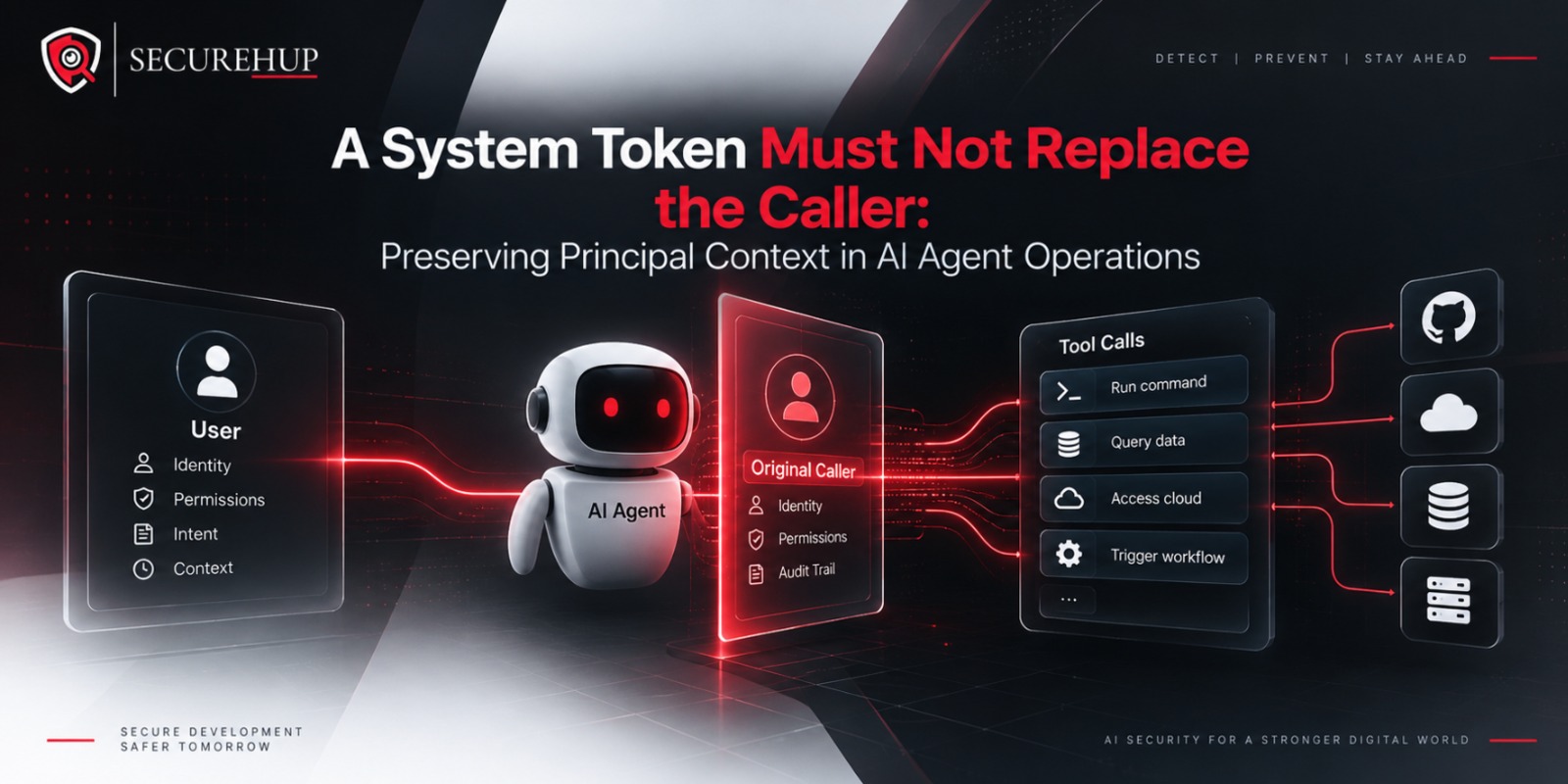
Validation, preview, import, plugin, notebook, and execution features may look like separate product surfaces, yet they often converge on the same worker. That is why we prefer a source-to-effect view: it shows whether identity checks happen before scheduling, whether the worker inherits ambient credentials, and whether a supposedly harmless validator actually invokes the runtime. Isolation and fail-closed authorization reinforce each other; neither one proves the other exists.
A harmless execution canary provides a practical regression anchor after the immediate route is fixed. Replaying it through alternate paths can reveal whether the application closed one shortcut while preserving the same authority elsewhere. The meaningful outcome is not simply that a known request now fails, but that untrusted input cannot acquire runtime authority beyond its verified principal and purpose.
#AISecurity #AgentSecurity #RemoteCodeExecution #ApplicationSecurity #DevSecOps #ContinuousValidation #SecureAI
Find issues like this in your own codebase
SecureHup runs this exact exploit chain — discovery, enumeration and cross-tenant validation — on every deployment, automatically.