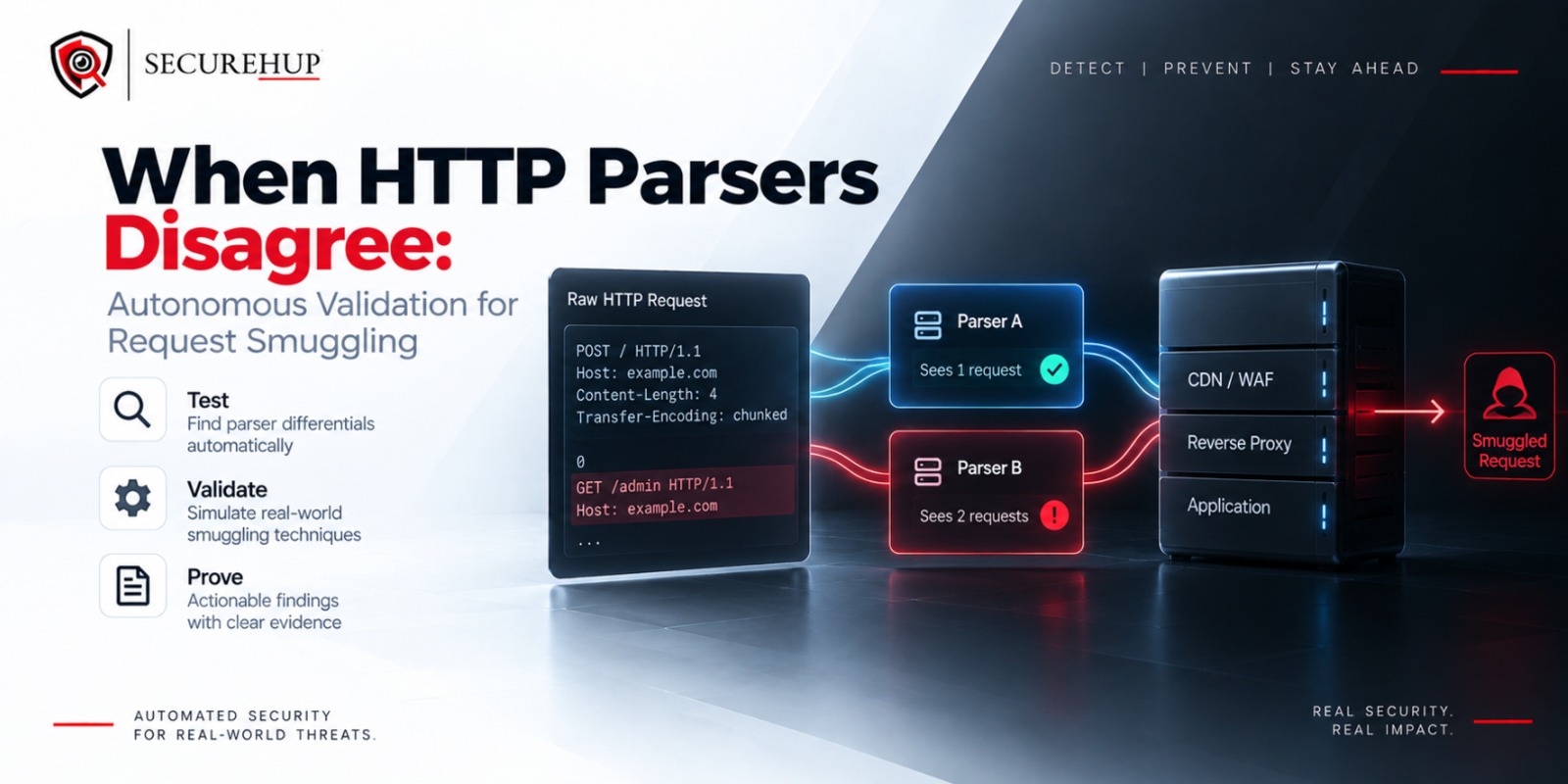
An edge parser reaches its header-count limit and omits the final framing header from the application-visible collection. The same parser still uses that hidden header to stream the body. A forwarding component rebuilds the outbound request from the visible headers while copying bytes governed by the hidden framing decision. Edge and origin now disagree about where one request ends.
Request smuggling is this loss of message-boundary consensus across components sharing a connection. One hop authorizes, logs, caches, or routes request A while another consumes residual bytes as request B. Authentication can be correct at both layers and still apply to different messages.
Safe validation needs an isolated, production-like chain, inert markers, controlled connection sequencing, and telemetry from each hop. Differential agents can explore parser, limit, conversion, and topology combinations, but the assertion remains narrow: all recipients must agree on target, framing, identity, and request count, while rejected ambiguity leaves no residual state.
Key Takeaways
- Request smuggling is a differential parsing failure: two or more HTTP recipients disagree about message boundaries or semantics on a shared connection.
- Security review must cover the deployed chain and protocol transitions, not only the origin framework or edge proxy in isolation.
- Limits on headers and bodies must reject the complete message or close the connection; silently truncating the application-visible view can create a dangerous split from parser reality.
- A proxy that reconstructs headers must forward a body derived from the same validated message representation, rather than mixing normalized metadata with an independently streamed original body.
- Safe autonomous validation uses inert marker requests, one controlled connection, hop-by-hop traces, and synthetic identities in an isolated environment; it does not probe unrelated public infrastructure.
- Passing a known payload list is not a proof of parser agreement. Dependency upgrades, configuration, HTTP version conversion, connection pooling, and custom middleware can change the effective behavior.
The Security Property Is Parser Consensus
The most useful invariant is not "the edge rejects malformed requests." It is:
For every accepted byte stream, every recipient in the trusted request chain
agrees on the number, order, boundaries, method, target, identity-bearing fields,
and body of the requests forwarded downstream.
If a component rejects the stream, it should not forward a prefix, preserve ambiguous remainder bytes, or reuse the connection in a way that lets the next request inherit them. Rejection and connection state are part of the same decision.
Why Shared Connections Matter
HTTP/1.1 persistent connections allow multiple requests to use one transport connection. Proxies also pool backend connections across clients for efficiency. The performance benefit creates state: after parsing one message, both sides must agree on the exact next unread byte.
If the front end believes a body ends earlier than the back end, the back end waits for bytes the front end considers a new request. If the front end believes the body is longer, bytes that it associates with the first request may become a second downstream request. The exact consequence depends on topology, but the root failure is the same: connection state diverges.
HTTP/2 and HTTP/3 have explicit framing, yet risk can reappear when an intermediary translates a request to HTTP/1.1, reserializes fields, or applies different validation before downgrade. "We use HTTP/2 at the edge" is therefore not a complete answer. Document the protocol on every hop.
Where Interpretation Can Diverge
Framing headers are the best-known source, but not the only one.
| Differential | Front-end interpretation | Downstream interpretation | Security concern |
|---|---|---|---|
| Conflicting body lengths | Chooses or normalizes one length | Chooses another or rejects differently | Leftover bytes shift the next boundary |
| Transfer coding ambiguity | Removes, accepts, or ignores coding | Parses a different coding sequence | Body termination diverges |
| Duplicate framing fields | Merges or selects a value | Uses first, last, all, or rejects | One byte stream gets two lengths |
| Header syntax leniency | Accepts unusual whitespace or separators | Splits or rejects differently | Hidden field or changed field name |
| Header-count truncation | Exposes only a bounded subset to user code | Internal parser still applies omitted semantics | Rebuilt headers and streamed body disagree |
| Trailer handling | Ends message at one position | Treats trailer bytes as fields or content | Next-message alignment changes |
| Line termination | Tolerates non-canonical separators | Requires or interprets another boundary | Start-line or field confusion |
| HTTP version conversion | Maps structured fields into HTTP/1.1 text | Parses generated text under different rules | Downgrade creates ambiguity |
| Absolute versus origin target | Routes from one authority or path | Reconstructs another | Cache, host, or authorization mismatch |
| Connection error handling | Returns an error but keeps connection alive | Retains unread bytes | Ambiguity survives into the next request |
The defensive goal is not to support every historical variation. It is to minimize accepted syntax, apply current protocol rules consistently, and close connections when framing integrity is uncertain.
Limits Must Fail Closed, Not Create a Second View
Header count, field length, body size, and request-line limits protect availability. Their failure behavior also affects message integrity.
A dangerous pattern is:
parser uses all received fields to frame the message
application API exposes only the first N fields
proxy rebuilds outgoing request from the exposed field map
proxy streams the original body from the parser
Now the headers governing the outbound request are derived from a truncated view while the body is delivered according to a fuller internal view. The forwarding code has combined two different messages.
A safer rule is atomic rejection: if a security-relevant limit is exceeded, reject the request before application forwarding and close the connection. Do not silently omit fields that can affect framing, routing, authentication, cache behavior, content decoding, or downstream interpretation.
Treat Parser Metadata as a Contract
Framework APIs often expose several representations: normalized header map, raw header sequence, distinct values, body stream, parsed URL, and socket. Engineers may assume these views are interchangeable. They are not necessarily complete in the same way.
Before building a proxy or gateway, establish:
- Whether limit exceedance rejects or truncates.
- Whether duplicate fields are preserved, merged, or discarded.
- Whether framing fields remain visible after normalization.
- Whether body delivery follows raw or normalized metadata.
- Whether trailers are exposed separately.
- What happens to unread bytes on error.
- Whether upgrades or alternate parser backends change behavior.
This contract should be covered by integration tests against the exact runtime version and flags.
A Forwarder Must Own One Message Representation
Custom forwarding services are particularly risky because they bridge parser semantics. They may authenticate a request, modify headers, and pipe the body to another connection.
Choose one of two defensible models:
- Validated streaming: The server parser strictly validates framing, exposes a complete representation, and the proxy forwards through a library that derives framing from the same stream and metadata without accepting caller-supplied conflicts.
- Bounded buffering and reserialization: For appropriately sized bodies, the proxy reads the complete validated message, removes hop-by-hop and ambiguous framing fields, computes one outbound length or coding, and emits a canonical request.
Neither model should copy arbitrary framing headers while independently streaming bytes. The forwarder must not send both an old length and a newly encoded body. It should remove hop-by-hop fields according to protocol semantics and reject combinations it cannot normalize safely.
Canonicalization Is Not a Universal Cure
Canonicalization helps only after one component has unambiguously parsed the message. Trying to "clean" ambiguous text before strict parsing can create another differential. If the input has conflicting framing or invalid line syntax, rejection is safer than guessing what the sender intended.
Connection Reuse After Error
When framing is invalid or incomplete, close the client connection. Depending on where the error occurred, the backend connection may also need retirement. Returning 400 while keeping a stream with unknown unread bytes available for reuse preserves the problem.
Connection pools need health rules that understand protocol errors. A generic retry layer must not replay a partially sent request on another shared connection without knowing whether the first backend consumed any bytes.
Security Controls Can Observe the Wrong Request
Parser disagreement becomes critical because infrastructure controls are attached to different hops.
Authentication and Authorization
The edge may authenticate request A and attach identity headers. If the origin parses an extra request from residual bytes, that request may inherit a connection or header context not intended for it. Conversely, the origin may see a protected target while the edge authorized a harmless one.
Identity headers should be stripped from untrusted input and regenerated by the trusted proxy, but that control still depends on correct message boundaries. Network isolation must prevent clients from bypassing the proxy and reaching a header-trusting backend directly.
Routing and Access Control
A firewall may inspect one path while the application executes another. Host reconstruction, absolute-form targets, path normalization, and protocol conversion can combine with boundary disagreement. Route policy should be tested at the effective origin handler, not inferred only from edge logs.
Caching
A cache can associate a response with the wrong request or key if its parser state differs from the origin. This can expose personalized content or persist attacker-influenced responses. Keep authenticated responses non-cacheable unless a carefully reviewed key and variation policy exists, but remember that cache directives do not repair parser divergence.
Logging and Incident Reconstruction
The WAF log may show one request while the origin log shows two. Without connection and request correlation across hops, responders can mistake the second origin request for internal traffic or another client. Observability must preserve hop-specific parsing results.
Inventory the Real HTTP Chain
Start with a deployed-path diagram, not a generic architecture slide.
For each hop, record:
- Product, exact version, parser implementation, and relevant flags.
- Client-facing and backend-facing HTTP versions.
- TLS termination and connection ownership.
- Header and body limits plus exceedance behavior.
- Duplicate-field, transfer-coding, trailer, and whitespace policy.
- Request-target and authority reconstruction.
- Hop-by-hop field removal.
- Backend connection pooling and retry behavior.
- Authentication, routing, WAF, rate-limit, and cache decisions.
- Custom middleware or code that reserializes requests.
Include alternate paths: direct origin access, health ports, internal load balancers, websocket upgrades, serverless adapters, preview environments, and disaster-recovery routes. A secure primary path does not protect an exposed secondary path with different parsing.
Autonomous Differential Testing
Request smuggling testing is a comparison problem. An agent needs observations from at least two recipients and control over connection sequencing.
Build an Isolated Replica
The test environment should reproduce:
- The same edge, gateway, ingress, runtime, and parser versions.
- The same HTTP version transitions and relevant configuration.
- Backend connection reuse behavior.
- Synthetic routes with harmless effects.
- Synthetic identities, tenants, cache keys, and authorization policies.
- Per-hop request IDs and parse summaries.
- A backend marker service that records method, target, selected headers, body digest, connection ID, and sequence number.
Do not point differential parsing agents at arbitrary public services. A malformed stream can affect other users sharing an intermediary or backend connection even when the intended path is harmless.
Use an Inert Protocol Corpus
Build cases from current protocol requirements, parser release regressions, and your own accepted grammar. The corpus should represent ambiguity classes without embedding privileged application actions.
Examples include:
- Duplicate or conflicting framing metadata with inert bodies.
- Header-count and field-size boundaries around configured limits.
- Canonical and rejected line endings and whitespace.
- Transfer-coding and trailer edge cases.
- Incomplete bodies and early connection closure.
- HTTP/2-to-HTTP/1.1 conversion boundaries.
- Absolute and origin-form target reconstruction.
- Error followed by a benign marker request on the same connection.
- Two synthetic clients sharing or not sharing a backend pool.
The corpus should be versioned by topology and expected result: reject-and-close, accept-as-one canonical message, or unsupported. Never mark an ambiguous request "expected accepted" merely because the current stack happens to accept it.
Practical Test Matrix
| Test family | Agent action | Cross-hop evidence | Passing condition |
|---|---|---|---|
| Baseline | Send two canonical marker requests on one connection | Edge and origin sequence | Both hops see exactly two matching requests |
| Framing conflict | Send an inert stream with conflicting length signals | Parse result, forwarded count, connection closure | Edge rejects and no origin request is created |
| Header limits | Exercise count and size just below and above policy | Visible/raw field counts and origin trace | Below is consistent; above rejects atomically |
| Duplicate fields | Vary order and representation of security-relevant duplicates | Normalized and raw summaries | Policy is identical across hops or request is rejected |
| Trailer handling | Send documented and invalid trailer structures | Body digest, trailer set, next marker | Recipients agree and next marker remains aligned |
| Line syntax | Exercise prohibited and accepted separators | Hop decisions | Invalid syntax never reaches origin |
| Downgrade | Deliver structured front-end request through backend conversion | Generated HTTP/1.1 summary and origin parse | One canonical message with matching target and body |
| Error recovery | Follow rejected ambiguity with a new marker on same client stream | Connection IDs and origin sequence | Rejected connection is closed; no residual request appears |
| Pool isolation | Coordinate two synthetic clients against reused backend pool | Client-to-backend correlation | One client's bytes never affect another's request |
| Proxy reserialization | Change body and header limits around forwarding code | Outbound framing and body digest | Metadata and bytes derive from one complete representation |
| Cache/auth routing | Use inert public and protected marker routes | Edge decision and origin handler | Both layers apply policy to the same request |
Why Response Timing Is Not Enough
Timing differences, connection stalls, and unusual status codes can indicate parser disagreement, but they are not proof. Networks, retries, timeouts, and application behavior create similar signals. The oracle should compare hop telemetry and count actual origin requests.
A validated result might state:
Edge accepted one request and forwarded one message.
Origin recorded two request boundaries on backend connection C.
The second marker reached protected synthetic handler H without a matching edge decision.
That is substantially stronger than "the server paused for five seconds."
Coordinate Agents by Connection, Not Volume
One agent controls a client byte stream, one observes edge decisions, one observes origin parse events, and another verifies cache or authorization effects. Tests need precise sequencing and barriers, not high request rates.
Capabilities should be separated. The stream agent cannot edit origin traces. The observer cannot inject traffic. A trusted coordinator compares signed or immutable telemetry after the case completes.
Safe Rules of Engagement
Request smuggling tests can cross request, user, and cache boundaries. Rules should specify:
- Exact isolated domains, IPs, ports, and topology.
- Synthetic accounts and marker-only routes.
- Maximum connections, cases, bytes, and duration.
- Whether shared caches and backend pools are dedicated to the test.
- Prohibited production credentials, state changes, and real user traffic.
- Automatic teardown after parser errors.
- Kill switch and operator contact.
- Evidence retention without storing unrelated request content.
Production testing should normally be limited to non-ambiguous configuration checks and explicitly approved validation on dedicated infrastructure. Even a harmless marker can desynchronize a shared connection and affect a request that the tester did not send.
Code Review Questions for Gateways and Proxies
Parsing and Limits
- Does every limit exceedance reject the entire request?
- Are framing fields ever omitted from application-visible metadata while still affecting body delivery?
- Are duplicate and conflicting framing fields rejected consistently?
- Are trailers and invalid whitespace handled according to the deployed protocol contract?
- Does the server close the connection after framing uncertainty?
Forwarding
- Are hop-by-hop fields removed correctly?
- Does outbound framing come from the same complete representation as outbound body bytes?
- Can caller input set both transfer coding and content length?
- Does a retry know whether any body bytes reached the first backend?
- Are HTTP version conversions covered by byte-level integration tests?
Trust Boundaries
- Can a client reach the origin without the trusted edge?
- Are identity headers stripped and regenerated?
- Do cache, WAF, routing, and origin logs correlate the same request?
- Are alternate and internal paths subject to the same strict parser policy?
- Are runtime and parser upgrades included in security regression selection?
Continuous Validation and Dependency Changes
Parser behavior can change without application source changes. Trigger focused differential tests when any of these move:
- HTTP runtime, framework, parser, proxy, ingress, mesh, or WAF version.
- Header and body limits.
- HTTP/2 or HTTP/3 enablement and downgrade paths.
- Custom forwarding, request cloning, or streaming code.
- Connection pooling, retries, keep-alive, and timeout settings.
- Cache topology and key policy.
- Header normalization and identity propagation.
- Container base image or compile option that changes parser backend.
Run a small canonical and reject-and-close suite in CI where feasible. Run the full connection and topology matrix in an ephemeral pre-release environment. Preserve prior verified failures as exact byte fixtures in a restricted test repository; do not paste potentially reusable ambiguous streams into public CI logs.
Observability for Parser Consensus
Useful telemetry includes:
- Client, edge, and backend connection identifiers.
- A generated request correlation ID at the first trusted hop.
- Parsed method, normalized target, authority, selected framing mode, body length, and body digest at each hop.
- Rejection reason and whether the connection closed.
- Backend pool assignment and request sequence.
- Retry and failover events.
- Differences between raw field count and application-visible field count.
- Origin requests without a matching edge decision.
Do not log complete sensitive headers or bodies. Digests, lengths, safe selected metadata, and synthetic test markers are usually sufficient. Alert on unmatched origin requests, impossible sequence gaps, framing-related rejection spikes, and parser-version drift.
Incident Response When Desynchronization Is Suspected
- Remove direct origin exposure and narrow affected paths.
- Disable or reduce backend connection reuse if it is needed as a temporary containment, understanding the performance cost.
- Apply runtime, parser, proxy, and ingress updates from their maintainers.
- Reject ambiguous framing and close connections under uncertainty.
- Compare edge, origin, WAF, and cache logs using connection and timing data.
- Investigate authorization bypass, cache poisoning, credential exposure, and cross-user response anomalies as separate possible consequences.
- Reproduce only in an isolated copy using sanitized markers.
- Convert the exact topology and parser differential into a regression case.
Do not assume that patching the origin library fixes a differential if the edge, downgrade, or custom forwarder remains unchanged. The vulnerable unit is the chain.
FAQ
Is request smuggling only an HTTP/1.1 problem?
Classic message-boundary ambiguity is strongly associated with HTTP/1.1 text framing and persistent connections. However, an HTTP/2 or HTTP/3 request may be translated to HTTP/1.1 by an intermediary, and the conversion can create inconsistent semantics. Test every protocol transition in the deployed path.
Does using a major CDN or managed load balancer eliminate the risk?
No component choice proves chain-wide consensus. Managed edges can provide strict parsing, but origin servers, custom proxies, downgrades, configuration, and direct-access paths still matter. Validate the exact supported topology and keep every layer updated.
Can a DAST scanner reliably detect request smuggling?
It may identify known response or timing signals, but reliable validation requires connection control and observations from multiple hops. A timing anomaly alone should remain a hypothesis until origin request boundaries or protected effects confirm it.
Why close the connection after rejecting an ambiguous request?
Because unread bytes may remain and the recipients may disagree about where the rejected message ended. Reusing that stream can let ambiguity influence the next request. Closing resets the parser state.
Can autonomous agents test this in production?
Shared production connections and caches make the blast radius difficult to bound. Use an isolated production-like chain with synthetic handlers and dedicated pools. Production checks should be narrowly authorized, non-ambiguous, and incapable of affecting unrelated traffic.
Every Hop Needs the Same Message Boundary
Strict parsing, atomic rejection at limits, a complete header-and-body representation, careful protocol conversion, and connection retirement after ambiguity all support the same goal: keeping edge, proxy, and origin in agreement. Version consistency matters across the deployed chain because an origin tested alone cannot reveal how an upstream parser reframes its input.
We use inert byte fixtures and synthetic routes to compare request count, target, framing, identity, and residual connection state at each hop. Repeating that matrix after parser, proxy, limit, or forwarding changes turns consensus into an observable property. One accepted stream should become the same messages everywhere; a rejected stream should leave no bytes for another component to reinterpret.
#ApplicationSecurity #HTTPRequestSmuggling #HTTPDesync #AutonomousPentesting #ProxySecurity #SecureCoding #DevSecOps
Find issues like this in your own codebase
SecureHup runs this exact exploit chain — discovery, enumeration and cross-tenant validation — on every deployment, automatically.