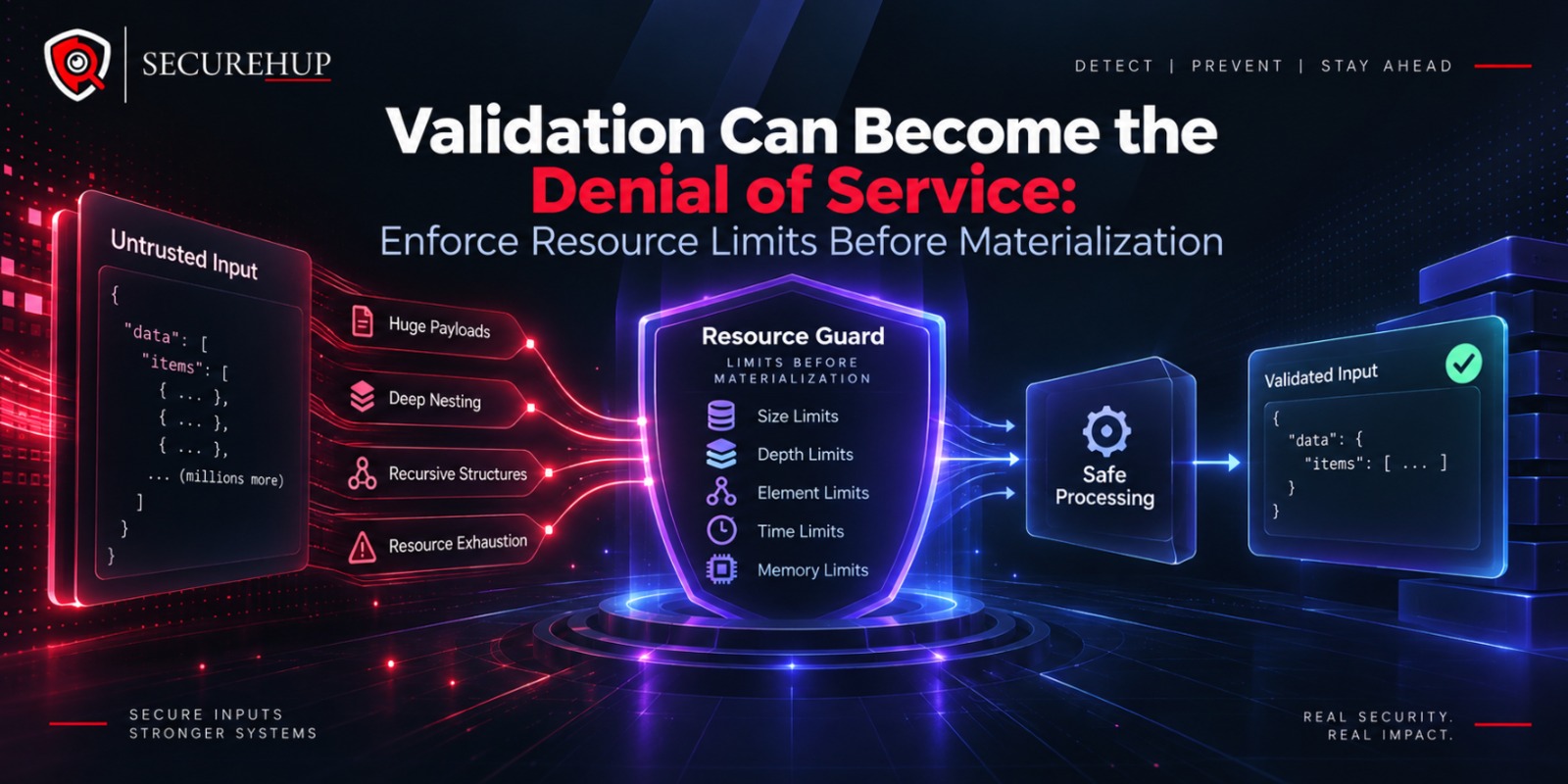
A compact request carries an index that causes the decoder to allocate a huge sparse structure. Only after allocation does schema validation reject the index as out of range. The client receives the correct 400; the process has already consumed the memory the rule was meant to protect.
Validation middleware becomes part of the attack surface whenever expensive materialization precedes the limit. Deep nesting, decompression, graph expansion, regular-expression compilation, and object construction can all turn a small wire representation into large CPU or memory work. A final error is not evidence of early rejection.
Measure the work before refusal. In an isolated environment, record wire bytes, decoded bytes, object count, depth, allocations, CPU, cancellation, and concurrent impact across parsing, normalization, materialization, validation, and business execution. The investigation should stop at bounded evidence, not stress a production service.
Key Takeaways
- A small request can cause disproportionate CPU, memory, allocation, recursion, storage, or downstream work when compact input expands during decoding.
- Schema constraints such as maximum items are ineffective against pre-validation exhaustion if the full object is materialized before the constraint is checked.
- Rate limiting requests per second does not bound the cost of one accepted request; request count and per-request work are different controls.
- Resource limits must exist at every expensive phase: transport, decompression, parsing, key/index handling, materialization, validation, execution, and response serialization.
- Safe testing compares request size with observed work in an isolated target and stops at conservative thresholds instead of forcing a crash.
- Durable remediation changes ordering and representation, for example validating indices before allocation or preserving sparse data without filling attacker-selected gaps.
The Validator Has an Execution Pipeline
The word "validation" sounds like one boolean decision. In a real service it is a pipeline:
bytes on the wire
  -> proxy and framework framing
  -> decompression and transfer decoding
  -> URL, form, multipart, or JSON parsing
  -> parameter-style decoding
  -> normalization and type coercion
  -> object or collection materialization
  -> schema and business validation
  -> handler execution
  -> response serialization
Each arrow can increase work. Percent decoding can change token boundaries. A compressed body can become much larger. Bracket notation can turn one key into a nested object. A sparse numeric index can become a dense array. Recursive coercion can allocate a second representation. Error formatting can walk the entire rejected value. Logging can duplicate it again.
The final schema check only governs the value it receives. It cannot retroactively refund memory allocated by the decoder or CPU consumed by normalization. That is why a security review must ask two separate questions:
- Is the resulting value valid?
- Was the cost of deciding that bounded?
A service can answer the first question correctly and fail the second catastrophically.
Rejection Is Not Proof of Safety
Suppose an API declares that a list may contain at most ten items. A request encodes one item at index fifty million. The decoder decides to preserve index position, so it creates a dense list from zero through fifty million and fills every missing entry. Only after that work does the schema validator observe that the list exceeds ten items and return a clean 400 response.
From a functional test perspective, the control passed. From a security perspective, the request may have exhausted the process. The oracle cannot be the response alone. We need allocation, latency, process health, and downstream-effect evidence.
Wire Size and Work Size Are Different Quantities
Most perimeter controls measure what is easy to see:
- Request body bytes.
- Header bytes.
- URL length.
- Requests per second.
- Concurrent connections.
- Response bytes.
Those measurements are useful, but none directly expresses internal work. A compact value can select a huge number, long range, recursive depth, or expensive branch. The relevant amplification ratio is:
amplification = server work caused / attacker-controlled input size
"Server work" can be memory allocated, objects created, loop iterations, parser states, database rows scanned, files opened, tasks queued, or response nodes visited. We do not need one universal unit. We need a budget for each scarce resource and evidence that attacker-controlled values cannot create unbounded amplification.
Common Expansion Mechanisms
Several input patterns deserve explicit review:
- Sparse-to-dense conversion: A high numeric key causes every missing position to be represented.
- Nested object reconstruction: Delimited keys become recursively allocated maps and lists.
- Decompression: Small compressed input expands before body-size policy is applied.
- Regex backtracking: Short or moderate strings trigger superlinear matching time.
- Entity or reference expansion: Repeated references multiply parser output.
- Recursive coercion: One parsed representation is copied into a typed representation.
- Range and pagination expansion: Start/end/count values produce large loops or result sets.
- Error construction: Rejected input is traversed, copied, rendered, or logged in full.
- Fan-out: One validated request schedules many jobs or downstream calls.
These are not all the same vulnerability class, but they share one design failure: an untrusted compact instruction controls expensive work before a trustworthy budget decision.
Materialization Is a Security Boundary
Materialization converts an encoded description into runtime objects. Developers rarely mark it as a security boundary because it often happens inside a framework or library. Yet it is the moment abstract attacker input becomes memory, handles, tasks, or storage under server authority.
Consider four representations of a collection:
| Representation | Cost driver | Security property |
|---|---|---|
| Repeated values | Number of values actually sent | Cost roughly follows wire input |
| Sparse map | Number of populated keys | High index does not require missing entries |
| Dense array | Highest index plus one | One high index can dominate allocation |
| Lazy iterator | Number of values consumed | Cost can be stopped by a downstream budget |
Choosing a dense array may be convenient for application code, but it silently changes the cost contract. If the highest index is untrusted, that index is an allocation parameter. It must be validated before creating the array.
Validate Shape Before Building Shape
The safe order is usually:
tokenize minimally
  -> validate key syntax and numeric domain
  -> enforce count, index, depth, and byte budgets
  -> choose bounded representation
  -> materialize
  -> apply full schema and semantic validation
This does not require duplicating the entire schema inside the parser. It requires a small set of pre-materialization safety invariants: maximum nesting, maximum decoded tokens, maximum index, maximum key length, maximum aggregate bytes, and maximum expansion ratio. Full semantic validation can still happen later.
Why Familiar Controls Miss This Class
Availability controls are often layered, but their assumptions can align in the wrong direction.
Body and URL Size Limits
They bound transport input, not decoded expansion. They help when work scales with bytes. They do little when a ten-digit index selects billions of positions or when a tiny compressed body expands after the gateway check.
Schema Limits
maxItems, maximum length, and numeric maximums help only if they are evaluated before the expensive operation they constrain. A schema library may need to decode and coerce a value before it can apply those keywords. Test the actual ordering instead of inferring it from the contract.
Request Rate Limits
Rate limits constrain repeated calls. A single-request amplification bug can cross the failure threshold below any reasonable rate limit. Cost-aware quotas should combine request count with estimated or observed work.
Container Memory Limits
A memory limit contains host impact, but an out-of-memory restart is still a successful availability attack. In a replicated service it can create restart loops, readiness churn, retry storms, and noisy-neighbor effects. Containment is necessary; it is not input validation.
Timeouts
Timeouts are only effective when work observes cancellation and allocated resources are released promptly. A timeout at the proxy does not stop a backend loop that ignores context cancellation. Test the process after the client has received a timeout.
Autoscaling
Autoscaling can multiply cost. If each malicious request looks like legitimate load, scaling creates more workers that perform the same amplification. It may protect latency temporarily while increasing infrastructure expense and widening the denial-of-wallet impact.
Build a Phase-Specific Resource Budget
A useful design assigns ownership and a hard limit to every stage.
| Phase | Example budget | Enforcement point | Failure behavior |
|---|---|---|---|
| Transport | URL, header, compressed and uncompressed bytes | Edge and server | Reject before application parsing |
| Tokenization | Token count, key length, nesting depth | Parser | Stop without building partial deep state |
| Index handling | Non-negative index, maximum index, sparsity ratio | Decoder | Reject before dense allocation |
| Materialization | Object count, aggregate bytes, allocation estimate | Decoder/runtime | Abort and release temporary state |
| Validation | Rule count, recursion, regex time | Validator | Bounded error without echoing full input |
| Business execution | Rows, fan-out, external calls, job count | Handler/domain service | Deny or require asynchronous bounded workflow |
| Response | Item count, serialization bytes, render time | Serializer | Paginate or truncate safely |
| Request scope | CPU time, wall time, memory, cancellation | Runtime/container | Cancel, clean up, preserve service health |
Budgets should be explicit configuration with safe defaults, not undocumented consequences of integer sizes or machine memory. Their values should reflect endpoint purpose. A search endpoint and a file conversion endpoint may need different limits, but neither should inherit "unbounded" because a framework makes it convenient.
Unknown Cost Must Not Mean Free
If the parser cannot estimate a representation safely, it should use a conservative bounded path or reject the shape. Falling back from "cannot calculate" to "continue" turns uncertainty into attacker-controlled work. This is the same fail-open pattern seen in authorization, expressed as resource policy.
A Code-Aware Validation Workflow
Testing should begin with code and contract context, not random load.
1. Inventory Structured Input Surfaces
Map query objects, form fields, multipart names, JSON bodies, headers, path parameters, uploaded archives, compressed requests, filters, pagination, batch APIs, graph queries, and import formats. Record the parser and validator used by each route.
2. Trace Ordering
Follow the request from framework entry to handler. Identify when limits run relative to decompression, parsing, normalization, allocation, validation, logging, and error formatting. Dependency code matters because the expensive loop may be outside the repository.
3. Identify Attacker-Controlled Cost Selectors
Look for values used as:
- Slice or array lengths.
- Loop bounds.
- Recursion depth.
- Capacity hints.
- Range endpoints.
- Regex input or pattern.
- Batch or page sizes.
- Decompression targets.
- Worker counts.
- Timeout or retry values.
Pay special attention to conversions from strings to integers and to maximum-key calculations.
4. Establish a Safe Baseline
Use a disposable service instance with production-equivalent parser configuration, strict process limits, metrics, and synthetic data. Send a valid small request and record allocation, CPU, latency, response, process health, and object counts.
5. Increase One Dimension Conservatively
Change one semantic dimension while keeping wire size nearly constant: index magnitude, nesting depth, number of delimiters, expansion ratio, regex structure, or requested page size. Stop before the target approaches its memory or latency ceiling. Extrapolate only when the growth curve is stable and label the extrapolation.
6. Verify the Fix and the Allowed Path
A patched path should reject the unsafe shape before large allocation. It must also continue to accept legitimate structured input. Test boundary minus one, boundary, boundary plus one, negative values, malformed values, duplicate keys, and alternative encodings.
Pre-Materialization Resource Tests
| Case | Input change | Expected result | Required evidence |
|---|---|---|---|
| Valid baseline | Small permitted object | Success | Normal allocation and latency |
| Boundary minus one | Highest allowed index/count | Success | Cost remains within budget |
| Exact boundary | Documented maximum | Defined success or rejection | Deterministic behavior |
| Boundary plus one | Small excess | Early rejection | No proportional materialization |
| Sparse high index | One value at large index | Early rejection | Allocation stays close to baseline |
| Negative index | Signed value below zero | Rejection before conversion | No wraparound or fallback |
| Huge numeric text | Value outside integer range | Parse error | No truncated or saturated allocation |
| Deep nesting | Incremental nested keys | Depth-limited rejection | Bounded stack and object count |
| Duplicate key | Repeated structural key | Documented deterministic rule | No multiplicative copy |
| Encoded delimiter | Alternate percent encoding | Same policy after canonicalization | Parser and validator agree |
| Compressed request | High but controlled ratio | Uncompressed-size policy | No edge/backend limit gap |
| Validation error | Invalid large-looking shape | Compact error | No full input echo or expensive rendering |
| Concurrent safe probes | Few synchronized requests | Per-request and aggregate bounds | Service remains healthy |
| Client cancellation | Cancel during parsing | Work stops promptly | Temporary resources released |
| Fixed-build replay | Original harmless canary | Early bounded rejection | Regression artifact retained |
Do not run an out-of-memory proof against production. A finding is credible when a low-risk sequence demonstrates attacker control of the cost selector, superlinear or extreme amplification, and the vulnerable ordering. Crashing a shared service adds harm without adding much technical certainty.
Evidence of Allocation Before Rejection
A strong report connects input to measured work:
- Exact endpoint and parser mode.
- Contract shape that activates the decoder path.
- Smallest controlled request demonstrating amplification.
- Wire bytes and decoded bytes.
- Numeric index, depth, count, or pattern dimension changed.
- Heap allocation, resident memory, CPU time, object count, and latency.
- Point at which the schema error occurs.
- Whether the handler or downstream service was reached.
- Process health, restart, readiness, and retry behavior.
- Authentication and tenant prerequisites.
- Production-equivalent configuration differences.
- Fixed-version replay and valid control request.
Severity depends on reachability and operational effect. An unauthenticated internet endpoint where one small request can restart every worker is different from an administrator-only import feature constrained to one isolated job. Horizontal scaling, retry policies, memory limits, request queues, and per-tenant isolation change blast radius.
Do not infer data compromise from an availability primitive. Likewise, do not minimize it because the response is 400. The relevant impact may be service outage, job starvation, cross-tenant noisy-neighbor effects, autoscaling cost, queue delay, or loss of in-flight work.
Remediation That Changes the Cost Model
Upgrading a vulnerable dependency is the immediate step when a fixed version exists, but application owners should still verify their own limits and alternate parsers.
Prioritize these changes:
- Reject invalid sign, range, depth, key length, and index before allocation.
- Avoid dense materialization when input is naturally sparse.
- Cap decoded tokens and aggregate object count.
- Apply uncompressed-size limits during streaming decompression.
- Use checked arithmetic for capacity, multiplication, and offset calculations.
- Make cancellation observable inside parser and validation loops.
- Bound error construction, logging, and rejected-value capture.
- Add per-request CPU, memory, fan-out, and downstream budgets.
- Apply per-principal and per-tenant cost quotas in addition to rate limits.
- Keep runtime memory and process isolation as containment.
- Preserve a harmless amplification regression test.
Blacklisting one large index is not a fix. Attackers can choose another magnitude, sign, nested location, or encoding. The invariant must be structural: no attacker-controlled scalar may cause allocation or iteration beyond the endpoint's declared budget.
Release Controls for Parser Resource Budgets
Resource-safety tests should run when parser dependencies, API contracts, middleware order, query parameter styles, serialization libraries, gateway settings, or error handlers change. Full stress testing is unnecessary for every pull request. Small deterministic probes can validate the growth curve and rejection order.
Track:
- Allocation per rejected request.
- CPU time per parse and validation phase.
- Maximum decoded token count and nesting.
- Rejections by budget type.
- Requests with extreme sparse indices or ranges.
- Cancellation-to-work-stop latency.
- Validator errors followed by process restarts.
- Memory-limit events grouped by endpoint.
- Response-error size relative to request size.
- Per-tenant resource amplification.
An alert on high memory is late. More useful telemetry identifies which parsing phase, route, contract field, and normalized dimension consumed the budget. Keep sensitive request values out of metrics and logs; store bounded structural facts such as depth, count, index class, and correlation ID.
Parsing-Order Review Questions
- Is compressed and uncompressed input bounded?
- Can a compact scalar select a large allocation, loop, range, or recursion depth?
- Are signs, integer ranges, overflow, and conversion errors checked?
- Does schema validation occur before or after materialization?
- Can sparse input become a dense runtime structure?
- Are parser, validator, error formatter, and logger independently bounded?
- Does cancellation stop backend work?
- Are limits consistent across query, form, multipart, JSON, and alternate routes?
- Are per-request limits supplemented by principal and tenant budgets?
- Can retries or autoscaling amplify one malicious request pattern?
- Is the test environment instrumented to prove cost without crashing?
- Does the regression include valid boundary controls?
Measure the Rejection Path
Add one release check that records peak allocation, CPU time, and handler reachability for a small family of invalid inputs. The test should compare ordinary malformed data with the cost-selecting shape that once forced early materialization. A 400 response passes only when the request is rejected before the expensive object exists and resource use remains within the declared budget. This turns parser order into an observable contract instead of an implementation assumption.
Frequently Asked Questions
Is a maximum request-body size enough to prevent parser denial of service?
No. It limits bytes received, which is important, but compact input can expand through decompression, sparse indices, nested reconstruction, coercion, or expensive algorithms. Apply budgets to decoded and materialized work as well as transport size.
If the validator returns an error, how can the request still be vulnerable?
The error may be produced only after the decoder has allocated or processed the dangerous structure. Measure resource use and ordering. A correct rejection after excessive work is still an availability weakness.
Should security testing intentionally crash the service to prove impact?
No. Use an isolated instance, conservative process limits, increasing safe probes, and stop thresholds. Demonstrating attacker-controlled amplification and vulnerable ordering is usually sufficient. A production crash creates unnecessary risk.
How is this different from ordinary rate limiting?
Rate limiting controls how often a caller can send requests. This class controls how expensive each request may become. A robust service needs both request-frequency limits and per-request work budgets.
What is the most durable engineering fix?
Make expensive work conditional on an earlier bounded decision. Validate numeric domains and structural budgets before allocation, preserve sparse representations where possible, use checked arithmetic, and retain a regression test that observes actual resource behavior.
An Availability Budget Only Works Before Allocation
The decoder and validator order determines whether a limit protects resources or merely describes an error returned after they are gone. Wire size, decoded size, depth, count, expansion ratio, time, and allocation budgets are most effective before the corresponding work begins. Streaming and bounded representations can reduce the amount that needs to exist at once, provided cancellation reaches the phase doing the expansion.
A compact, harmless CI probe can preserve this property by measuring peak work alongside the response. We would treat a parser or middleware change that restores unbounded materialization as a regression even if it still returns 400. Availability is protected by when the application refuses the input, not only by how it labels the refusal.
#APISecurity #ApplicationSecurity #ResourceExhaustion #DenialOfService #SecureCoding #FuzzTesting
Find issues like this in your own codebase
SecureHup runs this exact exploit chain — discovery, enumeration and cross-tenant validation — on every deployment, automatically.