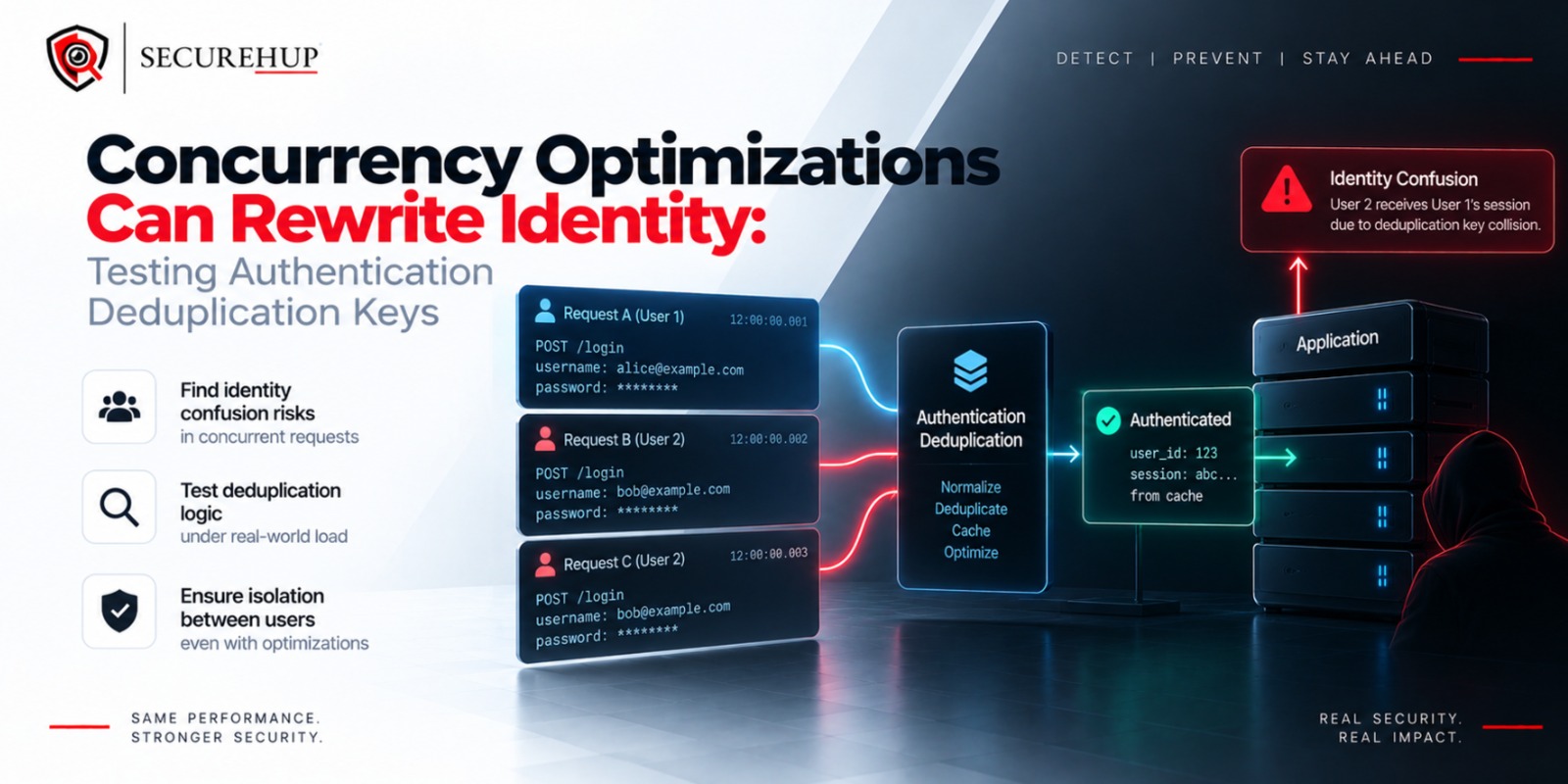
Two login requests reach separate workers at almost the same time. One contains a valid credential for Alice; the other carries different variable-length components for Bob. A single-flight helper concatenates those components into the same cache key, joins both callers to one password check, and returns true to both. The password verifier is correct. The optimization handed its answer to the wrong identity context.
This is a narrow concurrency failure, not a claim that result sharing makes every authentication service bypassable. The motivating vulnerability required significant prerequisites, including valid authentication material. Its broader value is architectural: once a cache, memoizer, or in-flight deduplication group shares an authentication result, the key defines which requests the system considers equivalent.
Reviewers should therefore ask for the semantic tuple before reviewing the hash or encoding. Which principal, credential version, tenant, verifier policy, and operation are allowed to share work? If that answer is incomplete, collision resistance in the final digest cannot restore the context that was omitted.
Key Takeaways
- Any cache or deduplication layer that shares an authentication decision is part of the authentication mechanism.
- A security key must be an injective encoding of every input that can change the decision, result meaning, or consuming principal.
- Delimiter-free string concatenation is ambiguous when fields have variable length, and a delimiter alone is unsafe when values can contain it.
- Shared results should carry verified identity and policy context, not only a Boolean that a different request can reinterpret.
- Race testing requires controlled overlap, negative controls, repeated trials, and effect-level assertions; sequential fuzzing is insufficient.
- Severity must reflect deployment prerequisites and downstream use, while remediation should still address the broken invariant at its source.
An Optimization Becomes a Policy Decision
Single-flight deduplication, request coalescing, and memoization all answer the same performance question: "Can this operation reuse a result that is already being computed or was recently computed?" For ordinary data, an occasional collision may cause a stale value or a wrong response. For authentication, a collision can change the principal recognized by downstream code.
Consider a conceptual password check:
verify(username, supplied_secret, stored_verifier) -> result
The result depends on more than the supplied password. The username determines which stored verifier is selected. Realm, tenant, credential version, hash policy, account state, and authentication method may also affect the decision. If a deduplication key omits or ambiguously encodes any of those fields, requests that are not semantically equivalent can share work.
Equivalence Must Be Defined Before Reuse
The optimization is valid only when equality of keys implies interchangeability of the complete result:
key(A) == key(B) => result(A) is valid for B
For security-sensitive decisions, "result" includes more than true or false. It can include:
- The authenticated subject.
- Tenant and realm.
- Authentication assurance level.
- Credential identifier and version.
- Account status and policy version.
- Expiration and revocation state.
- Downstream identity headers or claims.
- Audit attribution.
If request B receives request A's Boolean success but continues using B's username, the system has separated proof from identity. A credential was verified, but not for the identity later asserted.
Why Concatenation Is Not a Tuple
Developers often create cache keys with a convenient expression such as field1 + field2. This produces a string, not a uniquely encoded tuple. Variable boundaries disappear.
For example:
("ab", "c")  -> "abc"
("a", "bc")  -> "abc"
The inputs are different, but the key is identical. Adding a separator helps only if the separator cannot appear in either field or is escaped with a complete, canonical rule. Ad hoc escaping can introduce its own ambiguities through encoding, normalization, or double decoding.
Use Structured, Length-Prefixed Encoding
A safe key construction should be unambiguous and canonical. Options include:
- A typed binary encoding with fixed field order and lengths.
- Length-prefixing each byte sequence.
- Canonical serialization of a versioned structure.
- A cryptographic message authentication code over that canonical encoding when key confidentiality or tamper resistance matters.
Conceptually:
key_material = encode({
  version: 1,
  realm: realm_id,
  subject: normalized_subject_id,
  credential_id: credential_id,
  credential_version: credential_version,
  supplied_secret_digest: keyed_digest(supplied_secret),
  policy_version: policy_version
})

dedupe_key = hash(key_material)
Do not place plaintext passwords or reusable verifiers in logs, metrics, tracing labels, or externally visible cache names. A keyed digest can reduce direct secret exposure, but key construction still needs collision-resistant structured input and secure key management.
Canonicalization Must Match Authentication Semantics
If usernames are case-insensitive, normalize them once according to the identity store's actual rules. If Unicode identifiers are allowed, define normalization explicitly. If realms permit the same username, realm must be present. If a credential rotates, its version must invalidate cached outcomes. A cache key that uses different normalization from account lookup can merge or split identities incorrectly.
Empty and Missing Values Are Security States
Unknown users are often handled specially to reduce account enumeration and timing leaks. The application may perform a dummy password hash even when no account exists. That is good defensive behavior, but it creates a distinct security state that must remain distinct in the deduplication key.
Avoid representing these states with the same empty string:
- User exists and has an empty optional attribute.
- User does not exist.
- Credential lookup failed.
- Credential source timed out.
- Realm is missing.
- Parser rejected the username.
Use tagged types:
CredentialLookup =
  Found(credential_id, version, verifier)
  | NotFound(dummy_verifier_id)
  | Unavailable(error_class)
  | InvalidInput(reason)
Each branch should have explicit behavior and a distinct key domain. "Unknown" must not mean "reuse any nearby result." Failures should fail closed, and availability errors should not be cached as authentication decisions unless the policy explicitly defines that behavior.
Share Verified Objects, Not Naked Booleans
A Boolean discards the relationship between proof and subject. If an optimization returns only true, the caller may attach its own username, tenant, or role after the shared operation completes. A stronger API returns a result bound to what was verified:
VerificationResult {
  outcome,
  verified_subject_id,
  realm_id,
  credential_id,
  credential_version,
  assurance_level,
  evaluated_policy_version,
  issued_at,
  expires_at
}
The consuming request must confirm that this result matches its expected subject and context. Better yet, the authentication component should construct the final principal from the verified result rather than from the request's original untrusted identity claim.
Do Not Forward Unverified Identity Separately
A common gateway pattern verifies credentials, then writes the submitted username into a trusted downstream header. If verification and identity propagation use different data sources, a concurrency or parsing flaw can make them disagree. The forwarded identity should come from the authoritative account record associated with the verified credential, not from a request string.
The same rule applies to tokens. Claims forwarded downstream should be derived from the validated token and resolved subject, not reconstructed from request parameters after validation.
Map Every Result-Sharing Layer
Authentication decisions can be shared in more places than an explicit cache. Review:
- In-flight request deduplication.
- Positive and negative authentication caches.
- Session lookup caches.
- Token introspection caches.
- Public-key and issuer metadata caches.
- Connection-level authentication state.
- Reverse-proxy auth subrequest caches.
- Rate-limit buckets tied to identity.
- Promise or future memoization.
- Batch verification queues.
- Distributed result stores.
- Retry and circuit-breaker fallback values.
For each layer, document the input tuple, key encoding, value type, lifetime, invalidation trigger, isolation domain, and consuming code. A correct key in the password verifier does not help if a proxy caches the authorization response by URL alone.
Security-Relevant Key Checklist
| Dimension | Include when it changes | Typical failure if omitted |
|---|---|---|
| Subject | Account-specific verification or policy | One user's result applied to another |
| Tenant/realm | Names or credentials are scoped | Cross-tenant identity confusion |
| Credential ID/version | Rotation and multiple authenticators exist | Stale success after revocation |
| Authentication method | Password, API key, token, passkey differ | Assurance-level confusion |
| Secret-derived value | Supplied proof changes | Reuse across different credentials |
| Policy version | Rules or account state can change | Old decision survives policy update |
| Audience/service | Result has a specific consumer | Decision reused in another trust domain |
| Failure state | Lookup outcomes differ | Error or not-found path joins success path |
Not every field belongs in every key. Include all and only the dimensions required to make shared results semantically interchangeable. Then encode them without ambiguity.
Concurrency Changes the Test Method
A sequential test sends valid credentials, gets success, sends invalid credentials, and gets failure. Both paths can be correct in isolation while a shared in-flight operation is vulnerable. The test must create overlap at the exact expensive or asynchronous section.
Build a Deterministic Harness
Timing based on sleep calls is fragile. Instrument the verification boundary or use a controllable slow verifier in a test build. A barrier can pause request A after it claims the deduplication key but before it returns. Request B then enters with a different identity context. Release the barrier and observe which result each request receives.
Request A: valid low-privilege identity
  -> reaches verifier and pauses

Request B: distinct, unauthorized identity context
  -> enters while A is in flight

release A
  -> inspect HTTP result, downstream identity, protected resource, and audit log
The harness should not need a real expensive hash or production credentials. Use synthetic users and test-only coordination inside an isolated target.
Use Four Controls
- Valid baseline: Request A succeeds alone and maps to A.
- Invalid baseline: Request B fails alone and causes no protected effect.
- Concurrent candidate: A and B overlap under the suspected key relation.
- Non-colliding concurrency: A overlaps with a distinct B input that should not share work.
Repeat trials because scheduler behavior can vary. Record whether the test actually achieved overlap; a failed race attempt is not evidence of safety.
Assert the Protected Effect
Response status is not enough. Inspect:
- Which subject the backend received.
- Which tenant and roles were attached.
- Whether a protected object was read or changed.
- Which principal appears in the audit event.
- Which verification result ID each request consumed.
- Whether B's verifier callback actually ran.
This distinguishes a shared response artifact from a true identity boundary failure.
Property Tests for Key Construction
Concurrency proves the runtime consequence, but key functions also deserve direct property testing.
Injectivity over the Supported Domain
For generated input tuples, assert that semantically different tuples do not produce the same canonical encoding. A cryptographic hash can theoretically collide, so the practical property focuses first on the pre-hash encoding. If encoding is identical for distinct tuples, hashing cannot repair it.
Generate edge cases:
- Empty, missing, and null-like values.
- Prefix and suffix relationships.
- Embedded separators and escape characters.
- Very long fields.
- Unicode normalization variants.
- Case variants under identity rules.
- Numeric strings with alternate forms.
- Same subject across different realms.
- Credential rotation versions.
- Not-found and backend-error states.
Round-Trip and Domain Separation
If the encoding is decodable, assert that decode(encode(tuple)) returns the same typed tuple. Include a format version and operation domain so an authentication key cannot collide with a different cache family that happens to use the same store.
No Secret Leakage
Test that logs, traces, metrics, exception messages, and cache inspection APIs do not reveal supplied secrets or stored verifiers. A technically collision-safe key can still create a credential exposure if it embeds raw material in observable systems.
Severity Requires Context, Not Imagination
Concurrency authentication flaws can sound catastrophic, but responsible analysis must separate the invariant failure from deployment exploitability. Ask:
- Does the attacker need an existing valid account?
- Must they know a stored verifier or other privileged material?
- Is a particular downstream identity-forwarding feature enabled?
- Can they create both concurrent requests themselves?
- Does the protected backend distinguish users, or only authenticated versus unauthenticated?
- Is the affected version range present in production?
- Are management APIs or secrets exposed beyond intended administrators?
Strong prerequisites can make a vulnerability low severity in a default model. A specific deployment may still have greater impact if password hashes are broadly visible or downstream authorization trusts a forwarded identity. Do not erase either side. State the prerequisites, verify the configuration, and assess the protected effect in that environment.
This approach also prevents unproductive remediation. If stored authentication material is readable by low-privilege users, fix that exposure independently. If downstream services trust a gateway header, ensure the network path and header provenance are protected even after the deduplication key is repaired.
Remediation Beyond the Immediate Key Fix
A complete correction should include several layers:
- Replace ambiguous concatenation with a versioned, structured encoding.
- Include every security-relevant decision input.
- Return a subject-bound verification object rather than a naked Boolean.
- Construct downstream identity from the verified account record.
- Scope caches by tenant, realm, method, credential version, and policy as required.
- Invalidate decisions on password change, credential removal, account suspension, and policy update.
- Separate not-found, invalid, and unavailable states.
- Protect keys and telemetry from secret disclosure.
- Add deterministic coordinated tests and key property tests.
- Review adjacent result-sharing layers for the same equivalence assumption.
Where the performance gain is small, removing authentication result sharing may be the safest decision. Optimization should earn its complexity with measured need.
Continuous Validation for Identity-Sensitive Concurrency
Race conditions often return after refactoring because ordinary tests cannot see them. A developer changes the key for efficiency, moves identity propagation to another layer, or introduces a distributed cache. The fix needs a replayable concurrent test connected to the code path.
A code-aware testing workflow can identify authentication decisions entering shared state, derive the key's security dimensions, and coordinate multiple user personas to overlap at the right boundary. It can then verify the downstream identity and protected effect instead of treating response timing as success.
SecureHup's relevance here is practical: multi-persona testing and autonomous race coordination can turn a difficult timing hypothesis into repeatable evidence, while PR-level replay checks whether later changes preserve principal binding. The user benefit is a smaller gap between "this key looks unique" in code review and "two distinct principals cannot consume the same authorization result" in the running system.
Engineering Release Gate
Before releasing an optimized authentication path, require evidence for these invariants:
| Invariant | Verification method | Release failure |
|---|---|---|
| Distinct security tuples have distinct encodings | Property and fuzz tests | Any ambiguous pre-hash encoding |
| Shared result identifies verified subject | API/type test | Boolean reused with caller-supplied identity |
| Concurrent requests remain isolated | Barrier-based multi-user test | One request consumes another's success |
| Rotation invalidates old decisions | Credential lifecycle test | Success survives version or revocation change |
| Tenant and realm remain bound | Cross-tenant matrix | Same name or secret crosses scope |
| Unknown/error states fail closed | Fault injection | Backend failure joins positive result |
| Telemetry reveals no credential material | Log and metrics inspection | Raw secret or verifier appears |
| Downstream identity is authoritative | End-to-end effect test | Request claim differs from verified subject |
The gate should attach a minimal trace when it fails: input identities, canonical key components with secrets redacted, overlap proof, result IDs, downstream principal, and observed effect. That evidence helps developers fix the invariant rather than chase intermittent status codes.
Observe Reuse Without Exposing Credentials
Production observability should reveal whether the optimization behaves as designed, but authentication keys must never become convenient high-cardinality labels. Record a random verification-operation ID, whether a request was leader or waiter, the number of joined requests, decision latency, credential type, tenant boundary outcome, and a non-reversible key-version identifier. Do not record supplied passwords, stored verifiers, raw key material, or stable digests that enable offline guessing.
Useful alerts include an unusual rise in waiters across distinct request principals, positive results consumed by more than one request identity, cache hits after credential rotation, and a mismatch between verified subject and downstream subject. These events should be impossible under the intended design, so even a small count deserves investigation. Operational dashboards can also show whether deduplication provides enough benefit to justify the security complexity. If almost no requests join, removing the mechanism may improve both clarity and assurance.
Instrument invalidation as a first-class event. When a password changes, an authenticator is removed, an account is suspended, or a policy version advances, telemetry should prove that affected entries were evicted across every process and region. A local unit test cannot detect a distributed cache that keeps accepting an old result. Combine lifecycle events with a synthetic authentication probe that confirms the previous credential no longer produces a protected effect anywhere in the deployment.
FAQ
What is request deduplication in authentication?
Request deduplication lets concurrent authentication requests that are considered equivalent share one in-flight verification computation. It can reduce expensive password hashing or repeated external lookups. Because the shared value is a security decision, the equivalence key must include and unambiguously encode every input that changes which identity and policy were verified.
Is using a delimiter enough to make a cache key safe?
Only if the encoding proves field boundaries for every permitted value. A delimiter that can appear in a field creates ambiguity unless escaping is canonical and correctly implemented. Length-prefixed or typed canonical serialization is usually easier to reason about. Test the pre-hash encoding with generated edge cases instead of relying on visual inspection.
Why should an authentication result contain a subject instead of only true or false?
A Boolean says that some verification succeeded but does not preserve what was verified. If the caller later attaches its own username or tenant, a shared or misrouted result can authenticate the wrong identity. Returning a subject-bound result lets the consumer verify context and construct the principal from authoritative data.
How do we test an authentication race condition reliably?
Use a controlled test environment and instrument a barrier around the shared verification section. Pause one valid request after it claims the key, start a distinct invalid request, then release the first. Confirm actual overlap and inspect the downstream identity, resource effect, and audit record. Include sequential baselines, a non-colliding concurrent control, and repeated trials.
Does a low severity rating mean we can ignore the design flaw?
No. A low rating may accurately reflect demanding prerequisites or limited default impact. Patch according to the vendor's guidance and your exposure, but also examine the broken invariant. Similar ambiguous keys in higher-authority paths, broader credential exposure, or different downstream identity use can create more serious consequences.
Equivalence Is a Security Decision
Where authentication work or results are reused, the cache key expresses which operations the system considers interchangeable. Writing that tuple before choosing its encoding makes omitted principal, credential version, tenant, policy, or operation context easier to see. A result bound to the verified identity carries more meaning than a Boolean that can travel across callers.
Coordinated synthetic identities, deliberately shaped around field boundaries and omitted values, provide a focused concurrency test. We would assert the downstream principal after both requests leave the barrier, not just compare status codes. The optimization is doing its job only when it removes duplicate computation without allowing one identity to inherit another identity's proof.
#IdentitySecurity #Authentication #RaceCondition #SecureCoding #ApplicationSecurity #AutonomousPentesting
Find issues like this in your own codebase
SecureHup runs this exact exploit chain — discovery, enumeration and cross-tenant validation — on every deployment, automatically.