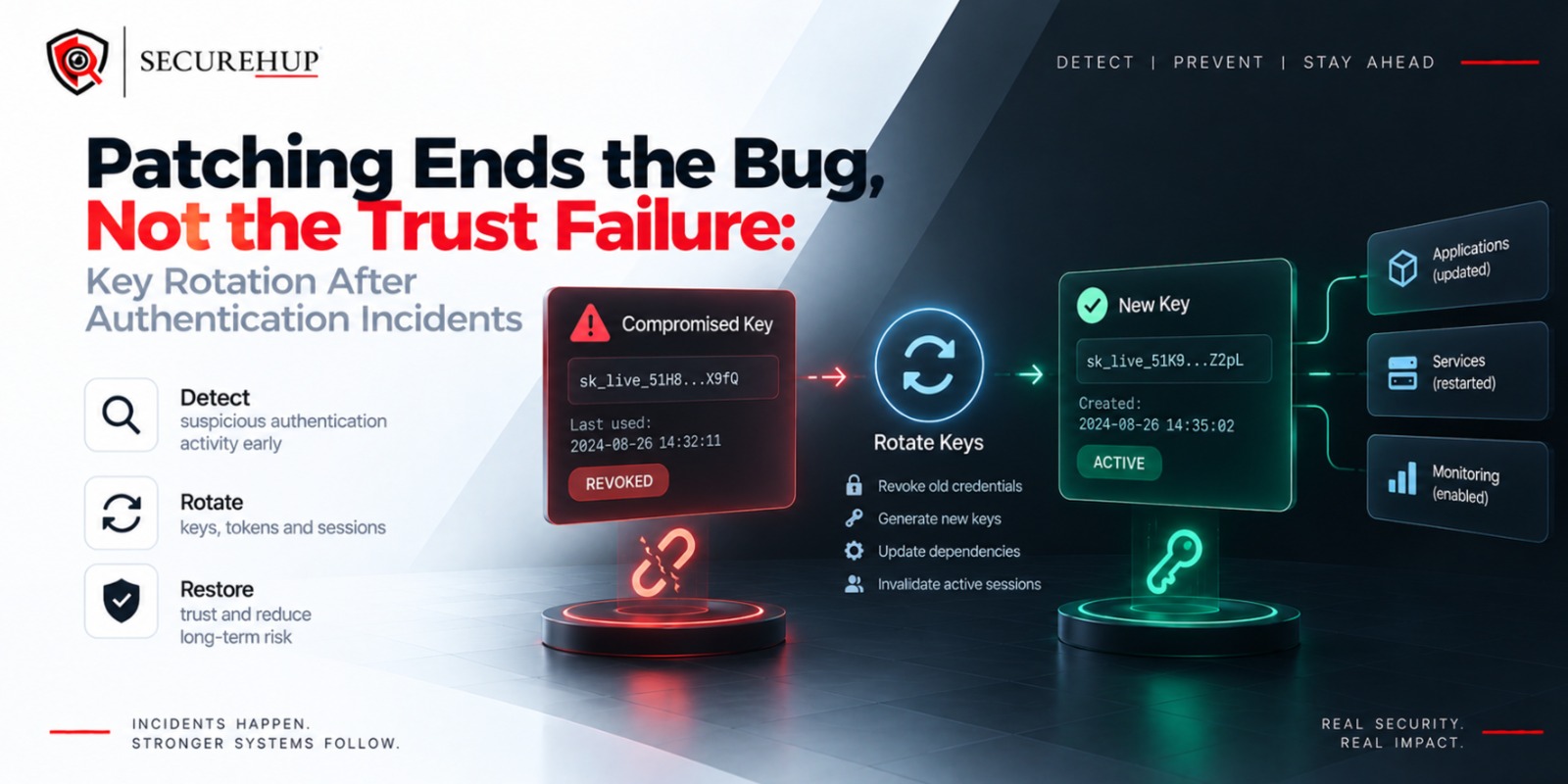
At 14:00, the vulnerable authentication component is replaced across production. At 14:05, a session cookie created before the deployment still opens an administrative page. The patched code is behaving correctly; the cookie is also behaving exactly as the old trust configuration allowed. Recovery has fixed issuance while leaving previously issued authority alive.
Authentication incidents have two separate workstreams. Code recovery removes the vulnerable behavior from every execution path. Trust recovery identifies credentials derived during the exposure window, replaces affected signing or encryption material, revokes sessions and tokens, and proves that old authority no longer reaches protected effects. One can finish while the other remains dangerously incomplete.
The sequence matters because keys and credentials form dependencies. Rotating an issuer before all verifiers accept the replacement can cause an outage; accepting old and new trust for too long preserves the attacker's window. A recovery plan needs an explicit graph of issuers, verifiers, sessions, cookies, downstream services, and emergency access paths before the first irreversible change.
Key Takeaways
- A patch prevents future exploitation of the known defect; it does not revoke sessions, API keys, refresh tokens, recovery links, or accounts created during the vulnerable window.
- Key rotation must follow dependency, not intuition. Teams need to know which artifacts are encrypted, signed, derived, or merely issued under the affected trust before invalidating them.
- A 2026 ASP.NET Core Data Protection vulnerability was configuration-specific and version-specific; affected internet-facing deployments required package remediation plus review of key rings and long-lived application artifacts.
- Rotation and revocation are different. Cryptographic keys may be replaced, while sessions, tokens, grants, secrets, and derived credentials often require their own invalidation paths.
- Emergency global logout can be appropriate, but staged rotation with overlap, scoped revocation, telemetry, and tested rollback often restores trust with less operational damage.
- Recovery is complete only when old artifacts are rejected across every instance, region, verifier, cache, and downstream service, and when unauthorized derived access has been addressed.
What a Patch Actually Changes
A software patch modifies code or configuration so a known invalid input, forged artifact, unsafe state, or vulnerable execution path is handled correctly. It changes future decisions made by updated components. It cannot travel backward through time and remove artifacts already accepted or created.
During the exposure window, an attacker may have obtained several kinds of durable advantage:
- A forged cookie that became an authenticated session.
- A legitimate refresh token issued after unauthorized authentication.
- An API key created through a compromised account.
- A new administrator, service account, OAuth application, or recovery method.
- A protected value decrypted while vulnerable behavior was available.
- A signing, encryption, or derivation key copied from memory, storage, logs, or backups.
- A downstream credential stored inside an application-protected payload.
- A trusted device, remembered browser, or federated grant established under false identity.
Some patched verifiers will immediately reject a previously forged artifact. Others will continue accepting a legitimately issued credential because the credential itself is correctly signed and has not expired. That distinction drives the response.
Code Validity and Security Validity Are Different
An artifact can be cryptographically valid after the incident and still be security-invalid. Consider a refresh token issued by the legitimate identity service after an attacker entered through a forged authentication cookie. The token's signature is genuine. Its issuance context is not.
Incident recovery must therefore evaluate provenance, not only cryptographic format:
Is the artifact technically valid?
        + Was it issued to the correct principal?
        + Was the issuing session trustworthy?
        + Is its current authorization still intended?
        = Should it remain accepted?
The patch answers only part of the first question.
A 2026 Data Protection Case
A 2026 security advisory for ASP.NET Core Data Protection, tracked as CVE-2026-40372, illustrates why post-patch trust work matters. The affected NuGet package range was Microsoft.AspNetCore.DataProtection versions 10.0.0 through 10.0.6, with 10.0.7 providing the fix. The issue could allow crafted protected payloads to be accepted in specific configurations, creating risk for authentication cookies and other application data protected by the subsystem.
Exposure was not universal across every ASP.NET Core 10 application. The primary affected configuration required the vulnerable package binary actually to be loaded for a .NET 10 target under particular framework-reference or package-pruning conditions, and the primary scenario was non-Windows. A secondary, unusual case involved 10.0.x package consumers using older target assets. Applications on other major framework lines or deployments resolving to safe shared-framework binaries required separate analysis rather than automatic classification.
These details matter because response should start with the binary that executed, not the version written in one project file. Runtime manifests, deployment images, operating system, target framework, package resolution, and process inventory determine whether the vulnerable implementation was reachable.
For an affected, exposed application, applying 10.0.7 or a later supported fixed release stopped the known behavior. The vendor's recovery guidance also addressed the Data Protection key ring and long-lived application artifacts. That second step recognizes a core incident principle: if an attacker used the vulnerable window to obtain legitimate sessions, refresh tokens, API keys, password-reset artifacts, or protected secrets, correcting the parser does not invalidate those consequences.
The public lesson is not that every Data Protection user must rotate everything. It is that confirmed or unresolved exposure requires a dependency map and evidence-based rotation scope.
Build the Authentication Trust Graph
Before rotating, identify how trust flows through the system. Authentication stacks usually contain more than one key and more than one token family.
Root identity / key-management authority
        |
        +--> application signing or protection key ring
        |         |
        |         +--> authentication cookies
        |         +--> CSRF / state / temporary protected payloads
        |         +--> reset, verification, or invitation artifacts
        |
        +--> OAuth/OIDC signing keys
        |         |
        |         +--> access tokens
        |         +--> ID tokens
        |
        +--> refresh-token store / session database
        |         |
        |         +--> token families and device sessions
        |
        +--> user-created credentials
                  |
                  +--> API keys, PATs, service accounts, webhooks
The graph must include downstream systems. A compromised application session may create cloud credentials, CI tokens, support impersonation grants, or third-party integrations that remain valid independently.
Classify Every Artifact
| Artifact | Typical Trust Dependency | Does Key Rotation Revoke It? | Additional Action Often Needed |
|---|---|---|---|
| Signed authentication cookie | Application protection/signing key | Usually, if old key is removed from validation | Invalidate server-side session and remembered-device state |
| Encrypted cookie or payload | Encryption/protection key | Prevents future decrypt if old key is retired | Assess data disclosed during exposure; rotate embedded secrets |
| Access token | Authorization-server signing key | Only if verifiers stop trusting the old key | Revoke session/grant; account for offline verifier caches |
| Refresh token | Token-family store or hash | Usually not through signing-key rotation alone | Revoke family, user, client, or global cohort |
| API key / PAT | Independent stored secret | No | Revoke and reissue explicitly |
| Password-reset link | Purpose-specific protected token/key | Depends on validation-key retirement and security stamp | Invalidate outstanding recovery flows |
| OAuth grant | Authorization record | No | Revoke consent/grant and dependent tokens |
| Service-account credential | Separate key or secret | No | Rotate credential and review use |
| Session database record | Server-side state | No | Delete, mark revoked, or increment security stamp |
| Secret inside protected payload | Data-protection confidentiality | No, if attacker already recovered the plaintext | Rotate the underlying secret at its owning system |
This table prevents a common mistake: rotating one cryptographic key and assuming every form of access disappears.
Decide Whether Keys Are Compromised, Exposed, or Merely Associated
Rotation scope depends on what the vulnerability enabled and what evidence exists.
Key Compromise
If private key material was read, exported, logged, or otherwise exposed, treat the key as compromised. Stop using it for new operations, remove trust according to emergency policy, generate replacement material in a trusted environment, and assess every artifact the old key could produce or decrypt.
Validation Bypass Without Key Disclosure
Some vulnerabilities allow a verifier to accept forged data without revealing the key. The key may not be mathematically compromised, yet every artifact accepted during the window is suspect. Retiring the key or key ring may still be the safest way to invalidate ambiguous cookies or temporary tokens, particularly when there is no reliable server-side list.
Unauthorized Issuance
An attacker may use one forged entry point to obtain legitimate credentials. Those credentials depend on other keys and databases that were never exposed. They must be revoked by issuance context, time window, principal, client, or token family rather than by replacing only the originally affected key.
Confidentiality Exposure
If affected protection could reveal plaintext, rotation of the protection key does not make disclosed data secret again. Passwords, API keys, webhook secrets, database credentials, client secrets, or recovery codes found inside protected payloads need rotation at their source systems.
Rotation, Revocation, and Expiration
These terms are related but not interchangeable.
- Rotation creates new key material and changes which key is used for new cryptographic operations.
- Retirement stops using an old key for new operations while it may remain accepted for a transition period.
- Revocation marks an artifact, key, session, grant, or credential as no longer trusted before normal expiration.
- Destruction removes key material when retention and recovery obligations allow it.
- Expiration is a preconfigured end of validity and is not an incident response by itself.
Normal rotation often preserves old decryption or validation keys so existing sessions continue working. Emergency rotation may need the opposite: remove old validation trust so potentially forged artifacts stop working. Reusing a normal availability-first runbook during a compromise can preserve attacker access.
Define the Cryptoperiod and Validation Window
Document how long each key creates new artifacts and how long old keys remain accepted. The acceptance window may be much longer than the issuance window. Backups, dormant instances, offline verifiers, and disaster-recovery environments can silently extend it.
During an incident, inventory every verifier and key cache. A key is not revoked because the primary service stopped issuing with it; it is revoked when no relevant verifier accepts it.
A Safe Rotation Sequence
Emergency action must be fast, but unplanned key changes can create outages, lock out responders, corrupt encrypted data, or destroy evidence. Use a pre-tested sequence adapted to the incident.
1. Contain the Vulnerable Path
Patch or isolate the affected service, block exposed routes where necessary, and prevent old instances from receiving traffic. Verify the fixed binary in every deployment. Do not rotate while vulnerable nodes can still mint or accept artifacts under the new trust state.
2. Preserve Evidence
Capture package resolution, runtime version, image digest, configuration, key identifiers, deployment history, authentication events, token issuance, and protected-operation logs. Do not copy private key material into ordinary tickets or chat. Use the incident evidence process and access controls.
3. Define the Exposure Window and Cohorts
Establish the earliest vulnerable deployment and complete remediation time across all regions and replicas. Build cohorts by user, tenant, client, artifact type, issuance time, risk, and observed activity. Exact cohorts allow targeted revocation when evidence is strong; uncertainty may require broader action.
4. Generate New Keys in a Trusted Context
Create replacement keys through the approved key-management system with appropriate algorithm, size, access policy, purpose separation, backup, and audit. Do not clone potentially compromised key-store permissions into the replacement without review.
5. Switch New Issuance
Deploy the new primary key or key ring and confirm all issuers use it. Monitor issuance by key ID. Stop old nodes and background jobs that continue creating artifacts with retired material.
6. Revoke Suspect Derived Access
Invalidate affected sessions, refresh-token families, reset links, verification tokens, remembered devices, grants, API keys, and accounts created or modified during the window. Apply more specific evidence where available, but do not let uncertainty default to preserving high-impact access.
7. Remove Old Validation Trust
After the planned overlap, or immediately when risk requires it, make every verifier reject old-key artifacts. Update caches, gateways, workers, offline services, disaster-recovery environments, and downstream consumers. Measure rejection, do not infer it from configuration rollout.
8. Rotate Exposed Plaintext Secrets
If protected payload confidentiality may have failed, rotate the contained secret at its actual authority: database, cloud provider, webhook receiver, OAuth provider, CI system, or application. Changing the wrapping key is not enough.
9. Recover Users Safely
Communicate forced sign-in or credential replacement without revealing unnecessary exploit details. Protect recovery channels from attacker-controlled email, phone, device, or session state established during the incident. High-risk accounts may require step-up or manual verification.
10. Validate Closure
Test representative pre-rotation artifacts and confirm rejection through every path. Confirm new artifacts work, no old issuer remains, revoked accounts cannot refresh, downstream credentials are replaced, and monitoring sees expected invalidation events. Keep canaries non-destructive and controlled.
Choose Scope with a Decision Matrix
| Evidence Condition | Suggested Starting Scope | Main Tradeoff |
|---|---|---|
| Key material confirmed copied | Revoke old key broadly; rotate every dependent secret/artifact | Highest user impact, strongest trust restoration |
| Forgery possible, no per-artifact inventory | Retire affected validation keys and force relevant session/token renewal | Broad logout but removes ambiguous artifacts |
| Unauthorized issuance visible in reliable logs | Revoke affected time/principal/client cohorts plus high-risk accounts | Lower disruption; depends on log completeness |
| Vulnerable path reachable but exploitation unclear | Risk-based broad invalidation for internet-facing/high-impact artifacts | Balances uncertainty against availability |
| Configuration proven not vulnerable | Document evidence; patch for hygiene; no incident rotation solely from package presence | Requires defensible runtime proof |
| Confidential payloads may have been read | Rotate each underlying plaintext secret in addition to protection keys | Operationally complex but necessary for confidentiality recovery |
The matrix supports judgment; it does not automate it. Asset criticality, regulatory obligations, customer impact, attacker evidence, token lifetime, and recovery-channel trust all affect scope.
Avoid Rotation-Induced Failure
Key rotation can harm security if it is rushed without dependency awareness.
Distributed Key Rings
All instances must converge on the same intended trust set. Split-brain key rings can create intermittent logout, acceptance differences, or issuance with retired keys. Use key IDs, rollout telemetry, and readiness checks to prove convergence.
Encrypted Data at Rest
Authentication protection systems may also protect durable application data. Destroying every old key immediately can make required data unrecoverable. Separate keys by purpose where possible. For durable data, decrypt and re-encrypt through a controlled migration before retirement, while still removing unsafe authentication acceptance as quickly as required.
Offline and Downstream Verifiers
APIs, gateways, functions, mobile backends, partner systems, and disaster-recovery regions may cache public keys or metadata. Define maximum cache lifetime and emergency refresh. A forgotten verifier extends attacker access.
Recovery Channel Abuse
Forced logout creates a surge in password reset and support activity. Attackers exploit that confusion. Rate-limit recovery, monitor changes, require stronger proof for privileged users, and ensure help-desk procedures do not bypass the trust recovery.
Rollback Risk
Operational teams may roll back a patch during an outage and accidentally restore vulnerable code or old keys. Incident changes need explicit “do not roll back below” controls, immutable release markers, and an approved recovery path that preserves the fixed boundary.
Detection and Evidence During Trust Recovery
High-quality telemetry answers both “was the vulnerable behavior present?” and “did old trust stop working?”
Record and correlate:
- Runtime binary/package version and host environment.
- Instance, region, deployment, and image digest.
- Authentication artifact type and non-secret identifier.
- Key ID used for issuance or validation.
- Principal, tenant, client, and session family under access controls.
- Issuance, refresh, revocation, rotation, and rejection timestamps.
- Sensitive account changes and credential creation.
- Recovery-channel and help-desk actions.
- Downstream API key, OAuth grant, and service-account creation.
Never log private keys, raw tokens, full cookies, reset links, or plaintext protected payloads.
Useful detections include old-key validation after the revocation deadline, token refresh from a revoked family, successful action by an inactive account, new API key issuance shortly after anomalous authentication, many accounts sharing an unusual client or network pattern, and instances still issuing with retired key IDs.
Metrics should prove coverage: percentage of verifiers on the new trust set, count of active artifacts by key ID, revocation queue age, failed refresh attempts, forced reauthentication completion, and remaining downstream credential rotations.
Continuous Validation of Recovery Readiness
The first time a team tests emergency rotation should not be during an incident. Build safe exercises into normal operations:
- Rotate a canary key and confirm issuance changes.
- Retire a non-production validation key and verify every verifier rejects it.
- Revoke a synthetic session family across regions.
- Disable a canary account with active sessions and confirm bounded enforcement.
- Restore a disaster-recovery environment and verify it does not revive retired trust.
- Inventory API keys and grants derived from a synthetic compromised session.
- Measure how long caches and queues take to converge.
These tests turn rotation from a written runbook into an observed capability. They also reveal whether key ownership, token family metadata, and audit coverage are sufficient before a real exposure creates time pressure.
Authentication Incident Checklist
- [ ] Confirm the vulnerable code path and exact runtime artifact, not only declared dependencies.
- [ ] Patch or isolate every instance before introducing new trust material.
- [ ] Define the complete exposure window across staged rollouts and rollback events.
- [ ] Map key rings, signers, verifiers, sessions, tokens, grants, keys, recovery artifacts, and downstream credentials.
- [ ] Separate key disclosure, validation bypass, unauthorized issuance, and confidentiality exposure.
- [ ] Preserve evidence without copying reusable secrets into general systems.
- [ ] Generate replacement keys in a reviewed, trusted key-management context.
- [ ] Prove all issuers switched to the new primary key.
- [ ] Revoke suspect sessions and derived credentials by evidence-based cohort or broader policy.
- [ ] Remove old validation trust from every online, offline, regional, and recovery verifier.
- [ ] Rotate plaintext secrets that may have been exposed inside protected payloads.
- [ ] Protect account recovery and support workflows during forced reauthentication.
- [ ] Prevent rollback to vulnerable binaries or retired key configuration.
- [ ] Test old artifact rejection and new artifact success end to end.
- [ ] Document residual uncertainty and the evidence supporting incident closure.
FAQ
Why is patching an authentication vulnerability not enough?
The patch fixes future handling of the defect. Attackers may already hold valid sessions, refresh tokens, API keys, grants, accounts, or plaintext secrets obtained during the vulnerable period. Those artifacts need separate revocation, rotation, or recovery.
Does rotating a signing key log everyone out?
Only if applications and verifiers stop accepting artifacts signed by the old key and no independent server-side session remains valid. Normal rotations often retain old validation keys for overlap, so emergency revocation must explicitly remove that trust and address refresh tokens or sessions separately.
When should a team rotate the entire key ring?
Broad rotation is appropriate when key material is compromised, forged artifacts cannot be distinguished, the exposure is internet-facing and high impact, or evidence is too incomplete to scope safely. If configuration proves the vulnerable path was unreachable, document that evidence rather than rotating solely because a package appears in inventory.
What is the difference between key rotation and token revocation?
Key rotation changes cryptographic material used for new operations and, depending on trust policy, old validation. Token revocation marks particular sessions, token families, grants, or credentials invalid. Many authentication incidents require both.
How can teams rotate keys without causing a major outage?
Maintain a trust graph, separate key purposes, rehearse canary rotations, use staged issuance and measurable verifier convergence, preserve required decryption paths, protect recovery channels, and define an emergency path for rapidly removing old validation trust when compromise outweighs availability.
Patching Restores Code; Rotation Restores Trust
Closure becomes easier to defend when it includes negative proofs: a retired cookie fails across application paths, an old signing key fails at every verifier, a revoked refresh token cannot mint a replacement, and a session from the exposure window cannot survive through another device or recovery flow. Those observations belong beside evidence that the patched binary is actually running.
Only then does authenticated access begin to mean what the organization intends again. Shipping the fix is urgent, but we see it as one recovery milestone. The broader finish line arrives when authority created under the compromised state has either been re-established from trusted evidence or made unusable.
#IdentitySecurity #Authentication #KeyRotation #IncidentResponse #SessionSecurity #Cryptography #ZeroTrust
Find issues like this in your own codebase
SecureHup runs this exact exploit chain — discovery, enumeration and cross-tenant validation — on every deployment, automatically.