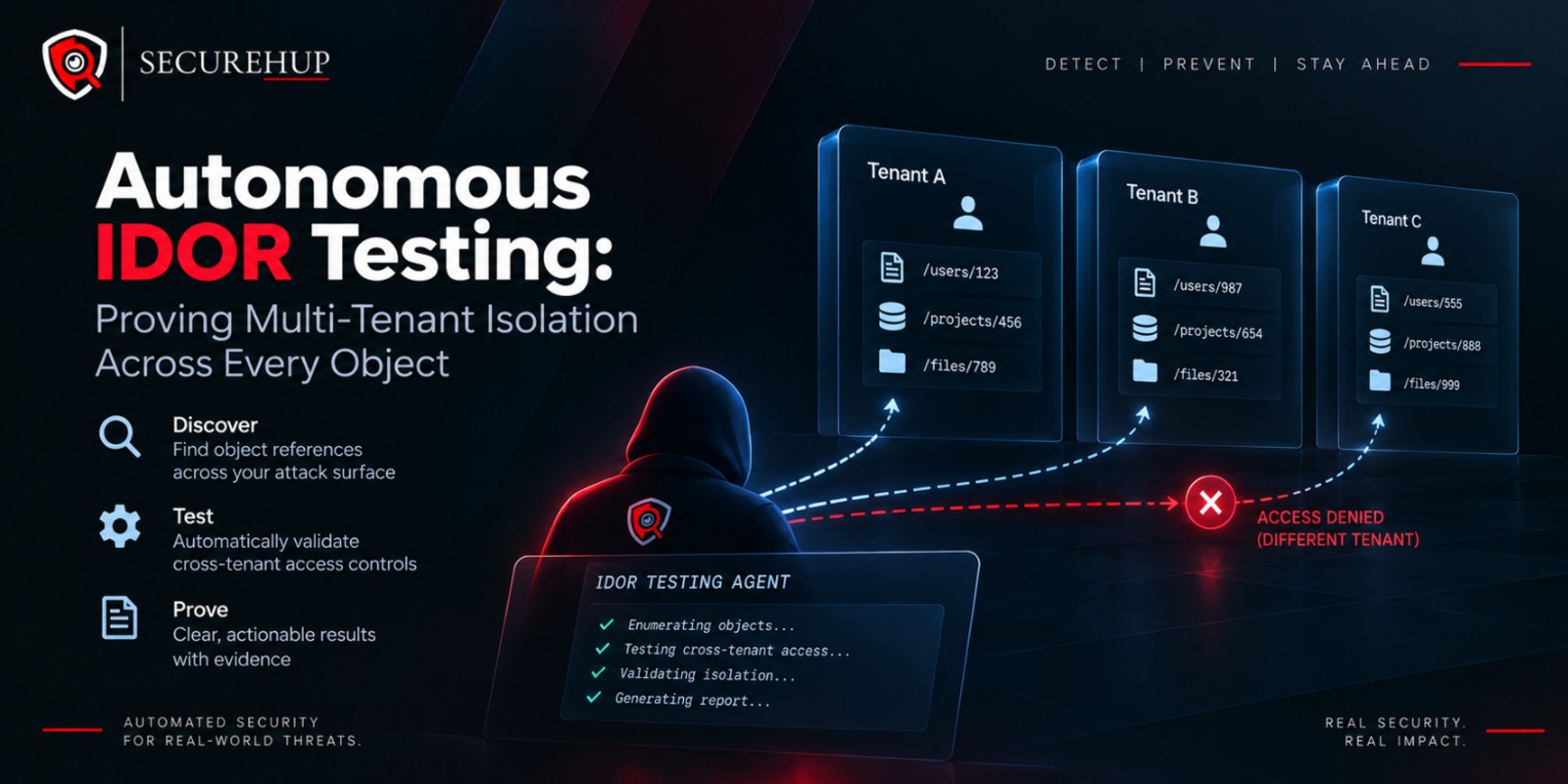
Tenant Alpha owns invoice A-17; tenant Beta owns a user allowed to create exports. The Beta user changes only the invoice reference in an otherwise valid export request. The API returns 202, a service-account worker loads the invoice by ID, and the resulting file appears in Beta's download area. The direct read endpoint was secure. The asynchronous path crossed the tenant boundary.
That sequence explains why replacing one UUID in one request is only the beginning of IDOR testing. Object references also travel through GraphQL variables, nested resources, file keys, cursors, webhooks, caches, background jobs, shares, restores, and bulk actions. Each path may resolve identity and ownership through different code.
Safe autonomous coverage starts with two synthetic tenants and an explicit ownership oracle, not identifier guessing against customer data. Discover routes and data-access paths, generate cross-boundary object-action-state combinations, and inspect direct plus delayed effects. A reproducible violation can then become regression coverage tied to the code that lost the binding.
Key Takeaways
- IDOR and broken object-level authorization are failures to enforce access on a specific object, not failures of identifier randomness.
- Multi-tenant testing needs a five-part oracle: principal, tenant, object, action, and state. Omitting any dimension creates blind spots.
- Coverage must include indirect channels such as list results, exports, caches, files, search, GraphQL relations, jobs, and bulk operations.
- Autonomous agents should use synthetic, labeled fixtures and a reviewed ownership ledger. They should not discover scope by probing arbitrary production identifiers.
- A reliable finding proves both unauthorized reachability and a protected effect, while keeping other tenants' real data out of the evidence.
- Every verified isolation failure should become a focused regression replay triggered by relevant code, schema, policy, or dependency changes.
IDOR Is an Authorization Failure, Not an Identifier Problem
The term Insecure Direct Object Reference describes a common symptom: an application accepts an object reference controlled by a client and fails to verify that the current principal may perform the requested action on that object. In API discussions, the broader term Broken Object Level Authorization, or BOLA, emphasizes the missing server-side decision.
The distinction matters because teams sometimes treat opaque identifiers as a fix. Moving from sequential integers to UUIDs can make opportunistic enumeration harder, but it does not authorize access. Identifiers leak through browser history, links, logs, analytics, support tickets, email notifications, shared documents, referrer data, mobile application storage, and integrations. A user who legitimately receives one object's UUID may still try it in another operation. A UUID may also appear inside a nested response that belongs to a different authorization context.
The security requirement is not "the attacker cannot guess the ID." It is:
For every request, the server independently proves that this principal,
acting in this tenant, may perform this action on this object in its current state.
Random identifiers are defense in depth. They reduce discovery opportunities. They never replace the proof.
Authentication Context Is Not Tenant Context
A valid token may identify a user who belongs to several organizations. The application still needs to determine which tenant is active and whether the token, membership, role, and resource all refer to that tenant. Trusting a client-supplied X-Tenant-ID header without binding it to authenticated membership lets the client choose the security boundary.
Even a tenant claim in a signed token may be insufficient when memberships change, tokens are long-lived, or one token is valid for multiple organizations. The exact architecture varies, but the invariant does not: tenant context must be derived from authenticated and authorized state, propagated consistently, and checked again where the protected resource is accessed.
The Five-Dimension Isolation Invariant
An object-level decision can be modeled as:
allow(P, T, O, A, S)
Where:
Pis the authenticated principal and its effective roles or permissions.Tis the active tenant or security domain.Ois the target object, including its owner, parent, and tenant binding.Ais the requested action, such as read, edit, delete, export, or approve.Sis relevant state, such as draft, locked, archived, transferred, suspended, or shared.
The decision should be true only when all relevant relationships hold. For a simple tenant-owned document, that may mean:
authenticated(P)
AND member(P, T)
AND belongs_to(O, T)
AND permitted(P, A, O)
AND action_allowed_in_state(A, S)
This model exposes why testing only user A versus user B is incomplete. Two users may belong to the same tenant but have different object permissions. One user may belong to two tenants with different roles. An object may be intentionally shared across tenants. A project child may claim one tenant while its parent belongs to another. A global administrator may have a controlled override. State transitions may remove or grant access.
The test oracle must encode these intended relationships. Otherwise, an agent cannot distinguish a vulnerability from a legitimate sharing feature.
Build an Object-Action Inventory Before Sending Requests
The largest gap in conventional IDOR testing is not payload generation. It is inventory. Security teams often test the endpoints visible in a browser session and miss alternate channels that touch the same data.
A code-aware system can combine several sources:
- OpenAPI operations and schemas.
- GraphQL types, queries, mutations, and resolver mappings.
- Route declarations and controller methods.
- ORM models, repositories, query builders, and row-level policies.
- Queue producers and consumers.
- Object-storage adapters and signed URL generators.
- Export, reporting, search, and analytics services.
- Cache construction and invalidation code.
- Authorization policy files and feature flags.
- Existing tests, fixtures, and historical findings.
The result should be an object-action graph, not just a list of URLs.
| Object family | Direct actions | Indirect access paths | Isolation evidence |
|---|---|---|---|
| Project | Read, update, archive, delete | Search, dashboard counts, audit feed | Response fields, row state, search result ownership |
| Invoice | View, pay, credit, download | Monthly export, email job, storage link | Payment state, artifact tenant, delivery recipient |
| User profile | Read, edit, deactivate | Team list, mention lookup, directory sync | Field-level response and identity lifecycle state |
| Secret | Create, reveal, rotate, delete | Deployment job, template render, audit event | Secret value never exposed; action bound to tenant |
| File | Upload, preview, rename, download | Signed URL, thumbnail worker, archive export | Storage namespace, URL audience, derivative ownership |
| API credential | Create, list, revoke | Integration test, webhook execution | Credential tenant and effective scope |
This graph helps the system ask a precise question: if a pull request changes invoice export logic, which tenant isolation tests should run? It also reveals objects whose authorization differs by action. A user may view an invoice but not issue credit. A support role may inspect metadata but not download the file. One generic "can access invoice" flag cannot safely represent every effect.
Creating a Ground-Truth Fixture Ledger
Autonomous testing needs controlled truth. The safest approach is to provision a small synthetic world and record every relationship before testing begins.
Minimum Two-Tenant Topology
Create at least:
- Tenant Alpha and Tenant Beta.
- Alpha owner, Alpha member, and Alpha restricted member.
- Beta owner, Beta member, and Beta restricted member.
- A principal who legitimately belongs to both tenants, with different roles in each.
- A platform-support principal if such a role exists, with its approved limits.
- Objects owned by each tenant and by different users within each tenant.
- Explicitly shared and explicitly private objects.
- Objects in relevant lifecycle states.
Every fixture receives a run-specific label and a provenance record:
object_id: test-run-8421-document-beta-private
type: document
tenant: beta
owner: beta-member-1
state: active
sharing: private
allowed_actions:
  beta-member-1: [read, update, delete]
  beta-owner: [read, update, delete]
  alpha-member-1: []
The real identifier may still be a UUID generated by the application. The external label lets the test orchestrator prove that every accessed object belongs to the test run and understand its expected policy.
Why the Ledger Must Be Independent
Do not ask the same vulnerable endpoint who owns an object and then use its answer as the oracle. Ownership should come from trusted fixture creation, direct test-environment setup, or a privileged verification channel separated from the path under test. Otherwise, a cross-tenant read bug can corrupt both the action and the expected result.
The ledger should be immutable during each case unless the test intentionally changes ownership or state. If a mutation succeeds when it should fail, the orchestrator can compare the final state with the recorded baseline and produce clear evidence.
Generating the Authorization Matrix
For each object-action pair, generate cases across the dimensions that can change the decision.
| Case | Principal relation | Tenant relation | Object relation | Expected result |
|---|---|---|---|---|
| Owner access | Object owner | Active tenant matches | Private object | Allow permitted actions |
| Same-tenant peer | Same role, different user | Matches | Peer-owned private object | Deny unless policy grants team access |
| Cross-tenant peer | Similar role | Does not match | Other tenant's object | Deny |
| Multi-tenant principal | Member of both | Wrong active tenant | Object belongs to other membership | Deny until correct context is selected |
| Lower privilege | Same tenant | Matches | Object is visible but action is restricted | Allow read, deny restricted mutation |
| Shared object | Authorized recipient | Explicit share applies | Shared object | Allow only shared actions and fields |
| Revoked share | Former recipient | Context otherwise valid | Share removed | Deny and invalidate cached links |
| Parent mismatch | Child identifier supplied | Child appears valid | Parent belongs to another tenant | Deny |
| Archived or locked | Authorized principal | Matches | State forbids action | Deny state-changing action |
| Support override | Approved support role | Explicit audited override | Customer object | Follow narrowly defined support policy |
This is not always a Cartesian product of every role and object. The agent should prioritize boundaries that can invalidate the decision. Code analysis can help identify them. If the repository query filters only by id, tenant mismatch is a priority. If an update handler loads the parent securely but later writes the child by child ID alone, parent-child mismatch is a priority. If a cache key omits tenant context, use objects with colliding local keys.
The Autonomous Testing Workflow
A mature workflow has nine stages.
1. Scope the Approved Surface
The orchestrator receives explicit applications, routes, environments, accounts, object types, and prohibited actions. It does not expand scope simply because it discovers a hostname or identifier. Destructive tests use disposable fixtures, while dangerous integrations are replaced with test doubles or disabled effects.
2. Extract Candidate References
The code-analysis agent identifies fields that select objects: path parameters, query keys, body attributes, GraphQL IDs, cursor values, storage keys, job IDs, and relationship fields. It traces them into data access and effect sinks.
3. Infer Enforcement and Confidence
The system records where tenant and object policy appears to be enforced. A query such as where: { id, tenantId } is useful evidence but not proof; role, state, sharing, and indirect paths may still matter. Inferred expectations remain reviewable.
4. Provision Synthetic State
The fixture agent creates tenants, users, objects, memberships, shares, and lifecycle states through approved setup APIs or test hooks. It stores the independent ledger and snapshots protected effects.
5. Generate Mutations
The execution plan changes one security relationship at a time where possible: same object with another user, same principal with another tenant context, same action against another tenant's object, or same object after share revocation. This makes failures easier to explain than random combinations.
6. Execute Through Every Relevant Channel
The request agent tests direct CRUD paths, then alternate representations and workflows. It preserves the application's normal protocol behavior rather than bypassing the public contract with internal database access.
7. Observe Responses and Effects
The evidence agent compares status, fields, object state, rows, events, queue messages, files, signed URLs, search results, cache entries, and audit logs with the fixture ledger.
8. Classify With Claim Boundaries
A response difference is not automatically a vulnerability. The system determines whether protected data or action crossed a reviewed boundary. Ambiguous policies are escalated for human decision. Only verified violations receive exploitability status.
9. Preserve and Replay
The minimal failing case becomes a deterministic security regression. Its principal, object provenance, request, expected decision, observed effect, and cleanup steps are versioned and linked to relevant code.
Test More Than the Direct GET Endpoint
The highest-risk isolation bugs often live outside the obvious object route.
List, Search, and Pagination
A direct GET /objects/{id} may be correctly scoped while GET /objects?sort=... omits the tenant filter. Search indexes may contain documents from several tenants and rely on an application-side filter that one query path forgets. Pagination cursors can encode a record boundary from another tenant. Tests should assert that every returned item, aggregate, facet, count, and cursor belongs to the active policy context.
Bulk Operations
Bulk endpoints create mixed-ownership risk. A handler may authorize the first object and apply the action to all supplied IDs, or filter unauthorized objects silently while still leaking which IDs exist. Build batches containing allowed, same-tenant forbidden, and cross-tenant objects. Define whether the operation must reject atomically or process an authorized subset, then verify both response and state.
Exports and Reports
Export APIs often enqueue asynchronous work and return before data is selected. Authorization at job creation is insufficient if the worker later queries without tenant scope. Test job records, worker context, generated file contents, storage location, signed URL recipient, expiration, and notification destination. A 202 Accepted tells us almost nothing about isolation.
GraphQL and Nested Resolvers
Top-level resolvers may authorize a project, while nested resolvers fetch comments, users, attachments, or billing records by identifier without inheriting tenant context. DataLoader caches can be shared across requests or keyed only by object ID. Test nested fields, aliases, batches, fragments, and repeated IDs under distinct tenant contexts. The goal is not query complexity for its own sake; it is detecting where context disappears between resolvers.
Cache Layers
An application can enforce the database query correctly and still leak a cached response. Cache keys must incorporate every security dimension that changes content, commonly tenant, object, principal class, locale, and field projection. Tests should warm the cache as Tenant Alpha, request the same logical key as Tenant Beta, and verify that no Alpha data or authorization decision is reused.
Files and Object Storage
Database ownership checks do not protect a predictable storage key or an over-broad signed URL. Verify upload namespace, derivative files, previews, thumbnails, archives, signed URL audience where supported, expiration, and behavior after access revocation. A file copied into an export must retain the correct tenant provenance.
Jobs, Webhooks, and Integrations
A user may submit a job ID, integration ID, webhook ID, or destination reference belonging to another tenant. The initial API can appear harmless while the worker performs the protected effect with service credentials. Trace authorization context through queue payloads and revalidate at execution time when state may have changed.
Code Patterns That Deserve Focused Tests
The agent should treat code patterns as test selectors, not automatic findings.
Unscoped Lookup Followed by a Separate Check
const record = await records.findById(input.id);
assertTenant(record, context.tenantId);
This can be correct, but it creates a gap if another caller forgets the second line, if the object is used before the assertion, or if an error path reveals its existence. Prefer repositories whose default query requires tenant context for tenant-owned objects.
Scoped Lookup
const record = await records.findOne({
  id: input.id,
  tenantId: context.tenantId
});
This reduces risk but does not prove complete authorization. It does not establish role, ownership, sharing rights, field permissions, or action state. The runtime test still matters.
Parent Authorized, Child Loaded Globally
const project = await loadAuthorizedProject(projectId, context);
const task = await tasks.findById(taskId);
The handler must prove that task.projectId == project.id, not merely that both identifiers exist. Otherwise, a child from another project or tenant can be attached to an authorized parent route.
Client-Selected Tenant
const tenantId = request.headers["x-tenant-id"];
The header may select among memberships, but it cannot establish membership. The server must bind the selected tenant to authenticated principal state and propagate a trusted context object downstream.
Global Cache Key
const key = `invoice:${invoiceId}`;
If IDs are not globally unique or representations differ by tenant, role, or field policy, the key can cross boundaries. Code-aware testing should inspect key construction and execute cache-warming cases.
Evidence Standards for a Verified Isolation Failure
An autonomous system should not place customer data in a finding. Synthetic fixtures make stronger and safer evidence possible.
A complete finding includes:
- Test run and environment identifier.
- Principal identity, memberships, active tenant, and relevant role.
- Target object's synthetic provenance and intended policy.
- Action and channel used.
- Minimal redacted request and response.
- Expected result from the reviewed ledger.
- Observed protected data or state change.
- Before-and-after snapshots for mutations.
- Code path or query evidence explaining likely root cause.
- Scope assessment across sibling actions and object types.
- Replay case and cleanup confirmation.
For reads, use marker values such as BETA_PRIVATE_MARKER_8421 rather than realistic personal or financial data. For writes, modify only disposable objects and verify restoration or deletion. For exports, inspect test-owned artifacts in an isolated storage namespace. These controls allow strong proof without collecting information the test never needed.
Remediation Patterns That Survive Refactoring
Fixes should make the secure path the easiest path.
Derive Tenant Context Once, Validate It Everywhere
Resolve the active tenant from authenticated state and approved membership. Place it in a trusted request context that application code cannot replace with raw client input. Revalidate at service boundaries where messages or jobs may outlive the request.
Scope Data Access by Construction
For tenant-owned models, repository APIs should require tenant context. Generic global lookup methods should be restricted to narrowly reviewed administrative code. Database row-level security can add defense in depth, but policies need their own tests and correct session context.
Authorize the Action, Not a Generic Object
Read, edit, delete, share, export, and approve can have different rules. Use action-specific policy and field projection. Avoid loading a rich object for a low-privilege response and relying on the client to hide fields.
Validate Relationship Chains
When routes contain parent and child identifiers, enforce the relationship in the query or policy. The same principle applies to tenant, workspace, project, task, attachment, and comment chains. Never assume the URL hierarchy proves database ownership.
Make Sharing Explicit
Cross-tenant collaboration should use explicit grants with subject, object, action, scope, expiration, and revocation. It should not rely on possession of an identifier. Cached representations and signed links must respond to revocation according to a documented bound.
Isolate Secondary Systems
Include tenant context in cache keys, search filters, queue messages, storage prefixes, analytics partitions, and audit records. Validate that workers consume the context safely rather than trusting a caller-provided tenant value.
Pull Request and Continuous Replay Strategy
Running the entire object-action matrix on every small change may be wasteful. Semantic diff analysis can select focused tests.
Trigger isolation replay when a change touches:
- A route, resolver, serializer, or controller that handles object references.
- Repository queries, ORM scopes, database policies, or migrations.
- Authentication context, tenant selection, membership, or role logic.
- Cache key construction or cache lifetime.
- Search indexing or query filters.
- Export, reporting, file, queue, or worker code.
- Sharing, transfer, archive, restore, or deletion state transitions.
- API contracts that add identifiers, batch inputs, or nested fields.
The merge gate should block a deterministic case that shows synthetic data or an effect crossing a reviewed boundary. A code pattern without runtime proof can still prompt review, but it should not be mislabeled as confirmed exploitation. Scheduled broader exploration remains useful because a diff classifier can miss implicit dependencies.
Every fixed case should be replayed in three forms when relevant: the original channel, sibling actions on the same object, and variant objects using the same repository or policy helper. This turns one finding into variant analysis rather than one-line patching.
Metrics for Multi-Tenant Assurance
Useful program metrics include:
- Percentage of tenant-owned object families in the inventory.
- Percentage of object-action pairs linked to an explicit policy oracle.
- Coverage across direct, list, bulk, export, cache, storage, and job channels.
- Number of synthetic cross-tenant cases executed per relevant change.
- Verified isolation failures versus speculative IDOR alerts.
- Percentage of fixes with passing exploit replay.
- Median time from isolation-affecting diff to test result.
- Number of global data-access methods and their approved callers.
- Number of ambiguous sharing or support-override policies awaiting review.
- Test cleanup success and orphaned fixture count.
Avoid using raw request volume as a success metric. Sending millions of identifier mutations can create operational risk while proving less than a small, well-modeled matrix.
FAQ
Are UUIDs enough to prevent IDOR?
No. UUIDs reduce guessability, which is useful defense in depth, but identifiers can leak or be obtained legitimately. The server must authorize every action on the referenced object regardless of identifier format.
What is the difference between IDOR and BOLA?
IDOR commonly describes the direct-reference pattern, while BOLA emphasizes the broader API failure to enforce authorization for a specific object. In practice, both point to the need for server-side object and action checks. Testing should also include indirect references and channels, not only URL parameters.
Can an autonomous agent test tenant isolation safely?
Yes, when it operates in an approved environment with synthetic tenants, test-owned objects, explicit scope, rate limits, effect controls, and a cleanup process. It should use a provenance ledger rather than enumerate arbitrary customer identifiers.
Should a cross-tenant request return 403 or 404?
Either may be valid. Some applications return 404 to avoid revealing that the object exists; others use 403 for an authenticated but unauthorized principal. Consistency and absence of protected effects matter more than one universal status code.
Is database row-level security enough?
It is valuable defense in depth, but it does not automatically cover caches, files, search, queues, external services, incorrect session context, or action-level policy. Row-level policies also require negative and cross-tenant tests.
Isolation Is Proven Across an Object's Whole Lifecycle
One critical object family is usually enough to establish a useful pattern. A principal-tenant-object-action-state policy, paired with Alpha and Beta fixtures, can be exercised through direct endpoints, nested paths, search, export, jobs, caches, shares, and files. Durable state and delayed workers matter as much as the first response because they may resolve ownership through different code.
Once the ownership oracle and cleanup are deterministic, the same approach can extend to another object family without turning into indiscriminate request volume. In our view, tenant isolation becomes credible when each important channel has a repeatable negative proof built on known ownership and bounded effects.
#ApplicationSecurity #IDOR #BOLA #MultiTenantSecurity #AutonomousPentesting #APISecurity #AccessControl
Find issues like this in your own codebase
SecureHup runs this exact exploit chain — discovery, enumeration and cross-tenant validation — on every deployment, automatically.