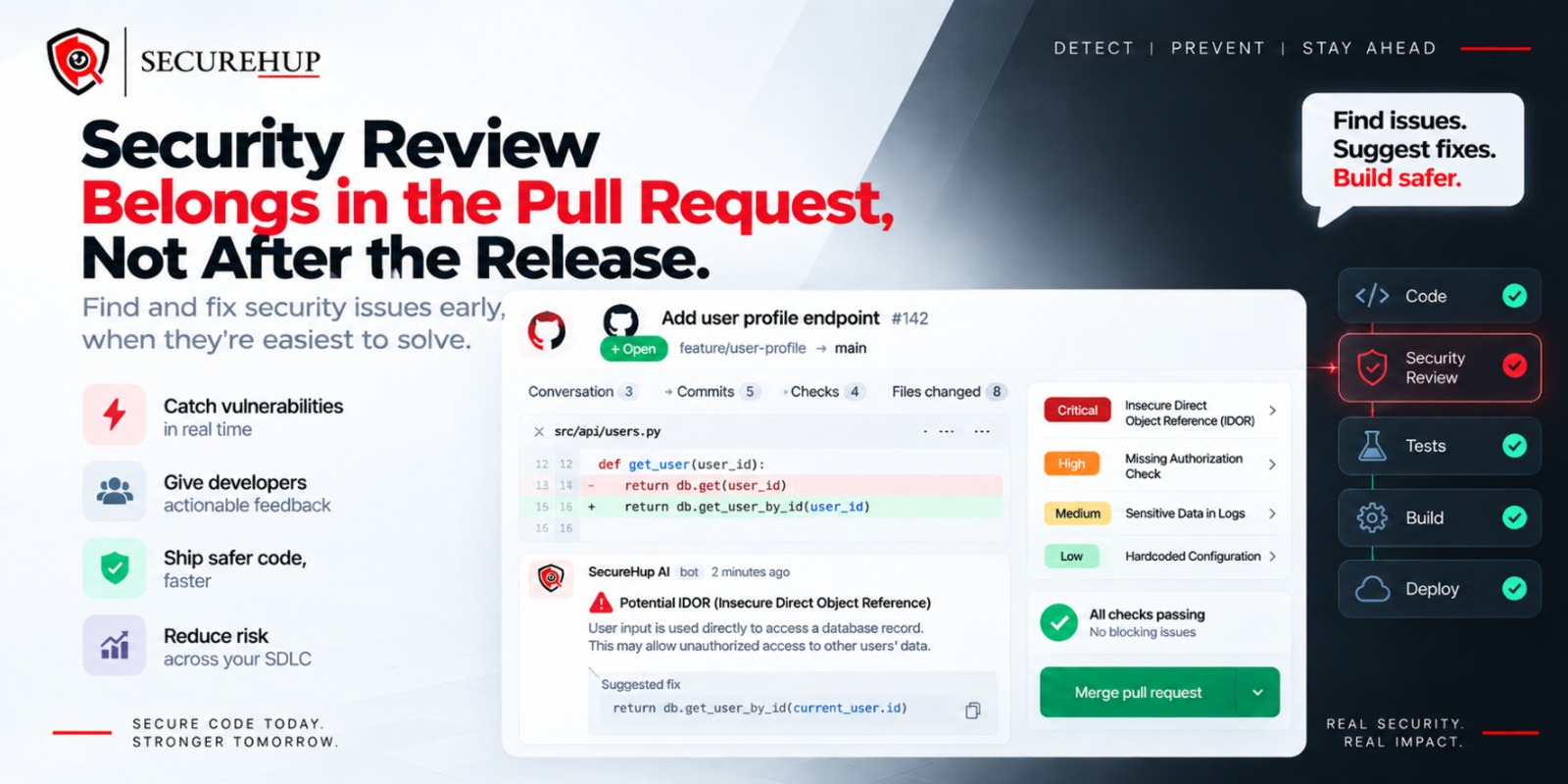
A pull request moves tenant lookup from a repository method into a caller. The diff is short, tests are green, and the author still remembers why the change was made. Two weeks after release, the same omission would arrive as a cross-tenant incident ticket with a much larger investigation and far less context.
Pull-request security review should concentrate effort at that moment without making every developer process a generic scanner backlog. The review needs to recognize changes that touch trust boundaries, sensitive data flows, authorization, parsing, execution, secrets, and deployment authority, then ask for evidence proportional to the potential effect.
Automation can cover repeatable rules and route risky diffs. Human review owns product intent and unusual abuse paths. Blocking belongs to credible high-impact evidence; uncertain signals should remain visible without turning the merge queue into a denial-of-service mechanism.
Key Takeaways
- PR security review should be diff-aware, risk-based, and focused on exploitability, not a generic checklist pasted onto every change.
- The highest-value reviews target changes to authentication, authorization, tenant boundaries, payment logic, data exports, secrets, infrastructure permissions, deserialization, file handling, and sensitive workflows.
- Automated checks are useful for repeatable patterns, but context-aware review is needed when risk depends on role, object ownership, workflow state, business rules, or deployment behavior.
- A good merge gate blocks verified critical risk, high-confidence secrets exposure, dangerous infrastructure changes, and exploitable access-control mistakes; it should not block low-confidence noise by default.
- Security feedback works best when it lands as actionable PR comments with expected behavior, observed behavior, impact, and fix guidance.
Why Post-Release Security Feedback Comes Too Late
Security teams often discover risky code after it has already shipped. The finding may come from a scanner, a penetration test, a bug bounty report, a customer audit, an incident, or a quarterly assessment. By then, the code is harder to change. The original author may be working on another feature. The team may need to preserve backward compatibility. The vulnerable behavior may already be depended on by clients, integrations, support scripts, or internal workflows.
Late findings create extra work because they are no longer only code problems. They become coordination problems. Product must decide whether behavior can change. Engineering must schedule the fix. Security must validate impact. Customer-facing teams may need messaging. Leadership may ask whether data was exposed. If the issue is serious, incident response may need to determine whether it was exploited.
Pull request review changes the timing. The code is still isolated. The diff is visible. The author remembers the intent. Tests are being discussed. Review comments are expected. The cost of changing direction is much lower.
This does not mean every pull request needs a manual security review. That would not scale and would quickly make security look like a bottleneck. The real goal is to detect which PRs deserve security attention, apply the right level of review, and reserve blocking gates for issues that are both credible and meaningful.
What Makes PR Security Review Different From Code Review?
Normal code review usually focuses on correctness, maintainability, style, performance, test coverage, and architecture. Security review asks a narrower but deeper set of questions: can this change create a path for unauthorized access, data exposure, privilege escalation, account takeover, financial manipulation, remote code execution, or infrastructure compromise?
The difference is not just the checklist. It is the mindset.
A normal reviewer may ask whether a new endpoint returns the right data. A security reviewer asks whether the endpoint returns the right data to the right user in the right tenant under the right conditions. A normal reviewer may check that a file upload works. A security reviewer asks whether the file can be executed, parsed unsafely, stored publicly, used for path traversal, or abused to overwhelm processing. A normal reviewer may verify that a feature flag hides a premium feature. A security reviewer asks whether the backend enforces the entitlement without trusting the UI.
Security review also cares about negative behavior. Happy-path tests show that the feature works. Security tests show that forbidden paths remain forbidden. The PR is the ideal place to ask for those negative cases because the developer is already adding or modifying tests.
The Problem With Generic Merge Gates
Many teams start with a simple idea: run all security tools on every PR and block merge when anything serious appears. The idea is understandable. Nobody wants vulnerable code to ship. But generic gates can become counterproductive when they produce too much noise, lack context, or block issues that are not actually introduced by the PR.
There are several common failure modes.
First, the gate flags legacy debt unrelated to the change. Developers then learn that security checks are unpredictable obstacles rather than feedback on their work.
Second, the gate treats all high severity labels as equal. A vulnerable library in an unreachable development-only path may not deserve the same response as a newly introduced tenant isolation bypass.
Third, the gate catches technical patterns but misses business risk. A scanner may pass a PR that changes refund approval logic, removes an ownership check, or exposes a new export path because the code does not match a known vulnerability signature.
Fourth, the gate blocks without fix guidance. A comment that says "security issue found" but does not explain exploitability, expected behavior, root cause, or remediation path slows everyone down.
Effective merge gates need discrimination. They should ask: did this PR introduce or modify a security-relevant behavior? Is the risk exploitable or high-confidence? Is the impact meaningful? Can the developer act on the feedback now?
Diff-Aware Security: Review What Changed
PR security review works because the diff provides focus. Instead of trying to re-test the entire application, we can inspect what changed and infer which security assumptions may have moved.
A diff-aware review looks for specific signals:
- New routes, controllers, resolvers, endpoints, webhooks, jobs, or command handlers.
- Changes to authentication, sessions, tokens, MFA, password reset, OAuth, SSO, or account recovery.
- Changes to authorization checks, role policies, tenant filters, object ownership, or permission mapping.
- Changes to payment, billing, discount, credit, refund, checkout, invoice, quota, or entitlement logic.
- New data export, reporting, search, filter, or bulk-download functionality.
- New file upload, parsing, decompression, media processing, template rendering, or user-controlled content handling.
- New secrets, environment variables, CI/CD permissions, cloud roles, storage permissions, or infrastructure configuration.
- Changes to serialization, deserialization, dynamic execution, shell commands, SQL construction, redirects, URL fetching, or template engines.
- Removal or weakening of validation, rate limits, audit logs, idempotency, locking, or state checks.
Not every signal means the PR is dangerous. It means the review should ask better questions. Security attention should follow the parts of the diff where a small mistake can become a large exploit path.
PR Workflow Breakdown
| PR stage | Security question | What to automate | What needs context-aware review |
|---|---|---|---|
| Author opens PR | Does the diff touch security-sensitive code or workflows? | File/path rules, dependency checks, secret scanning, code scanning, infrastructure policy checks | Whether the change modifies trust boundaries, role behavior, tenant isolation, or business-critical workflow rules |
| Initial checks run | Is there a known high-confidence issue introduced by the change? | SAST rules, dependency advisories, IaC misconfiguration checks, secret patterns, linting for unsafe APIs | Whether the alert is reachable, exploitable, or relevant to the changed behavior |
| Reviewer examines diff | Can the new behavior be abused by a different user, role, tenant, or state? | Suggested review prompts based on changed files and patterns | Authorization reasoning, workflow abuse, entitlement logic, payment manipulation, data exposure |
| Developer updates tests | Do tests prove forbidden behavior remains forbidden? | Required test status, coverage expectations, replay of known exploit regressions | Negative test design for roles, tenants, states, and edge cases |
| Merge gate evaluates risk | Should this PR be blocked? | Policy rules for verified criticals, secrets, dangerous permissions, failing exploit regressions | Final judgment on exceptions, compensating controls, and acceptable temporary risk |
| Post-merge validation | Did the fix or control behave correctly in a deployed environment? | Staging checks, dynamic tests, regression replay, deployment policy checks | Production-specific context, feature flags, customer-specific behavior, runtime-only exposure |
This workflow keeps security close to engineering without asking every developer to become an expert in every vulnerability class. Automation handles repeatable signals. Context-aware review handles intent, ownership, state, and impact.
What Should Block a Merge?
Security gates lose credibility when they block too much. They also fail when they do not block the issues that matter. A practical policy needs clear severity, confidence, and ownership rules.
The strongest blockers are high-confidence issues with immediate exploit potential:
- A secret, token, private key, or credential committed to the PR.
- A newly introduced authentication bypass.
- A missing authorization check that allows cross-user or cross-tenant access.
- A direct path to sensitive data exposure.
- A change that grants broad infrastructure permissions without clear need.
- A failing regression test for a previously verified exploit.
- A dependency or configuration issue that is both reachable and known to be dangerous in the deployed context.
- A remote code execution path, unsafe deserialization path, command execution path, or dangerous file handling path introduced by the change.
Other issues may deserve comments, tickets, or follow-up work rather than blocking. Examples include low-confidence static findings, legacy issues outside the diff, hardening improvements with no immediate exploit path, or theoretical concerns that require additional investigation.
This distinction matters. Developers are more likely to respect a gate that blocks a small number of real problems than a gate that treats every warning as a release emergency.
Merge Gate Decision Matrix
| Finding type | Confidence | Impact | Merge decision | Expected PR response |
|---|---|---|---|---|
| Hardcoded credential in diff | High | High | Block | Remove secret, rotate it, verify no exposure, add prevention control |
| Cross-tenant object access introduced | High | High | Block | Add object/tenant authorization, include negative tests, verify with reproduction path |
| New admin permission without approval path | Medium to high | High | Block or require explicit risk sign-off | Scope permission, document need, add review approval, verify least privilege |
| Scanner alert in unchanged legacy code | Variable | Variable | Do not block this PR by default | Create separate backlog item unless the PR makes it reachable |
| Low-confidence static finding in changed code | Low | Unknown | Comment or request investigation | Ask for clarification, safe pattern, or test; block only if exploitability becomes credible |
| Missing negative test for sensitive workflow | Medium | Medium to high | Request changes | Add role, tenant, state, or entitlement test before merge |
| Failing exploit regression | High | High | Block | Fix regression and replay proof before merge |
| Hardening improvement with no current exploit path | Medium | Low to medium | Do not block by default | Track as follow-up, or include fix if low effort |
The matrix should be customized to the organization, but the principle is stable: block when the issue is credible, relevant to the PR, and capable of causing meaningful harm.
Review Questions That Catch Exploitable Changes
Good PR security review is not a 200-item checklist. Long checklists are rarely used well under delivery pressure. A smaller set of high-leverage questions works better.
For authentication and sessions:
- Does this change create, consume, refresh, revoke, or trust tokens?
- Are password reset, email change, MFA, device trust, and invitation flows bound to the right user and state?
- Can tokens be replayed, reused, guessed, logged, leaked, or accepted after expiration?
For authorization:
- Does every new data access path check user, role, tenant, object ownership, action, and state?
- Is authorization enforced server-side rather than only in the UI?
- Does the PR add a bulk action, export, search, or direct object lookup that bypasses existing policy?
For business logic:
- Can users skip, repeat, reverse, or parallelize workflow steps?
- Are trusted values such as price, quota, discount, role, approval status, or payment state computed server-side?
- Does the feature behave correctly for trial, downgraded, suspended, invited, expired, and read-only users?
For data exposure:
- Does the PR introduce new fields in API responses, logs, events, exports, analytics, or error messages?
- Could sensitive data cross account, tenant, region, or environment boundaries?
- Are filters and pagination applied after authorization rather than before it?
For infrastructure and CI/CD:
- Does the change add cloud permissions, service account privileges, workflow tokens, deployment credentials, or public storage access?
- Can a compromised build step access secrets it does not need?
- Are production actions separated from pull request actions and untrusted code paths?
These questions are short enough to use, but specific enough to reveal real exploit paths.
What Good PR Security Feedback Looks Like
Security feedback in a PR should be precise. Developers do not need vague warnings. They need enough detail to make a correct change quickly.
A useful comment includes five parts:
- The risky behavior introduced or modified.
- The exploit condition or misuse path.
- The expected secure behavior.
- The suggested fix or control.
- The test or proof needed before merge.
Compare these two comments:
"Possible authorization issue."
"This new GET /reports/{id}/export path checks that the user is authenticated, but it does not appear to verify that the report belongs to the user's tenant. A user from Tenant A may be able to request a Tenant B report if they know or guess the ID. Expected behavior: bind report ownership to the current tenant before export. Please add an object/tenant authorization check and a negative test using two tenants."
The second comment is more useful because it is actionable. It explains the abuse case, expected behavior, likely fix area, and verification requirement. It also avoids drama. The goal is not to shame the author. The goal is to make the safe path obvious.
Evidence Beats Opinion
Security review can become subjective if it relies only on reviewer intuition. Evidence makes it stronger.
Evidence in a PR does not always require a full exploit. Sometimes it is a failing test showing that a lower-privilege role can call a new endpoint. Sometimes it is a request sequence demonstrating that a state transition can be skipped. Sometimes it is a diff showing that a tenant filter was removed. Sometimes it is a local reproduction proving that a file upload accepts executable content or that a URL fetcher can reach internal metadata.
The best evidence is safe, minimal, and tied to the changed code. It should answer three questions:
- What changed?
- How can it be abused?
- How do we know the fix works?
Evidence also helps with exceptions. If a team wants to merge with a known risk, the decision should be explicit. What is the impact? Is there a compensating control? Is the feature behind a flag? Who accepted the risk? When will it be fixed? Without evidence, exceptions become informal and difficult to audit.
How to Avoid Slowing Developers Down
Security teams often worry that stronger PR review will slow delivery. It can, if implemented poorly. The solution is not to avoid PR review. The solution is to design it around developer workflow.
First, route reviews based on risk. A documentation change does not need the same review as a payment flow change. A CSS tweak does not need the same gate as a new admin endpoint. Use changed files, ownership metadata, labels, service criticality, and detected patterns to decide what needs deeper review.
Second, keep feedback close to the diff. Comments should point to the exact line, function, endpoint, policy, or configuration that matters. Separate long reports are harder to consume during PR review.
Third, give fix guidance. A blocker without a path forward creates frustration. If the expected fix is a policy check, negative test, secret rotation, permission reduction, or safe parsing library, say so.
Fourth, separate blockers from recommendations. Developers need to know whether the issue must be fixed before merge or can be handled as follow-up. Mixing the two creates confusion.
Fifth, measure false positives and review latency. A gate that blocks often but rarely finds real risk will lose trust. A review process that takes days will be bypassed. Security controls need operational metrics, not only security intent.
Designing PR Security Checks by Risk Area
Different code areas need different security checks. A single global checklist misses nuance.
Authentication code should trigger review for token lifetime, session invalidation, replay resistance, reset flow binding, MFA bypass, device trust, and account recovery state. Tests should include expired tokens, reused tokens, wrong users, and out-of-order steps.
Authorization code should trigger object-level and action-level review. Tests should cover different roles, tenants, ownership relationships, direct object access, bulk actions, and export paths. We should look for server-side enforcement, not only UI conditions.
Billing and entitlement code should trigger checks for client-controlled values, plan transitions, downgrade behavior, coupon reuse, quota enforcement, payment confirmation, refund approval, and trial abuse. Tests should include tampering, replay, edge plan states, and concurrent requests.
File handling code should trigger checks for content type trust, extension validation, storage location, public access, scanning, size limits, path traversal, decompression behavior, parser safety, and downstream processing.
Infrastructure and CI/CD changes should trigger least-privilege review. Permissions should be scoped. Secrets should not be exposed to untrusted workflows. Deployment tokens should not be available to pull requests from untrusted contexts. Public storage, network exposure, security group changes, and service account privileges should be reviewed carefully.
This targeted approach improves both security and speed. Reviewers ask the right questions because the change tells them where to look.
Turning PR Findings Into Better Tests
The most valuable PR security review outcome is not only a fixed line of code. It is a stronger test suite.
Every meaningful security finding should ask: what test would have caught this before review? The answer may be a unit test for a policy function, an integration test for an endpoint, an API test with two tenants, a regression test for a previous exploit, an infrastructure policy test, or a dynamic test in staging.
For authorization bugs, add negative tests that prove the wrong user, wrong role, wrong tenant, or wrong state is rejected. For workflow bugs, add tests that attempt skipped steps, repeated steps, stale tokens, and concurrent actions. For secrets and infrastructure mistakes, add automated checks that fail fast before review. For dependency or unsafe API patterns, add rules that run on future PRs.
This is how PR security review compounds. Each finding improves the next review cycle. The team does not depend on remembering the same lesson forever; the lesson becomes a control.
Practical PR Security Review Template
Security review does not need to be heavy to be useful. A compact template can guide reviewers and authors:
| Review area | Questions to answer before merge | Evidence to include |
|---|---|---|
| Trust boundary | Does this PR accept new input, call new external systems, or expose new output? | Changed endpoint, input source, output sink, validation/control location |
| Authentication | Does the change create or trust identity, session, token, invite, or recovery state? | Token lifecycle tests, wrong-user tests, expiration/replay checks |
| Authorization | Can the wrong user, role, tenant, or account access this object or action? | Negative tests across users, roles, tenants, and object ownership |
| Business logic | Can the workflow be skipped, repeated, reversed, raced, or abused through direct API calls? | Request sequence, state transition tests, server-side rule checks |
| Data exposure | Does the PR add fields, logs, exports, analytics, errors, or events containing sensitive data? | Response examples, log review, tenant/account boundary tests |
| Secrets and infrastructure | Does the PR add credentials, permissions, public exposure, or CI/CD access? | Secret scan result, least-privilege justification, policy check |
| Regression | Does this touch an area where we had a previous exploit or incident? | Replay of the old proof or regression test result |
This template can be used manually, partially automated, or embedded into PR labels and review workflows. The important point is that it turns security review into a set of concrete questions rather than a vague approval ritual.
Metrics That Show PR Security Review Is Working
Security review inside pull requests should be measured like an engineering process. Useful metrics include:
- Number of security-relevant PRs identified by routing rules.
- Percentage of high-risk PRs reviewed before merge.
- Median time from PR open to security feedback.
- Percentage of security comments that include fix guidance and test expectations.
- Number of verified exploitable issues found before merge.
- Number of false-positive blockers.
- Number of security findings converted into regression tests.
- Recurrence rate of similar issues after a fix.
- Percentage of exceptions with documented owner, expiry, and compensating control.
- Developer rework caused by late security findings after release.
These metrics help security teams tune the process. If review latency is high, routing may be too broad. If false-positive blockers are high, gates need better confidence thresholds. If the same bug class recurs, the fix is not only reviewer education; it is a stronger automated control or test pattern.
FAQ
Should every pull request receive a security review?
No. Every PR should receive baseline automated checks, but manual or deep security review should be risk-routed. Changes to authentication, authorization, payments, data exports, tenant boundaries, secrets, infrastructure permissions, and sensitive workflows deserve more attention than low-risk changes.
What is the difference between PR security review and SAST?
SAST detects repeatable code patterns and data-flow issues. PR security review uses the diff, product context, roles, workflows, and intended behavior to reason about exploitability. They work best together: automated checks catch scalable patterns, while review catches context-sensitive risk.
What should block a merge for security reasons?
Block high-confidence, high-impact issues that are relevant to the PR: committed secrets, authentication bypass, cross-tenant access, missing authorization on sensitive actions, failing exploit regressions, dangerous infrastructure permissions, reachable critical dependency risk, or direct paths to sensitive data exposure.
How do we prevent security review from slowing delivery?
Route review by risk, keep comments close to the diff, provide fix guidance, distinguish blockers from recommendations, automate repeatable checks, and measure review latency and false positives. A precise gate is faster than a broad, noisy one.
What should a security PR comment include?
It should describe the risky behavior, the abuse path, expected secure behavior, suggested remediation, and the proof or test needed before merge. The comment should help the author make the right change without rediscovering the issue from scratch.
Useful Friction Follows Security-Relevant Change
Changes that touch trust boundaries and protected effects deserve a different review path from routine low-risk edits. Repeatable checks can run automatically, sensitive behavior can carry negative tests, and ambiguous high-impact changes can reach a reviewer who understands the product context. Explaining why a gate was selected also makes the review easier for an author to challenge or improve.
Confirmed findings become more valuable when they return as regression controls linked to future changes. We would judge the process by whether it catches exploitable behavior while the context is fresh and allows low-risk work to keep moving. Equal warning volume on every pull request is consistency, but not necessarily useful security.
#ApplicationSecurity #PullRequest #SecureCodeReview #DevSecOps #SecurityEngineering #AppSec #SoftwareSecurity #CyberSecurity
Find issues like this in your own codebase
SecureHup runs this exact exploit chain — discovery, enumeration and cross-tenant validation — on every deployment, automatically.