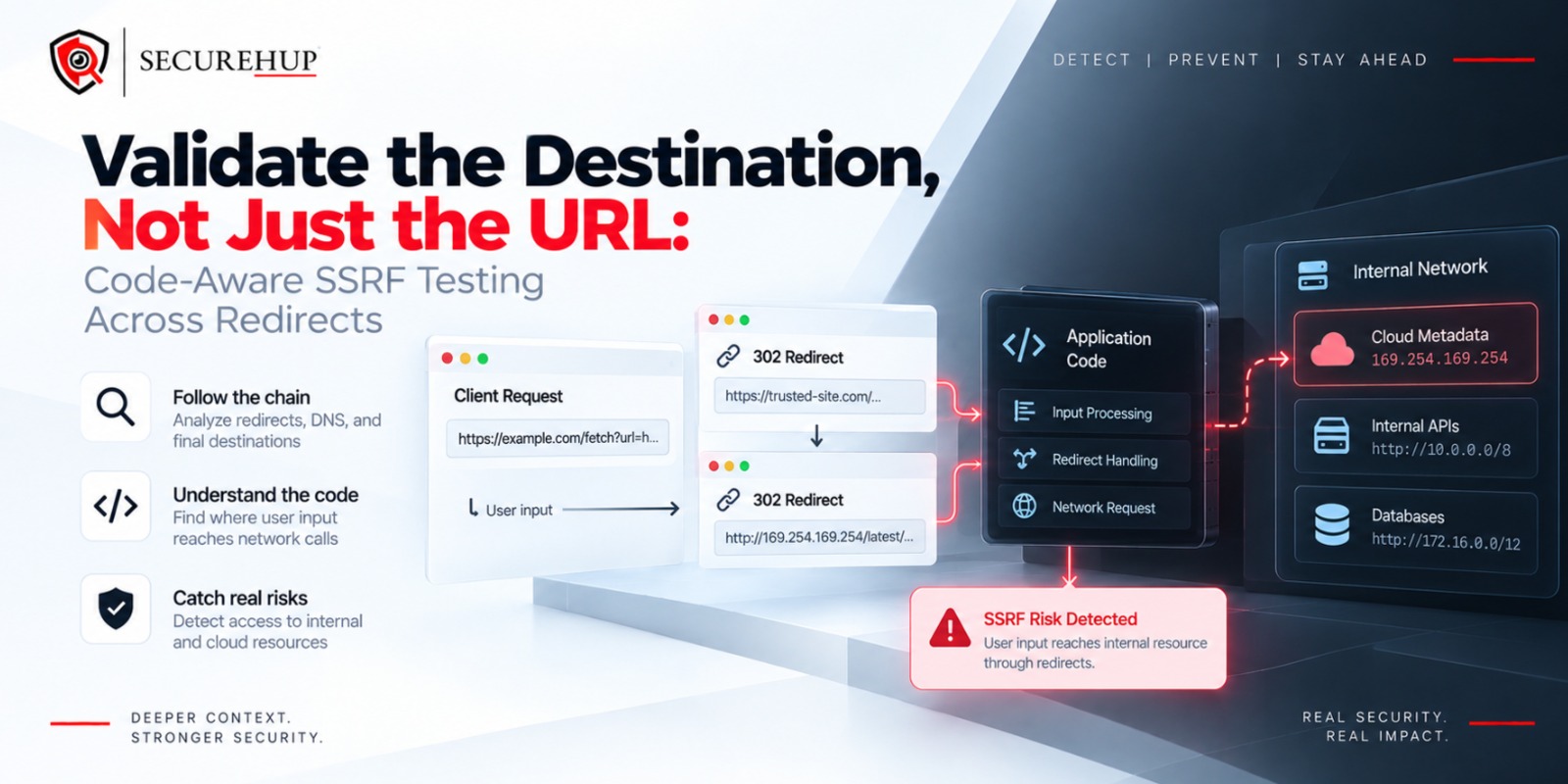
A media importer accepts https://assets.example.test/photo.jpg. The application parses the URL, checks the hostname against policy, and approves the job. The remote server answers with a redirect to a test-owned canary address that the importer was never meant to reach. The HTTP client follows it automatically. Every validation log says allow; the packet capture records a boundary crossing.
The deciding URL in that sequence is the redirect target, not the string submitted by the user. Similar handoffs occur when repository importers invoke version-control clients, document services launch converters, or webhook workers use a shared HTTP stack. DNS resolution, proxy behavior, protocol support, and redirect policy may all belong to a component the original validator never sees.
A useful SSRF test follows that complete execution path without probing real internal systems. Code analysis identifies the component that makes the connection; controlled redirectors and canaries show where it can actually go; egress telemetry confirms the effect. The evidence should name the last policy decision before the connection, because that is where a remediation can be tested rather than guessed.
Key Takeaways
- SSRF policy must apply to the effective destination of every connection, not only the originally submitted URL.
- Redirects, DNS resolution, proxies, protocol helpers, and subprocesses can change the destination after application validation.
- A validator and a network client that use different parsers or policies create a security-critical interpretation gap.
- Code-aware agents can map source-to-sink behavior and select precise tests instead of spraying internal address ranges.
- Safe validation uses controlled redirect services, synthetic canary zones, explicit scope, egress telemetry, and no customer data.
- Durable defense combines application-layer destination control, redirect handling, protocol restrictions, and network egress policy.
SSRF Is a Destination-Control Failure
Server-Side Request Forgery occurs when an application performs a network action influenced by untrusted input without sufficiently ensuring that the action reaches an allowed destination. The visible feature may be legitimate: importing a repository, fetching an avatar, validating a webhook, rendering a document, checking a feed, generating a link preview, or synchronizing a remote resource.
The vulnerable property is not simply "the application accepts a URL." Many products need URLs. The failure is that an untrusted party can influence where a more privileged server connects. That server may have access to:
- Internal services not exposed to the user.
- Cloud control-plane or workload identity endpoints.
- Databases, caches, admin interfaces, and orchestration APIs.
- Services that trust the server's network position.
- Credentials automatically attached by proxies or client configuration.
- Local or mounted resources through non-HTTP protocols, depending on the client.
A meaningful SSRF review therefore begins with the workload's network authority. If the fetcher can reach only a narrow public egress proxy with strict policy, impact differs from a worker that shares a flat network with production control systems. Application bugs and deployment controls jointly determine reachability, but a strong network boundary does not make incorrect application validation acceptable. It limits blast radius and buys resilience.
The Checked URL and the Effective Destination
The central invariant is:
Every connection made on behalf of untrusted input must be authorized
against the effective scheme, host, port, resolved address, and request context.
One validation at input time cannot prove that invariant if later components can transform the request.
Consider the path:
user input
  -> application URL parser
  -> allow/block decision
  -> client or subprocess configuration
  -> DNS resolution
  -> first network connection
  -> redirect response
  -> redirect URL parsing
  -> second DNS resolution
  -> effective connection
  -> follow-up requests or scheduled refreshes
Security policy can disappear at any arrow. The application may validate only the first host. The client may follow a redirect automatically. A redirect may change scheme or port. Follow-up requests may use the redirected URL as a base. A scheduled worker may store the original URL but later re-resolve it under different DNS state. An external tool may load global configuration that changes proxy or redirect behavior.
The practical rule is simple: validate where the connection will go, at the component that controls the connection, every time the destination can change.
Redirects Are New Security Decisions
Redirects are not merely response-handling convenience. Each redirect supplies a new destination selected by the previous server. If the application accepts arbitrary public URLs, the first server may be controlled by the same user who supplied the input. Treating its Location value as trusted defeats the original destination policy.
Three strategies are defensible, depending on the business requirement.
Disable Redirects
If the feature does not require redirects, turn them off in the actual network client. This includes subprocesses and scheduled fetch paths, not only the application's shared HTTP library. A validation layer cannot compensate for a different client silently following redirects later.
Follow Redirects in Controlled Code
If compatibility requires redirects, disable automatic following and process each hop through one policy function. Apply limits to hop count, total time, response size, and allowed scheme. Resolve and evaluate the next destination before connecting. Decide whether credentials, cookies, or authorization headers may be forwarded; the safe default across origins is not to forward them.
Use an Egress Broker
A centralized fetch service or proxy can enforce destination and protocol policy at the connection boundary. This reduces duplicated parser logic and makes egress observable. The broker itself becomes critical infrastructure and must protect against parser discrepancies, DNS changes, redirects, request smuggling, credential forwarding, and tenant mix-ups.
The wrong strategy is validating the first URL and assuming the downstream client's redirect defaults preserve the same trust decision.
Delegated Clients Expand the Attack Surface
Applications frequently delegate network work to mature tools. That can be a sound engineering choice, but it transfers security-sensitive behavior too.
A child process may have its own:
- Redirect defaults.
- Supported URL schemes.
- Proxy discovery rules.
- Credential helpers and configuration files.
- DNS resolver behavior.
- Retry policy.
- Base-URL handling after redirects.
- Environment-variable overrides.
- Configuration precedence.
The parent application can validate with one URL parser while the child interprets the string differently. It can pass an allowed original URL while the child follows a response to a destination the parent never sees. It can set a safe option for initial import but omit it for periodic synchronization. Security review must include the actual client invocation, environment, working directory, global configuration, and every later path that reuses the remote.
Wrapper Safety Is a Contract
Create a wrapper whose contract states what schemes, hosts, ports, redirect behavior, proxy behavior, credentials, timeouts, and size limits are allowed. Test that wrapper against the real underlying tool version. Do not scatter raw subprocess calls across services and assume every caller remembers the same flags.
If the underlying tool cannot expose each effective destination for policy evaluation, either disable destination-changing behavior or place the tool behind network enforcement that it cannot bypass.
DNS Makes a Hostname a Time-Dependent Decision
A hostname is not one address. It can resolve to several IPv4 and IPv6 addresses, change between validation and connection, return different answers by resolver or region, or rotate during a long-lived job. Checking the string alone is not enough when policy concerns network ranges.
Important requirements include:
- Parse and canonicalize with a well-tested URL library.
- Resolve through an approved resolver path.
- Evaluate every returned address, not only the first convenient result.
- Reject destinations outside the allowed address policy.
- Ensure the connection uses an address that was evaluated, without breaking TLS hostname verification.
- Re-evaluate on each new connection and redirect according to the application's DNS strategy.
- Treat IPv4, IPv6, mapped forms, and unusual textual encodings consistently.
- Apply network egress controls even if application checks are correct.
Implementing secure resolution and connection binding is platform-specific. A generic "resolve, check, then call the URL normally" sequence can reopen a check-use gap if the client resolves again. A controlled connector or egress proxy is often easier to reason about than duplicating low-level behavior in every feature.
DNS Failure Must Not Become Allow
Timeouts, partial answers, resolver errors, and unsupported address forms should not cause the application to skip policy. For sensitive fetchers, uncertainty is a denial or a controlled retry, not permission to connect without classification.
Parser and Scheme Boundaries
URL parsing is security-sensitive because equivalent-looking strings can be interpreted differently. User information, encoded separators, Unicode hostnames, trailing dots, mixed case, default ports, fragments, backslashes, and nested URLs may produce parser disagreement. The defensive goal is not an ever-growing regex. It is one canonical structured representation shared by validation and execution as far as the stack allows.
Protocol scope must also be explicit. A feature that needs HTTPS should not inherit every scheme supported by a general-purpose client. Scheme changes across redirects should be denied unless specifically required. File, local IPC, mail, and other protocol handlers can cross different security boundaries and should not become reachable accidentally through a generic URL field.
Allowlisting known destinations is strongest when the business flow contacts a small set of services. When arbitrary public destinations are required, deny known non-public and internal zones, use controlled resolution and connection, require egress routing, and recognize that a blocklist alone is not a perfect boundary. Defense in depth is mandatory.
Code-Aware Source-to-Sink Analysis
Before executing a test, an autonomous system should build a network-effect graph.
Sources
Identify user-controlled or tenant-controlled values from:
- API and form fields.
- Import or migration configuration.
- Webhook and callback settings.
- Feed, image, document, and preview URLs.
- Repository remotes and package sources.
- Stored configuration later consumed by workers.
- Redirect or proxy values returned by external services.
Transformations
Trace parsing, normalization, decoding, template expansion, base-URL resolution, DNS lookup, allow/block checks, and storage. Record whether the validated value is the same object later sent to the network client or merely the original string.
Sinks
Map:
- HTTP client calls.
- Browser or rendering engines.
- Version-control and package-manager processes.
- Media and document tools.
- Socket or RPC clients.
- Queue workers and scheduled jobs.
- Proxy and egress-broker calls.
Policy Ownership
For each sink, determine who owns redirects, DNS, proxy selection, credential attachment, retries, and protocol support. The highest-risk path is one where policy is applied in an upstream component that cannot observe the final connection.
This analysis selects focused tests. A direct HTTP client with redirects disabled needs different cases from a background importer that invokes an external tool and persists a remote for periodic refresh.
Safe Autonomous SSRF Test Architecture
The test environment should make forbidden reachability observable without touching real internal services.
Controlled Destination Zones
Provision several test-owned endpoints:
- Approved public endpoint: a normal allowed destination.
- Public redirector: returns configurable redirects but contains no sensitive data.
- Blocked canary endpoint: reachable only from the tested workload's restricted test network zone.
- Credential canary: records whether forbidden headers or cookies arrive, using synthetic values only.
- Persistent-fetch canary: records later scheduled requests associated with the test run.
The blocked canary stands in for an internal service. Contact with it proves a policy crossing without probing an actual database, metadata endpoint, admin panel, or customer workload.
Run-Scoped Correlation
Every request includes a random non-secret test identifier in an allowed path or header. Canary logs record timestamp, source workload, destination, method, and safe header presence. They never need production secrets or response content.
Network Guardrails
The orchestrator allows destinations only from the test fixture manifest. It does not enumerate address ranges, ports, or hostnames. Rate and redirect depth are capped. Response bodies are small. Destructive methods are disabled. A kill switch can terminate the fetch worker or block the test egress route.
Independent Observation
Use egress gateway logs, canary access logs, DNS telemetry, and application traces. A response shown to the user may hide the effective connection, especially in blind SSRF or background jobs. Independent telemetry supplies the oracle.
Redirect and DNS Boundary Test Cases
| Test case | Initial destination | Destination change | Expected result |
|---|---|---|---|
| Direct approved fetch | Approved canary | None | Allowed within size/time policy |
| Direct blocked fetch | Blocked canary | None | Denied before connection |
| Approved-to-approved redirect | Approved redirector | Approved canary | Follow only if redirects are required and hop is revalidated |
| Approved-to-blocked redirect | Approved redirector | Blocked canary | Denied; blocked canary receives no request |
| Multi-hop chain | Approved redirectors | Final blocked canary | Every hop evaluated; chain denied before final connection |
| Scheme change | Approved HTTPS fixture | Unsupported scheme fixture | Denied |
| Port change | Approved host | Disallowed port on test fixture | Denied |
| Mixed DNS answers | Test hostname | Approved and blocked canary addresses | Follow documented policy; never connect to an unevaluated blocked address |
| Cross-origin redirect | Approved origin | Different approved origin | No synthetic auth header or cookie forwarded unless explicit policy permits |
| Background refresh | Approved stored remote | Later redirect to blocked canary | Scheduled fetch revalidates and denies |
| Subprocess path | Approved input | Tool-controlled redirect | Same policy result as native client path |
| Failure mode | DNS or policy service unavailable | Unknown | Fail closed or use documented bounded retry; no uncontrolled connection |
The matrix deliberately avoids real internal addresses. It tests the policy mechanism, not the organization's hidden topology.
Prove the Canary Boundary Before Trusting the Result
A canary is useful only when its placement represents the policy being tested. Before running redirect cases, verify three baselines. First, the approved endpoint must be reachable through the normal fetch path. Second, a direct request to the restricted canary must be denied by application or egress policy. Third, the canary must not be reachable from the public test controller, because an unrelated request could otherwise be mistaken for a server-side fetch.
Canary logs should accept only run-scoped markers and record the workload identity or trusted network source that contacted them. Health checks, monitoring agents, and service-mesh probes need separate paths so they cannot produce false evidence. The redirector should keep a signed or otherwise integrity-protected run configuration in the test control plane, while the public URL contains only a non-secret correlation value.
After each case, the orchestrator should reconcile application traces, redirector logs, DNS events, egress decisions, and canary hits on one timeline. A canary hit without the expected run marker is noise until investigated. An application error with a correlated canary hit is a verified connection despite the visible denial. This provenance discipline prevents both false positives and false reassurance.
What Counts as a Verified Finding?
A static path from input to an HTTP call is not automatically SSRF. The application may enforce a strong destination policy or route all traffic through a restrictive broker. Conversely, an error response does not prove that no connection occurred.
A verified finding should show:
- The input source and required user privilege.
- The application or worker that performs the request.
- The intended destination policy.
- The validated original destination.
- The effective destination observed by a test-owned canary.
- The transformation that changed the destination, such as a redirect or downstream client behavior.
- Egress or canary evidence with run correlation.
- Whether any synthetic credentials crossed origins.
- Whether the action persists through retries or scheduled refresh.
- Network reachability prerequisites and affected deployment scope.
- A minimal regression case and cleanup confirmation.
Impact should be bounded by evidence. Reaching a restricted canary proves a policy bypass and an SSRF primitive. It does not by itself prove remote code execution, arbitrary file access, cloud credential theft, or access to every internal service. Those are separate claims requiring separate proof and may be unsafe to test. Professional reporting states what was reached, what authority the workload has, and what remains unconfirmed.
Remediation Architecture
SSRF fixes are strongest when policy is enforced at more than one layer.
1. Minimize Destination Freedom
If users need to select a known integration, accept an integration identifier and construct the destination server-side. If only a domain is needed, avoid accepting a complete URL. Use strict allowlists where business requirements permit them.
2. Centralize Structured Validation
Use one maintained component to parse, canonicalize, classify, and authorize destinations. Return a structured destination or approved request object rather than a boolean that leaves the caller free to reconnect differently.
3. Own Redirects Explicitly
Disable automatic redirects by default. If required, process each hop in controlled code and apply the same scheme, host, port, address, credential, hop-count, and size policy. Ensure every alternate client and background path uses the same behavior.
4. Bind Resolution to Connection
Use a connector or egress proxy that evaluates the actual address used for the connection while preserving proper TLS verification. Re-evaluate new connections according to DNS policy. Do not validate with one resolver and let an opaque client resolve again without enforcement.
5. Constrain Delegated Tools
Set explicit command options and sanitized environment. Disable unsafe schemes, redirects, proxy inheritance, and credential helpers unless required. Pin behavior through wrapper contract tests and review changes when the underlying tool is upgraded.
6. Enforce Network Egress
Place fetchers in a workload identity and network segment with only required outbound routes. Block restricted ranges and sensitive services at an egress gateway or firewall. Require authentication on internal services even when they are not internet-facing.
7. Bound the Fetch
Apply connect and total timeouts, response-size limits, content-type expectations, decompression limits, redirect caps, and rate limits. These controls address denial-of-service and parser risk alongside destination control.
8. Revalidate Persistent Remotes
Stored URLs, mirrors, subscriptions, and scheduled imports are not approved forever. Apply policy at every fetch, including redirect and DNS decisions, and disable jobs when the destination becomes invalid.
CI/CD and Continuous Exploit Replay
Semantic diff analysis should trigger focused SSRF tests when code changes:
- URL parsing or destination policy.
- HTTP client construction.
- Redirect callbacks or defaults.
- DNS and connection handling.
- Proxy or service-mesh configuration.
- Subprocess commands and wrappers.
- Import, webhook, preview, media, document, or sync features.
- Background jobs and persisted remote configuration.
- Container egress rules or workload identity.
- Dependencies that own network behavior.
The PR layer can run unit tests over canonicalization and policy plus wrapper contract tests. An isolated integration layer can use controlled redirect and DNS fixtures. Staging can verify egress policy with the blocked canary. A merge should be blocked when a deterministic test proves that a test-owned restricted destination received a request through an input path that policy says must deny.
Preserve the redirect chain, client configuration, and canary assertion as a regression artifact. When the network library or delegated tool changes, replay the case even if application code did not. Defaults are part of the security contract.
Operational Monitoring
Preventive controls need telemetry. Record, without sensitive URL query data:
- Feature and tenant initiating the fetch.
- Canonical destination host, port, and scheme.
- Classified address category.
- Redirect count and destination changes.
- Policy decision and reason.
- Egress gateway decision.
- Response size, duration, and terminal status.
- Background job and original request correlation.
Alert on blocked internal-zone attempts, repeated redirect-policy failures, unexpected scheme changes, direct egress that bypasses the broker, and destination-policy evaluation errors. Avoid logging embedded credentials, sensitive query parameters, or complete signed URLs.
FAQ
Is validating the original URL enough to prevent SSRF?
No. Redirects, DNS changes, proxies, and downstream tools can alter the effective destination. Policy must be enforced where each connection is made and whenever the destination changes.
Should applications always disable redirects?
Disable them when the feature does not require them. When redirects are necessary, follow them in controlled code, revalidate every hop, cap the chain, and control credential forwarding. Automatic opaque redirects are the risky default.
Can a firewall fully solve SSRF?
Egress controls are essential defense in depth and can greatly reduce impact, but they do not correct application policy or protect every allowed internal service. Combine network enforcement with destination-aware application controls.
How can autonomous agents test SSRF without scanning the internal network?
Use test-owned canary endpoints placed in approved and restricted test zones. A controlled redirector points only to fixture destinations, and independent egress logs prove whether policy was crossed. No address or port enumeration is needed.
Does a blocked response prove the server made no request?
No. The server may connect and then hide or transform the result. Verify canary, DNS, proxy, and egress telemetry in addition to the application response.
The Final Destination Is the Security Decision
A user-influenced fetch path includes more than its first validator. Resolver behavior, redirect handling, proxies, the final connector, and egress policy all contribute to where the workload can actually connect. A bounded redirect from an approved origin to a restricted canary can expose that relationship without probing a real internal service. Either the second connection is refused before it leaves or an independent egress control blocks it and records why.
We would keep that case beside changes in URL parsing, client configuration, proxy rules, and worker architecture. The assertion concerns the observed destination rather than the original string. Once a team can explain where the workload connected and which decision allowed it, SSRF remediation becomes a network property instead of another layer of increasingly complicated URL filters.
#CloudSecurity #SSRF #ApplicationSecurity #AutonomousPentesting #SecureCoding #NetworkSecurity #DevSecOps
Find issues like this in your own codebase
SecureHup runs this exact exploit chain — discovery, enumeration and cross-tenant validation — on every deployment, automatically.