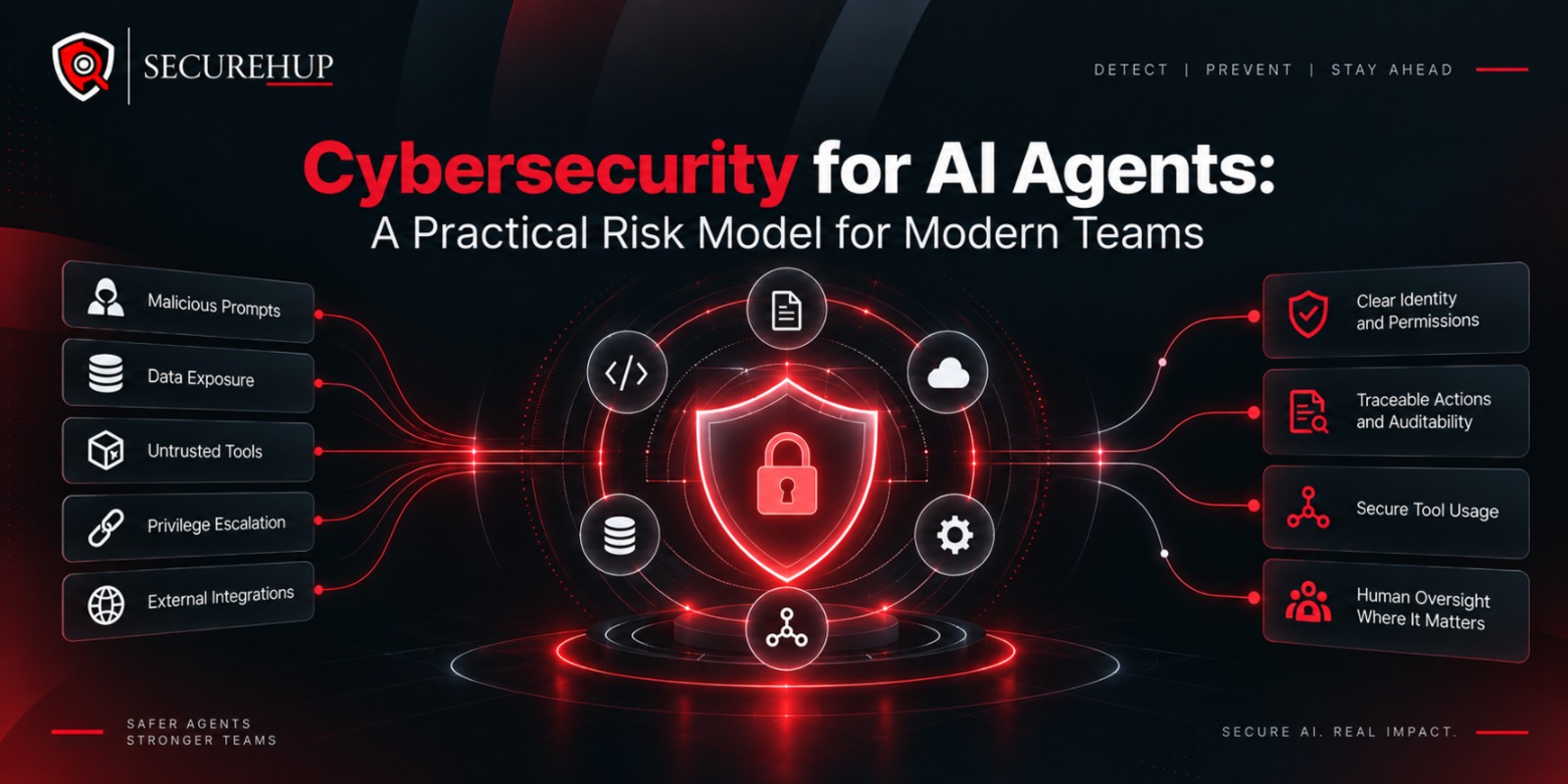
Two teams deploy the same model. One uses it to summarize public documentation without tools. The other lets it read customer contracts, create support cases, and email external recipients under a shared service identity. A model-level safety label cannot describe the difference between those systems; their capabilities, data, users, and failure consequences are different.
A practical risk review begins with what the deployed agent can cause. Which identities does it use? What data can it retrieve? Which tools create durable effects? Can untrusted content influence planning? Who can invoke it, approve it, stop it, and reconstruct its actions? These answers support an engineering decision in a way that a generic request to "use AI carefully" does not.
The model in this article scores seven dimensions so teams can compare agents and attach required controls to each risk tier. It is deliberately about the system around the model. A low-authority internal assistant and a public agent with payment tools should not enter production through the same review path.
Key Takeaways
- AI agent risk should be assessed by what the agent can do, not only by which model it uses.
- The most important dimensions are autonomy, data sensitivity, tool authority, identity model, external exposure, user population, and auditability.
- Low-risk agents can move quickly when they are read-only, scoped, and well logged.
- High-risk agents need human approval, tool-level policy, dedicated identities, rollback plans, and incident response procedures.
- A scoring model helps product, security, and business teams discuss risk consistently.
- Risk should be reassessed whenever tools, data access, autonomy, or user population changes.
Why AI Agent Risk Needs Its Own Model
Traditional application risk models are still useful, but they do not fully capture agent behavior. A normal application executes predefined logic. An agent can interpret a goal, select tools, use retrieved content, adapt to context, and produce different action paths. That flexibility is the reason agents are useful. It is also the reason they require a different review.
The risk is not only malicious behavior. It can be excessive helpfulness, misplaced confidence, unclear authority, or unsafe interpretation of untrusted content. An agent may summarize a document incorrectly, retrieve sensitive data unnecessarily, call the wrong tool, expose internal information in a response, or take a step that technically fits the prompt but violates business policy.
Security teams need a model that captures these realities without blocking every agent. The model should help answer:
- Does the agent only advise, or can it act?
- Can it access sensitive data?
- Can it communicate externally?
- Does it use a dedicated identity?
- Are tool calls constrained?
- Can humans review high-impact actions?
- Can we reconstruct what happened?
- Can we shut it down quickly?
If those answers are unclear, the agent is not ready for broad deployment.
The Seven Dimensions of AI Agent Risk
A practical risk model should cover seven dimensions.
1. Autonomy
Autonomy measures how much the agent can do without human approval. A read-only assistant that suggests next steps has lower risk than an agent that executes a multi-step workflow on its own.
Autonomy levels can be defined as:
- Suggest only: the agent provides recommendations.
- Draft with review: the agent prepares content or actions for human approval.
- Execute approved steps: the agent performs predefined actions after approval.
- Execute within policy: the agent acts automatically within strict rules.
- Full workflow autonomy: the agent plans and executes multiple steps with limited supervision.
Risk rises as the agent moves from suggestion to execution.
2. Data Sensitivity
Data sensitivity measures what the agent can see and process. Public information is different from customer records, employee data, security logs, vulnerability reports, secrets, source code, or regulated data.
The key question is not only whether the agent can access sensitive data. It is whether that data can appear in prompts, memory, tool parameters, logs, outputs, or external messages. Data can leak through many surfaces.
3. Tool Authority
Tool authority measures what the agent can do through integrations. A search tool is different from an email sender. A ticket writer is different from a cloud admin API. A code execution tool is different from a documentation retriever.
The more a tool changes the environment, the stronger the control should be. Tools that write, delete, approve, send, execute, or modify access should be treated as high impact.
4. Identity Model
Agents need accountable identities. If the agent shares credentials, impersonates users silently, or uses broad service accounts, risk increases. If the agent has a dedicated identity, scoped permissions, lifecycle management, and clear ownership, risk is easier to manage.
Identity design should also show whether the agent acts as itself, on behalf of a user, or after a named human approval.
5. External Exposure
Some agents only serve internal users. Others interact with customers, vendors, public websites, email, chat platforms, or external APIs. External exposure increases the chance of hostile input, data leakage, reputational harm, and abuse.
An externally exposed agent needs stronger abuse detection, content filtering, rate limits, and monitoring.
6. User Population
An agent used by five trained analysts is different from one available to every employee or customer. Larger and less trained user populations create more misuse, accidental disclosure, prompt injection attempts, and unexpected workflows.
User population also affects support and incident response. If an agent fails, how many users are impacted?
7. Auditability
Auditability measures whether the organization can reconstruct agent behavior. Can we see the request, context, data retrieved, tools offered, tools called, approvals, outputs, and final changes? If not, risk is higher because incidents become hard to investigate.
For high-impact agents, auditability is not optional. It is the foundation of trust.
AI Agent Risk Model Table
| Risk Dimension | Low Risk | Medium Risk | High Risk |
|---|---|---|---|
| Autonomy | Suggests only | Drafts or executes approved steps | Executes multi-step workflows without review |
| Data sensitivity | Public or low-risk internal data | Confidential business data | Regulated data, secrets, security logs, customer records |
| Tool authority | Search and summarize | Create tickets or update internal records | Send externally, change access, run code, modify systems |
| Identity model | Dedicated identity, scoped access | Mixed user and agent context | Shared credentials or broad service account |
| External exposure | Internal trained users | Broad employee access | Customer/public/vendor-facing |
| User population | Small expert group | Department-level usage | Enterprise-wide or public usage |
| Auditability | Full trace of prompts, tools, approvals | Partial logs | Limited or no reconstruction possible |
This table creates a shared vocabulary. Product teams can understand why security asks for certain controls. Security teams can explain risk without relying on vague concern.
Scoring Matrix for Deployment Decisions
Teams can score each dimension from 1 to 3:
- 1 = low risk
- 2 = medium risk
- 3 = high risk
| Total Score | Deployment Guidance | Required Controls |
|---|---|---|
| 7-10 | Low-risk pilot | Basic logging, owner, scoped access, usage monitoring. |
| 11-15 | Controlled deployment | Access review, tool policy, approval for sensitive actions, periodic testing. |
| 16-19 | High-risk workflow | Dedicated identity, strong audit, human approval, rollback plan, incident playbook. |
| 20-21 | Restricted or executive-approved | Security architecture review, red-team testing, legal/privacy review, kill switch, continuous monitoring. |
The score should not be used blindly. A single critical issue, such as code execution against production systems, may require high-risk controls even if the total score is moderate.
Example: Comparing Three Agents
Consider three common agents.
A policy assistant answers employee questions using approved internal security policies. It has read-only access to a limited document set and no external communication. This is likely low risk if access and logging are handled correctly.
A SOC triage assistant reads security alerts, identity logs, and EDR context, then drafts incident notes. It touches sensitive security data but does not execute containment. This is medium risk. It needs stronger access control, data handling rules, and audit trails.
A cloud remediation agent identifies misconfigurations and can change infrastructure settings. This is high risk. It needs dedicated identity, change approval, test environments, rollback, strict tool policy, and incident response integration.
The same model can evaluate all three without pretending they are equivalent.
Controls by Risk Level
Low-risk agents should still have owners, scoped data, basic logs, user feedback, and monitoring for misuse. Low risk does not mean no governance.
Medium-risk agents need stronger controls: access reviews, data minimization, tool allowlists, human review for outputs, and periodic testing against prompt injection and data leakage.
High-risk agents need production-grade governance. That includes dedicated identities, least privilege, approval workflows, session recording or detailed audit trails, rollback procedures, kill switches, and incident response playbooks.
Restricted agents require executive-level decisions. If an agent can run code, modify access, communicate externally, act across multiple systems, or process regulated data at scale, it should not be approved through informal review.
Risk Changes Over Time
Agent risk is not static. A low-risk agent can become high risk when someone adds a new tool, connects a new data source, expands the user base, enables memory, or removes human approval.
Security teams should require reassessment when:
- New tools are added.
- Write access is introduced.
- External communication is enabled.
- Sensitive data sources are connected.
- User population expands.
- Memory or long-term context is enabled.
- The model or orchestration layer changes.
- The agent moves from pilot to production.
This prevents risk drift. It also gives product teams a clear path for growth.
Using the Model in Review Meetings
The risk model is most useful when it becomes part of a review conversation, not a spreadsheet stored after approval. Product, security, privacy, legal, and operations teams should walk through the seven dimensions together. The discussion should focus on evidence: which tools are connected, which data classes are accessible, which users are in scope, what the agent can change, and what logs will exist if something goes wrong.
The review should produce a decision in plain language. Approved as low risk. Approved with conditions. Approved only for pilot. Blocked until tool access is reduced. Escalated for executive approval. This keeps governance understandable and prevents the process from becoming a vague security objection.
The model also helps after deployment. If the team wants to add a new integration, enable memory, expand to more users, or remove human approval, the same dimensions can be rescored. That makes growth predictable. Teams know which change moves the agent into a higher risk tier and which control is needed before that change goes live.
Walk One Workflow Through the Model
Consider an agent that investigates suspicious access and can suspend an account. Its input includes an alert, identity records, recent sign-ins, and notes retrieved from a case system. Its output is not merely text; one tool call can deny a real employee access. The risk review should therefore follow the exact path from alert creation to account state.
First, label which inputs are authoritative and which an attacker might influence. Next, bind every lookup and proposed action to the same tenant and principal. Give the investigation tools read-only credentials, then place suspension behind a separately scoped executor and explicit approval. Set a maximum number of accounts per run, require fresh state before execution, and record both the evidence and policy decision. Finally, test a forged alert, stale asset data, a cross-tenant identifier, a tool timeout, and a duplicate retry.
This exercise produces a concrete risk statement. Instead of saying the model may hallucinate, the team can say which untrusted input could steer which capability, what control interrupts that path, and what evidence would prove the protected account state remained unchanged.
FAQ
What is an AI agent risk model?
An AI agent risk model is a structured way to assess how risky an agent is based on autonomy, data access, tool authority, identity design, external exposure, user population, and auditability. It helps teams choose the right controls before deployment.
Why is model choice not enough for risk assessment?
The model matters, but agent risk depends heavily on what the system can access and do. A strong model with dangerous tool access can create more risk than a weaker model with read-only access and tight controls.
How often should AI agent risk be reassessed?
Risk should be reassessed whenever tools, permissions, data sources, autonomy, user population, memory, or deployment scope changes. Periodic reviews should also be scheduled for production agents.
What makes an AI agent high risk?
High-risk agents can access sensitive data, execute actions, communicate externally, modify systems, use broad credentials, operate with limited human review, or lack audit trails. Any one of these can raise risk significantly.
Can a risk model speed up AI adoption?
Yes. A clear model speeds adoption because teams know what controls are required at each risk level. It replaces vague approval friction with predictable governance.
A Risk Score Matters Only When It Changes Access
The seven dimensions are most useful while an agent still has narrow permissions and the team can adjust its design without disrupting an established workflow. The evidence behind each score can then inform identity, data, tool, approval, logging, testing, and shutdown controls, with a named owner accepting what remains. Without that connection, the number is descriptive but not especially protective.
We also treat a material change to the model, prompt source, user population, data class, tool set, autonomy, exposure, or execution identity as a reason to revisit the assessment. The aim is not to slow every experiment. It is to make low-impact uses easier to recognize and prevent a once-small pilot from inheriting broad authority without a fresh look at its consequences.
#AISecurity #AgenticAI #CyberSecurity #RiskManagement #ZeroTrust #IdentitySecurity #AIGovernance
Find issues like this in your own codebase
SecureHup runs this exact exploit chain — discovery, enumeration and cross-tenant validation — on every deployment, automatically.