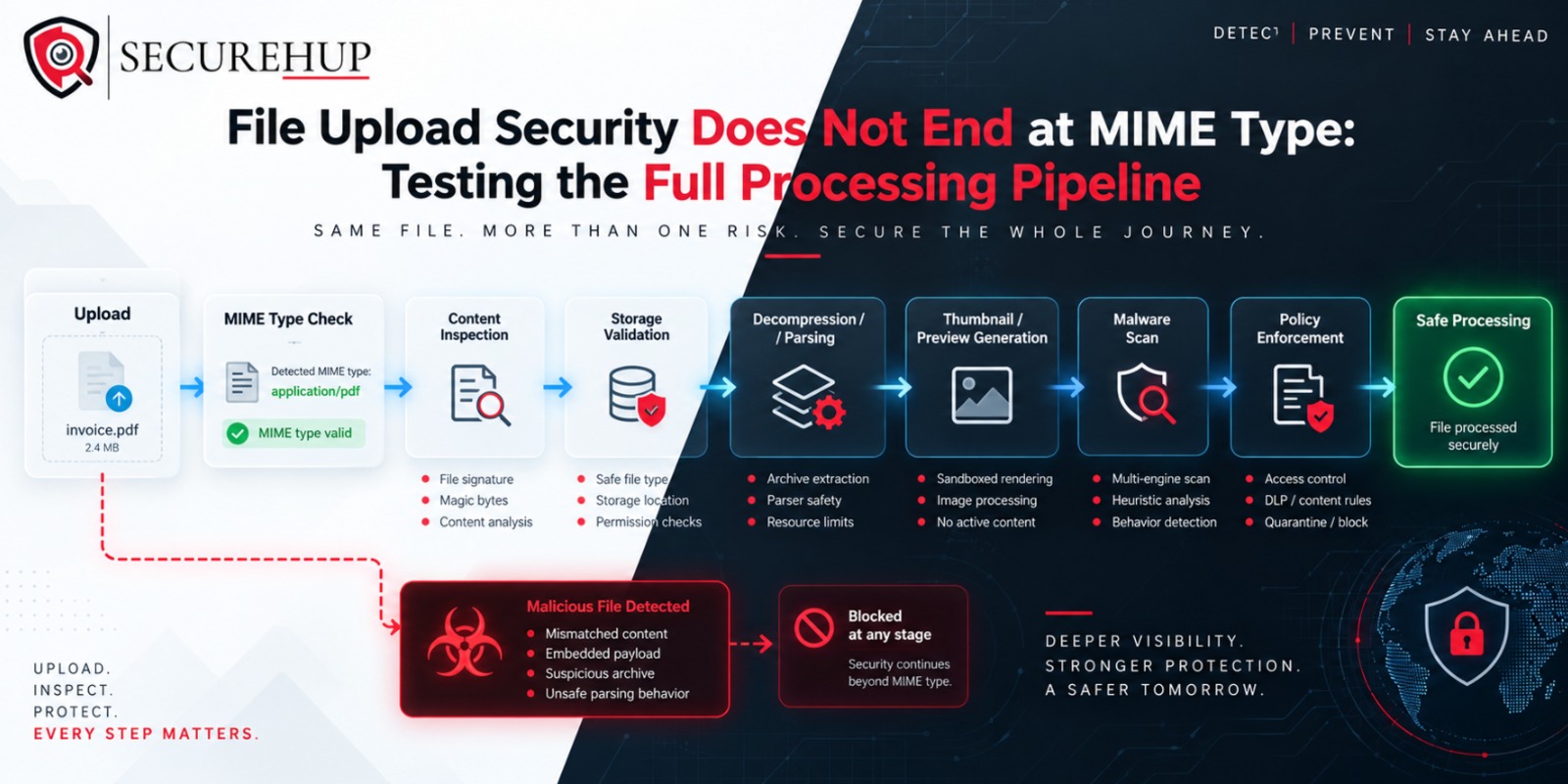
An upload endpoint accepts profile.png after checking the extension, declared content type, and leading bytes. Minutes later, a thumbnail worker uses a different parser, the original is stored under user-controlled metadata, and a preview route serves it to a browser with an active content type. The ingress check passed; three downstream interpretations changed what the file could do.
An uploaded file is not one typed field. It is attacker-controlled bytes plus metadata moving through proxy buffering, framework parsing, malware scanning, media conversion, AI indexing, object storage, signed delivery, browser rendering, retention, and deletion. Each stage may select another parser or authority.
The allowed purpose provides a reference for following an artifact to its final effects. Quarantine, parser isolation, evidence-based promotion, tenant ownership across derivatives, resource budgets, and safe delivery each protect a different stage. Autonomous coverage can exercise them with a controlled inert corpus inside disposable processing environments.
Key Takeaways
- Client-supplied MIME type and filename are untrusted claims; server-side content detection is useful corroboration, not a complete safety verdict.
- File policy should be defined by business purpose and downstream consumers, with an allowlist for formats, size, structure, transformations, and permitted delivery behavior.
- New uploads should enter quarantine and become available only after every required validation and transformation succeeds under a least-privileged worker.
- Storage keys, tenant ownership, retrieval authorization, response headers, and serving origin are part of upload security, not separate operational details.
- Size limits must cover request bytes, decoded or transformed size, parser time, page or frame count, memory, recursion, and downstream cost.
- Autonomous testing should trace one synthetic artifact across ingress, processing, storage, and delivery while using independent evidence to prove whether execution, disclosure, overwrite, or cross-tenant access occurred.
A File Has More Than One Identity
An uploaded object can be described by several values:
- The multipart field name.
- The client-provided filename.
- The client-provided
Content-Type. - The extension after normalization.
- The content signature or magic bytes.
- The type inferred by a parser.
- The type produced after conversion.
- The storage key and stored metadata.
- The response
Content-TypeandContent-Disposition. - The behavior chosen by the browser or desktop application.
These identities can disagree. An attacker controls several of them directly and may influence the rest through ambiguous or polyglot content. Security code often compares only two signals and assumes agreement means safety. Agreement merely increases confidence that a file resembles an expected format at one point in time.
The stronger question is:
Is this object permitted for this business purpose, and can every authorized
consumer process or deliver it without crossing a protected boundary?
That question includes parser behavior, tenant ownership, storage and browser interpretation. It cannot be answered at the HTTP controller alone.
Model the Complete Lifecycle
A practical upload threat model follows the object through its states.
| Stage | Trust question | Typical failure | Required evidence |
|---|---|---|---|
| Route admission | May this principal upload for this tenant and object? | Public or cross-tenant upload | Auth decision and owner binding |
| Ingress | Can the service receive the body within limits? | Memory, disk, or connection exhaustion | Bounded byte and time counters |
| Metadata normalization | Are names and types interpreted once and consistently? | Double extension, control characters, header ambiguity | Canonical server metadata |
| Content validation | Does content satisfy the allowed format contract? | MIME spoofing or malformed structure | Detector and parser results |
| Processing | Can transformation occur without escaping worker boundaries? | Parser exploit, external fetch, command execution | Sandbox telemetry and egress log |
| Promotion | Did every required control succeed before availability? | Fail-open release from quarantine | Signed processing state transition |
| Storage | Is the object isolated, non-executable, and immutable as intended? | Path overwrite or tenant collision | Generated key, policy, and digest |
| Retrieval | Is each read authorized for the owning tenant and current state? | IDOR or expired-link access | Principal-object decision |
| Delivery | Will clients interpret the response safely? | Stored XSS, content sniffing, inline execution | Response headers and isolated origin |
| Retention | Is deletion complete across derivatives, caches, and indexes? | Residual sensitive content | Tombstone and downstream deletion record |
This lifecycle also shows why an endpoint-only scanner misses meaningful risk. The unsafe behavior may occur minutes later in a queue consumer or only when another user downloads the file.
Start With a Purpose-Specific Contract
"Allow images" is not a sufficient policy. An avatar upload, radiology image, design asset, and identity document have different format, privacy, processing, and delivery requirements.
A useful contract states:
- Who may upload and on behalf of which tenant or resource.
- Which exact formats are needed, including variants and container features.
- Maximum request size and maximum decoded size.
- Maximum dimensions, pages, frames, objects, recursion, and processing time.
- Whether metadata, scripts, macros, links, fonts, or embedded files are permitted.
- Which transformations must occur before use.
- Which parser versions and sandbox profile process the object.
- Whether the original is retained, who can access it, and for how long.
- Whether delivery is attachment-only or may render inline.
- Which origin, headers, and authorization path serve it.
- What happens when scanning is unavailable or inconclusive.
The smallest format set that meets the feature is usually the safest set. If avatars only need a normalized raster image, accepting vector documents, archives, office files, and arbitrary media creates processing complexity without product value.
Reject Unknown, Do Not Guess
File systems and libraries often try to be helpful. They infer type, repair malformed input, ignore trailing bytes, or choose a parser from an internal header. Security boundaries should be less forgiving. If the normalized extension, detected content, and purpose contract disagree, reject or quarantine the object for a deliberate secondary process. Do not rename arbitrary bytes to an approved extension and assume the conversion happened.
MIME Type Is a Hint Supplied by the Sender
The multipart Content-Type value comes from the client. It is useful for routing and early rejection, but it is trivial to set independently of the bytes. A secure endpoint treats it as one claim among several.
The filename is also untrusted. It can contain multiple extensions, mixed case, Unicode lookalikes, path separators, control characters, reserved names, extremely long segments, or characters that change interpretation in response headers and logs. The server should generate its own opaque storage identifier and retain the original name only as separately encoded display metadata when the feature genuinely needs it.
Magic Bytes Improve Classification, Not Safety
Checking a file signature catches simple MIME spoofing. It does not prove the entire object is valid or inert. Some formats permit comments, scripts, external references, multiple streams, appended data, or nested objects. A file can be acceptable to a lightweight detector and dangerous to a full parser. Different consumers may also prioritize different signatures.
A specialized parser or decoder can validate the expected structure. Where practical, decoding and re-encoding to a restricted canonical representation removes unsupported features, although the image rewriter, document converter, or reconstruction engine becomes an attack surface of its own and belongs in isolation.
Avoid Universal "Safe File" Labels
A file may be safe for storage but unsafe to render inline, safe for one parser version but not another, or safe as an attachment but unsafe for an AI indexer that follows embedded links. Stage-specific decisions preserve those differences:
accepted_at_ingress
validated_as_pdf_profile_A
malware_scan_clear_at_time_T
converted_to_derivative_D
approved_for_attachment_download
not_approved_for_inline_rendering
A single is_safe = true flag erases the consumer and time context needed for reliable decisions.
Quarantine Is a State Machine
New bytes should not immediately become public or available to downstream jobs. An inaccessible quarantine store, server-generated identifier, immutable digest, owner and tenant identity, policy version, and processing state give the artifact a controlled starting point.
A basic lifecycle might be:
received -> bounded -> identified -> parsed -> transformed -> scanned -> approved
                                      \-> rejected
                                      \-> manual_review
Each transition should require explicit evidence. If the scanner times out, parser crashes, conversion returns partial output, or policy service is unavailable, the file remains quarantined. "Could not scan" is not equivalent to "clean."
Prevent Time-of-Check to Time-of-Use Gaps
Validation must apply to the same immutable bytes later processed or served. Compute a cryptographic digest when ingress completes, address or version the object immutably, and verify the digest at each handoff. Do not validate a temporary path and then reopen a mutable user-controlled path for transformation. Do not allow metadata updates to replace the object while preserving an approved status.
If a derivative is created, it receives its own digest, type, policy result, and owner binding. Approval of the source does not automatically approve every generated derivative.
Process Files as Hostile Programs
Parsers are complex. Media codecs, PDF engines, office converters, OCR tools, antivirus engines, archive readers, and AI extractors all consume attacker-controlled structure. Even fully patched software can encounter resource-exhaustion cases or unexpected external references.
Run processing workers with:
- A dedicated non-root identity.
- Read-only application code and minimal filesystem access.
- A fresh per-job workspace.
- No production credentials or cloud instance role.
- Network denied by default, with narrowly approved destinations if essential.
- CPU, memory, process, file descriptor, disk, and wall-clock limits.
- Seccomp, container, sandbox, or equivalent execution restrictions.
- No ability to write directly to the public serving bucket.
- Versioned tools and reproducible policy configuration.
The worker should emit a result artifact; a separate trusted coordinator decides whether to promote it. This separation limits the consequence if the parser is compromised.
External References Are Network Requests
Documents and media can contain URLs, linked images, fonts, imports, schemas, or other references. A processor that resolves them can turn upload into SSRF or data exfiltration. External resolution is safest when absent by default; a feature that genuinely needs it can use a controlled fetcher with destination, DNS, redirect, response, and credential boundaries.
Resource Limits Must Follow Expansion
Request size is only the first budget. A small compressed or highly structured input can produce large decoded output, many pages or frames, deep recursion, excessive CPU, or a costly third-party API call.
Track and cap:
- Compressed and uncompressed bytes.
- Pixel count, dimensions, frame count, and color depth.
- Page, object, node, and embedded-file counts.
- Recursion and nesting depth.
- Parsing, conversion, OCR, and scan duration.
- Temporary disk and final derivative size.
- Number and cost of downstream AI or SaaS operations.
Stop processing when any budget is exceeded and preserve a safe reason code, not the full hostile content, for diagnosis.
Storage Is Part of the Security Boundary
The safest upload directory is not a web-executable directory. Object storage or a separate host with no execution semantics, private access by default, and serving policies independent of uploaded metadata provide a simpler boundary.
Generated storage keys separate object identity from the original filename or user path. An immutable tenant and owner record prevents a global namespace collision from replacing another user's content. Encryption and retention still follow data classification, but encryption at rest does not replace access control.
Public URLs Need Deliberate Design
Making an object unguessable does not make it authorized. Signed URLs are easier to defend when short-lived, scoped to one object and operation, issued after authorization, and invalidated or versioned on ownership or state changes. Long-lived bearer links in logs, analytics, referrers, or public issue trackers work against that model.
If public sharing is a feature, represent it as an explicit share resource with owner, scope, expiry, revocation, and audit state. Do not infer public access from the mere existence of a storage URL.
Delivery Can Turn Stored Bytes Into Active Content
The browser decides what to do with a response using headers, content, context, and sometimes sniffing. A file rejected as executable by the server may still execute in a user's origin if served inline with a dangerous type.
Controls include:
- Serve untrusted content from a separate, cookie-less origin.
- Set a server-controlled
Content-Typebased on approved output, not stored client metadata. - Use
Content-Disposition: attachmentwhen inline rendering is unnecessary. - Set
X-Content-Type-Options: nosniff. - Apply a restrictive content security policy to any unavoidable render surface.
- Encode and sanitize download filenames before placing them in headers.
- Require authorization on every private retrieval, including derivatives and previews.
- Prevent range, cache, and CDN configuration from bypassing current access state.
Transforming an image into a canonical raster derivative and serving only that derivative is often safer than serving the original. The original may still need restricted retention for support or compliance, but it should not inherit the derivative's public status.
Authorization Applies to Upload, Processing, and Readback
Teams frequently protect the upload route but overlook later endpoints. Preview generation, processing-status polling, conversion downloads, share creation, metadata edits, and delete operations all need the same tenant-object binding.
Useful invariants include:
Only an authorized principal can create a file for Tenant A.
The upload identifier cannot choose or overwrite Tenant B storage.
A worker job cannot process an object outside its assigned tenant and policy.
Only approved derivatives can reach the delivery origin.
A private object remains private through preview, range, cache, and signed URL paths.
Deleting an object removes or revokes every derivative and share.
A tenant ID in multipart fields is input rather than trusted ownership context. Ownership should derive from the authenticated principal and server-side resource relationship, with any user-controlled chat, project, or folder reference authorized before the system consumes storage.
Autonomous Testing Must Follow the Artifact
Traditional upload testing often ends when the server accepts or rejects a request. Autonomous validation should maintain an artifact graph:
request -> quarantine object -> processing job -> derivative -> promoted object
        -> metadata row -> preview -> download response -> deletion/tombstone
The agent records identifiers and digests at each edge, then checks that policy and ownership remain consistent.
Build a Safe Test Corpus
Synthetic, non-executable fixtures can expose interpretation differences without carrying real malware or server code. Examples include:
- Valid minimal files for every allowed format.
- Wrong extension with benign content.
- Wrong client MIME with benign content.
- Truncated, oversized, deeply nested, and multi-frame samples within lab limits.
- Files with benign marker data after the expected end.
- Duplicate filename and Unicode-normalization cases.
- Active-content formats containing inert canary references to a controlled domain.
- Metadata values with path, header, and log delimiter edge cases.
- Objects assigned to two synthetic tenants for authorization tests.
Dangerous parser research belongs in a dedicated exploit lab under separate authorization. A routine CI agent should not download arbitrary internet payloads or generate live web shells.
Practical Pipeline Test Matrix
| Test family | Mutation or sequence | Evidence source | Expected invariant |
|---|---|---|---|
| Route authorization | Missing identity, wrong role, wrong tenant resource | Auth decision and storage inventory | No bytes or metadata created |
| Type disagreement | Vary MIME, extension, signature, and parsed structure | Policy decision with reason codes | Only contract-consistent files advance |
| Name handling | Duplicate extensions, control characters, reserved and long names | Generated key and response headers | Client name never controls path or header structure |
| Quarantine | Make scanner or converter fail, timeout, or return inconclusive | State history and serving origin | Object never becomes available |
| TOCTOU | Attempt metadata or object replacement after validation | Digests at every stage | Approved digest remains immutable |
| Processor isolation | Trigger inert network and filesystem canaries | Egress and sandbox telemetry | No forbidden access occurs |
| Resource budgets | Increase dimensions, pages, frames, nesting, or work factor | CPU, memory, disk, and duration counters | Job stops within approved budget |
| Tenant isolation | Swap upload, job, preview, and download identifiers | Both tenants' inventories | No cross-tenant read, write, or processing |
| Delivery | Retrieve approved and rejected objects through all paths | Headers, origin, browser behavior | Only approved content is safely delivered |
| Derivative lineage | Generate preview and conversion outputs | Parent/child digest and policy records | Every derivative has owner and approval state |
| Deletion | Delete source with previews, caches, shares, and jobs present | Tombstones and retrieval attempts | Access ends across the artifact graph |
Separate the Actor From the Oracle
The upload agent should not be able to edit the database rows or bucket policies used to prove the result. A read-only observer can inspect state transitions, object metadata, and canary telemetry. The final decision compares evidence with a reviewed invariant.
An HTTP 201 Created is not automatically a finding; the system may have accepted the object into quarantine. A 415 Unsupported Media Type is not automatically a pass; a temporary object may already be public. The artifact's later state resolves that ambiguity.
Evidence for a Validated Finding
A defensible finding should contain:
- Feature contract and allowed file profile.
- Synthetic principal, tenant, object, and upload identifiers.
- Client metadata plus server-normalized metadata.
- Cryptographic digest at ingress, processing, promotion, and delivery.
- Parser, scanner, and transformer versions and decision codes.
- Quarantine and promotion timeline.
- Storage key, owner binding, policy, and serving origin.
- Sanitized response headers and browser interpretation.
- Protected effect such as cross-tenant read, unauthorized promotion, overwrite, active rendering, or forbidden egress.
- Root-cause code and a regression fixture.
An unsafe file attached to a broadly accessible ticket creates unnecessary exposure. A restricted evidence system can hold the artifact while developer workflow receives inert reproductions and digests.
Integrating Tests Into CI and Continuous Validation
Cheap deterministic controls suit every relevant change:
- Configuration and route-authorization tests.
- Allowed-format contract unit tests.
- Raw-body, metadata, and filename normalization cases.
- Quarantine fail-closed tests.
- Storage key and tenant-binding tests.
- Delivery-header assertions.
Parser-heavy, browser, resource, and concurrency suites fit isolated scheduled or pre-release environments. Changes to upload routes, multipart middleware, file policy, parsers, converters, worker images, storage policy, CDN behavior, authorization, or download handling can trigger focused replay.
Every verified finding should become a versioned fixture with the expected stage, decision, and protected effect. Re-running only the endpoint request is insufficient if the original failure occurred during delayed processing or delivery.
Operational Metrics That Reveal Control Health
Useful metrics include:
- Uploads rejected by policy dimension, without retaining sensitive content.
- Percentage and age of objects remaining in quarantine.
- Processor timeout, crash, and resource-limit rates.
- Promotion attempts without complete evidence.
- Objects or derivatives missing tenant, digest, or policy version.
- Private retrieval denials and signed-link issuance rates.
- Scanner or converter version drift across workers.
- Mean time to revoke all derivatives after source deletion.
- Autonomous replay execution success and test-corpus coverage by allowed format.
Do not optimize for the number of files scanned. The useful outcome is that every available object has a traceable owner, immutable lineage, approved consumer profile, and enforceable delivery policy.
Incident Response for an Upload Control Failure
When a file validation or processing flaw is discovered, patching the route is only the beginning.
- Identify every entry point, including APIs, mobile endpoints, imports, support tools, and direct-to-storage flows.
- Determine which policy, parser, worker, storage, and delivery versions handled existing objects.
- Freeze promotion if safety cannot be established without making private content public or deleting evidence.
- Search stored originals and derivatives using metadata, digests, decision versions, and safe detection rules.
- Reprocess or quarantine affected content under the corrected policy.
- Revoke public links, purge caches, and invalidate previews where needed.
- Rotate credentials if a processing worker may have been compromised.
- Convert the exact pipeline failure into a durable regression test.
An endpoint patch does not neutralize already promoted files. The response scope follows the artifact graph.
FAQ
Is checking magic bytes enough to validate an upload?
No. It catches some simple type spoofing, but formats can contain active features, appended data, nested objects, or structures interpreted differently downstream. A purpose-specific structural validator and, where practical, canonical conversion in an isolated worker cover more of that behavior.
Should uploaded files always be renamed?
A server-generated opaque key keeps storage identity independent of the filename. The original name may remain encoded display metadata, but it should not choose a path, object key, response-header structure, or authorization decision.
Can antivirus make arbitrary file uploads safe?
No. Malware scanning is one signal. It does not enforce tenant authorization, stop parser vulnerabilities, prevent stored active content, control resource exhaustion, or guarantee safe browser delivery. A scan timeout must also fail closed rather than silently promote the object.
Is storing uploads in object storage sufficient isolation?
Not by itself. Bucket policy, key generation, tenant binding, public access, metadata, signed URLs, CDN caching, and response headers determine whether the object remains isolated. Processing workers also need separate least-privileged access.
How can autonomous agents test uploads without creating dangerous payloads?
A curated synthetic corpus with inert markers, interpretation mismatches, bounded resource cases, controlled canary URLs, and synthetic tenants can reveal quarantine, parser, storage, authorization, and delivery behavior. Real exploit research belongs in a separately authorized sandbox.
File Authority Changes at Every Derivative
Quarantine, scanners, processors, derived files, storage keys, previews, downloads, caches, exports, and deletion form one lifecycle even when different teams operate them. An explicit state, parser, identity, budget, owner, and promotion rule at each stage makes it harder for a failed artifact to become public through a later consumer.
An inert fixture set can vary type signals, names, structure, timing, ownership, and resource cost while each derivative is inspected independently. We would keep any parser disagreement or lifecycle escape as a regression. The enduring property is that the artifact never gains more behavior, reach, or ownership than the feature's declared purpose allows.
#ApplicationSecurity #FileUploadSecurity #SecureCoding #AutonomousPentesting #ContentValidation #CloudStorageSecurity #DevSecOps
Find issues like this in your own codebase
SecureHup runs this exact exploit chain — discovery, enumeration and cross-tenant validation — on every deployment, automatically.