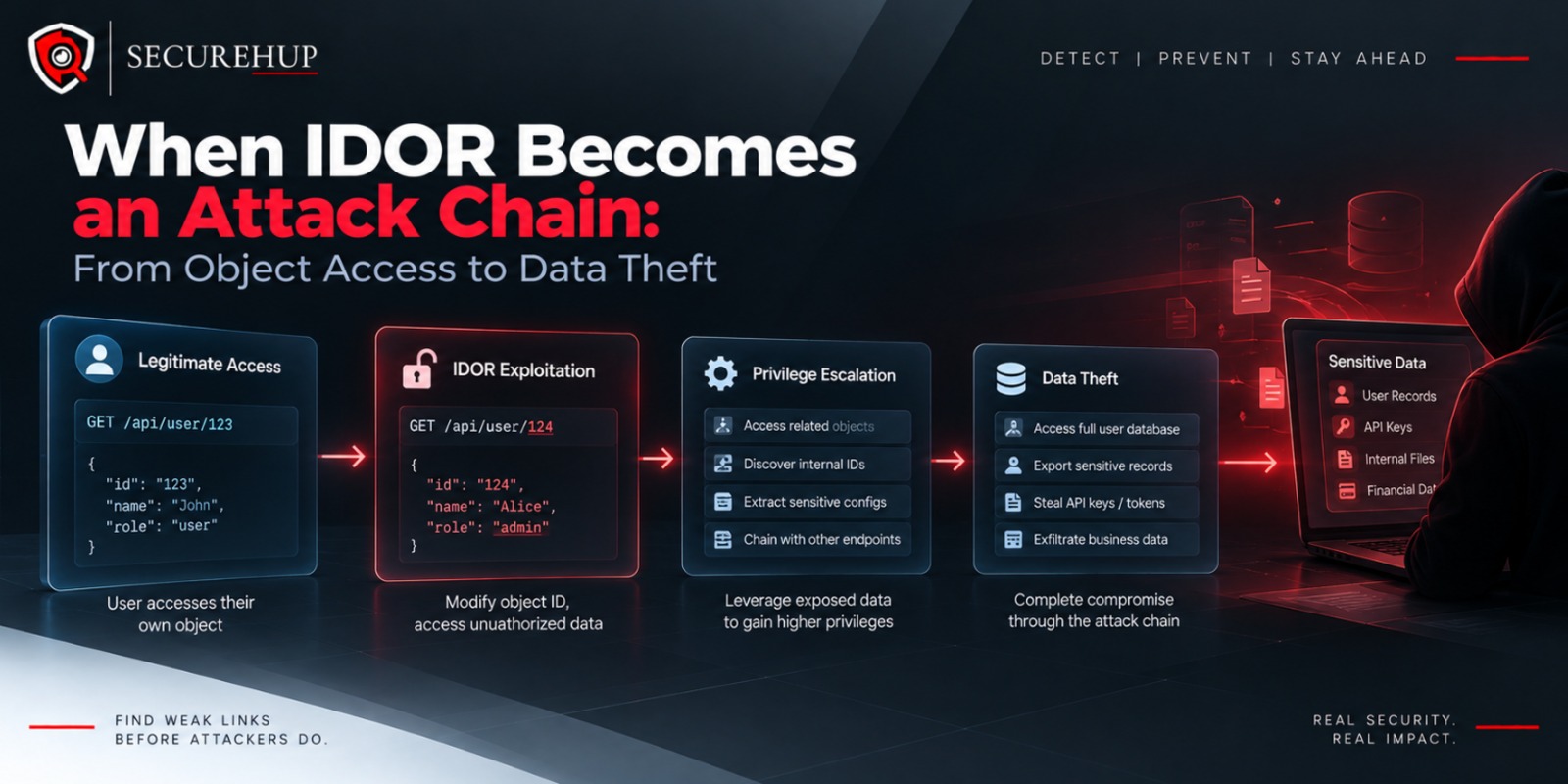
A user replaces one invoice ID and receives another customer's record. The response also reveals account and project identifiers. A related export endpoint accepts those identifiers in bulk, a background job creates the file, and the download route trusts job ownership rather than the source objects. One missing object check has become a repeatable collection path.
That blast radius depends on the surrounding application: identifier discovery, tenant binding, excessive fields, relationship traversal, export and search APIs, rate limits, job authorization, and useful audit events. Treating the first response as the complete finding can understate both impact and remediation scope.
An authorized assessment should expand the chain only with synthetic tenants and bounded records. The objective is to identify which control transitions amplify the primitive, how much data the designed workflow could expose, and where durable evidence should appear. It is not to enumerate real customer objects.
Key Takeaways
- IDOR and broken object-level authorization issues should be assessed as attack paths, not just isolated parameter tampering bugs.
- The highest impact appears when object access combines with enumeration, weak tenant boundaries, bulk APIs, exports, excessive response fields, or missing rate limits.
- Severity should be based on proven blast radius: what objects are reachable, which users or tenants are affected, what data is exposed, and whether the abuse can scale.
- Safe proof matters. Teams should validate impact with test accounts, synthetic tenants, limited samples, metadata, and replayable request sequences rather than copying real customer data.
- Strong remediation requires object-level authorization, tenant binding, centralized policy enforcement, response minimization, audit logging, and regression tests for the original attack chain.
Why IDOR Is Usually Underestimated
IDOR is easy to explain, which sometimes makes it easy to underestimate. The classic example is simple: a user changes invoice_id=1001 to invoice_id=1002 and receives another user's invoice. Because the bug looks small, teams may treat it as a narrow endpoint issue. Add an ownership check, close the ticket, move on.
That fix may be correct for the immediate bug, but the risk model is often incomplete. Object access issues rarely appear alone. If one endpoint trusts a client-supplied identifier without verifying ownership, similar patterns may exist in related endpoints: downloads, exports, previews, mobile APIs, admin views, search filters, background jobs, webhooks, and legacy routes. The first bug may be the visible edge of a broader authorization design problem.
Another reason IDOR is underestimated is that the first proof often shows only one object. A tester may demonstrate access to one document, one profile, one order, or one report. That proves the bug exists, but it does not prove the full impact. The real question is scale. Can the attacker enumerate IDs? Are IDs sequential? Can search or filter endpoints reveal valid object references? Can the object be downloaded in bulk? Does the response contain more fields than the UI displays? Can a lower-privileged user cross tenant boundaries?
When these answers are unfavorable, the issue is no longer "one object returned incorrectly." It becomes unauthorized data collection.
IDOR, BOLA, and the API Reality
Modern applications are API-heavy. Web clients, mobile apps, partner integrations, internal tools, background workers, and customer automation all rely on APIs. That architecture increases the importance of object-level authorization because objects are constantly referenced by identifiers: user IDs, organization IDs, report IDs, invoice IDs, project IDs, file IDs, ticket IDs, payment IDs, and message IDs.
APIs often expose the real structure of the application more directly than the UI. A button may be hidden, but the API route may still exist. A table may show only the current user's records, but the endpoint may accept any object ID. A frontend may filter by tenant, but the backend may trust a tenant ID submitted by the client. A mobile app may call endpoints that are not visible in the browser interface. A partner API may include fields never shown to normal users.
This is why object-level authorization must live server-side and close to the data access decision. Authentication answers "who is this user?" It does not answer "can this user perform this action on this object in this tenant under this state?" That second question is the core of IDOR prevention.
The API reality also changes how attackers work. They do not need to click through the UI. They inspect requests, identify object references, change them, replay them, automate them, and combine them with other endpoints. A single permissive endpoint can become the discovery mechanism for the next stage of the chain.
The Attack Chain Pattern
An IDOR-driven data exfiltration chain usually develops in stages. Not every chain includes every stage, but the pattern is common enough to be useful.
| Stage | What the attacker does | Control that should stop it | Why the chain grows |
|---|---|---|---|
| 1. Find object reference | Observes IDs in URLs, API bodies, mobile traffic, exports, logs, or frontend state | Minimize exposed identifiers and avoid trusting client-supplied object references | The application reveals how objects are addressed |
| 2. Test object access | Replaces the ID with another valid-looking ID | Server-side object ownership and action authorization | Endpoint checks login but not ownership |
| 3. Discover valid IDs | Uses sequential IDs, search results, leaked references, pagination, or error differences | Non-enumerable references, consistent errors, rate limits, access-controlled search | The attacker learns which objects exist |
| 4. Expand scope | Tries related endpoints such as download, export, preview, audit, invoice, attachment, or admin routes | Centralized policy enforcement across every data path | Some endpoints enforce policy, others do not |
| 5. Increase data value | Finds responses with hidden fields, metadata, tokens, emails, financial data, or internal notes | Response minimization and field-level authorization | APIs return more than the UI needs |
| 6. Automate collection | Scripts requests across IDs, tenants, pages, filters, or export jobs | Rate limits, anomaly detection, audit logs, job-level authorization | Abuse scales from one object to many |
| 7. Persist or pivot | Uses exposed data to access more accounts, reset workflows, target users, or abuse integrations | Monitoring, token protection, strong workflow controls | Data exposure becomes a stepping stone |
This table matters because it changes how we triage. A single successful object swap is serious. A repeatable chain that discovers IDs, expands across endpoints, exposes sensitive fields, and scales through automation is materially more severe.
A Practical Example: From One Invoice to Tenant-Wide Exposure
Imagine a SaaS billing portal. Each customer belongs to a tenant. Billing admins can view invoices. Normal users can view their own subscription summary but should not see invoices for other tenants. The UI works correctly: normal users do not see invoice links.
The API has a route:
GET /api/invoices/{invoice_id}
The endpoint checks that the user is authenticated. It does not verify that the invoice belongs to the user's tenant or that the user's role allows invoice access. A tester changes the ID and receives another tenant's invoice. That is the initial IDOR.
Now the chain expands.
First, invoice IDs are sequential. The attacker can infer nearby IDs. Second, the response includes customer name, billing email, address, tax details, plan, amount, payment status, and internal account ID. Third, a related endpoint downloads PDF invoices:
GET /api/invoices/{invoice_id}/pdf
It uses different controller logic and also lacks tenant authorization. Fourth, a search endpoint leaks invoice IDs through autocomplete when the attacker changes a date range. Fifth, there is no rate limit on invoice retrieval. Sixth, audit logs record the route but do not include tenant mismatch, object owner, or actor role, making detection difficult.
The original bug is not only "invoice ID can be changed." The real impact is that a low-privilege user can enumerate invoices across tenants, download PDF copies, collect billing metadata, and do it quietly enough that normal logs may not reveal the boundary violation.
That is data exfiltration, even if the attacker never uses malware, never bypasses login, and never sends a malicious payload.
Blast Radius Questions That Change Severity
Severity should not be assigned only by endpoint name or scanner label. It should be assigned by blast radius.
Important questions include:
- What data is exposed: public metadata, internal notes, financial data, personal data, credentials, tokens, documents, messages, health data, or regulated records?
- How many objects are reachable: one, a few, a tenant, all tenants, all users, historical archives?
- Can the attacker discover valid object IDs without prior knowledge?
- Are identifiers sequential, guessable, leaked in responses, or visible in client state?
- Does the bug work across tenants, roles, organizations, regions, or environments?
- Are there bulk, export, report, or attachment endpoints that amplify the issue?
- Does the response include fields the UI does not display?
- Can the attacker automate the behavior without rate limits or detection?
- Can exposed data enable further compromise, such as account takeover, targeted phishing, API token misuse, or support impersonation?
- Is there evidence in logs to detect abuse after the fact?
These questions help teams avoid two common mistakes: under-prioritizing a "medium" object access bug that can expose a full tenant, and over-prioritizing a theoretical issue with no reachable data or realistic path.
Safe Proof Without Copying Sensitive Data
Proving impact does not require collecting large amounts of real user data. In fact, a mature process should avoid that. The goal is to demonstrate exploitability and blast radius safely.
Good proof techniques include:
- Use two or more test accounts with different roles and tenants.
- Seed synthetic objects that look structurally similar to real records but contain non-sensitive data.
- Demonstrate unauthorized access to metadata rather than downloading full sensitive content when possible.
- Capture request and response structure, status codes, object ownership mismatch, and field names without storing sensitive values.
- Limit enumeration tests to a small controlled range.
- Use canary objects created specifically for validation.
- Record the exact request sequence and preconditions.
- Stop testing once impact is proven and scope is clear.
- Note what was not tested because it would risk touching customer data.
This evidence is usually enough for engineering. It shows the unauthorized path, the affected control, the likely blast radius, and the fix validation method. It also reduces the risk that security testing creates an avoidable privacy problem.
Where IDOR Hides
IDOR rarely lives only in obvious detail pages. It often hides in secondary data paths.
Download endpoints are common. The UI may show a document only to the owner, but the download route may accept a file ID directly. PDF generation, CSV export, image preview, attachment download, and signed URL generation all deserve object-level checks.
Search and filter endpoints are another hotspot. A list API may enforce tenant scope, but a search API may accept organization_id, user_id, or project_id from the client. If the backend trusts those filters, attackers can discover object IDs or retrieve unauthorized rows.
Background jobs create another risk. A user may create an export job for an object they should not access, then retrieve the result later. The job creation endpoint may check authorization, but the result download endpoint may not. Or authorization may be checked when the job is queued but not when it executes.
Mobile and partner APIs can be overlooked because they are not always tested as deeply as web routes. They may expose legacy fields, older authorization logic, or endpoints built for convenience before the permission model matured.
Administrative and support tools are also risky. A lower-level support role may receive object access intended for senior operators. Internal tools often grow quickly, and authorization assumptions can lag behind role complexity.
Remediation Patterns That Actually Work
The core fix is simple to state: verify that the current actor is allowed to perform the requested action on the requested object. In practice, durable remediation requires several patterns.
Object-level authorization should be mandatory in the service or policy layer, not scattered as optional controller logic. If each endpoint remembers to check ownership manually, some will forget. A centralized policy function or guard can reduce drift.
Tenant binding should be explicit. In multi-tenant systems, access should bind user, tenant, object, and action together. It is not enough to check that the user belongs to a tenant if the object belongs to another tenant. Queries should include tenant constraints derived from trusted server-side session context, not client-supplied tenant IDs.
Response minimization should reduce impact. APIs should not return fields the caller does not need. If a normal user only needs invoice status and amount, the response should not include internal account IDs, tax identifiers, support notes, or billing contact details.
Bulk and export endpoints need the same policy enforcement as detail endpoints. Export is often more dangerous because it turns one authorization miss into large-scale data collection.
Rate limits and anomaly detection should reduce abuse scale. They do not replace authorization, but they help detect and slow enumeration.
Audit logs should capture actor, role, tenant, object, action, decision, and denial reason. If a cross-tenant access attempt occurs, logs should make the boundary violation visible.
Regression tests should replay the original attack. A fix that cannot be tested is fragile. If the bug involved two tenants and an invoice export, the regression test should keep that exact abuse case forbidden.
Designing IDOR Out of the System
The best time to prevent IDOR is before endpoints are built. Retrofitting ownership checks after the application has hundreds of routes is harder than making authorization a design requirement from the beginning.
Start with a clear object model. Every sensitive object should have an owner, tenant, classification, and allowed actions. If the team cannot answer who owns an object, who can read it, who can modify it, who can export it, and who can delegate access, the implementation will likely become inconsistent. This is especially important for objects that move between states, such as tickets, invoices, approvals, shared folders, and support cases.
Next, make authorization part of the data access pattern. Developers should not need to remember a custom check on every route. Safer patterns include repository methods that require actor context, policy guards that wrap object retrieval, service methods that accept tenant-bound identifiers, and tests that fail when a sensitive object is fetched without authorization context. The goal is to make the secure path the easiest path.
Design should also avoid unnecessary direct references. This does not mean hiding IDs as the only defense. It means reducing the number of places where raw object references travel through clients, logs, URLs, and exports. When references must be exposed, the server should still treat them as untrusted input and re-check access on every action.
Finally, design reviews should include abuse cases. For every new object type or endpoint, ask how the wrong user, wrong role, wrong tenant, wrong state, or wrong workflow step could reach it. These questions are much cheaper during design than after data exposure has been proven.
Detection and Investigation Readiness
Even strong authorization programs should assume someone will attempt object access abuse. Detection matters because IDOR can be quiet. Requests often look authenticated, syntactically valid, and normal at the HTTP layer. Without the right log fields, abuse may blend into ordinary API traffic.
Useful telemetry includes actor ID, role, tenant, source IP, session or token type, requested object ID, object owner, object tenant, action, authorization decision, denial reason, response size, and whether the request used an export or bulk path. For privacy reasons, logs should not collect unnecessary sensitive data, but they should capture enough metadata to identify boundary violations.
Investigation readiness also requires correlation. A single denied request may be harmless. Hundreds of object lookups across different tenants, many 404 or 403 responses followed by a 200, or repeated export attempts from a role that rarely exports data are stronger signals. Security teams should be able to ask: did one actor touch objects outside their tenant, did response volume spike, did the user enumerate IDs, and did any successful access follow failed attempts?
Good detection does not replace prevention, but it reduces dwell time and supports incident response. When an IDOR bug is confirmed, logs should help answer whether it was exploited, which objects were accessed, which tenants were affected, and whether downstream actions occurred.
Decision Matrix: How to Prioritize IDOR Findings
| Context | Risk signal | Recommended response |
|---|---|---|
| One object exposed, no sensitive data, hard to discover IDs | Limited blast radius | Fix in normal sprint, add negative authorization test |
| Sensitive object exposed to another user in same tenant | Real data exposure | Prioritize quickly, validate similar endpoints, add role-based tests |
| Cross-tenant access works | Boundary failure | Treat as high priority, review tenant binding across related services |
| Sequential or discoverable IDs | Scalable abuse potential | Add rate limits, consistent errors, non-enumeration controls, and authorization proof |
| Export or bulk endpoint affected | Large-scale exfiltration path | Block release or hotfix depending on exposure, verify all export routes |
| Excessive sensitive fields returned | Impact amplification | Minimize response fields and add field-level authorization where needed |
| Previous similar bug exists | Regression signal | Add replay test and inspect shared authorization pattern |
| Logs cannot show abuse | Detection gap | Improve audit fields and retrospective investigation capability |
This matrix turns a vague "IDOR severity" conversation into an evidence-based prioritization process.
Fix Validation Checklist
Before closing an IDOR or object-level authorization issue, verify:
- The original unauthorized request now fails.
- The legitimate user can still access the object.
- The wrong user, wrong role, wrong tenant, and wrong state are rejected.
- Related endpoints such as download, preview, export, search, attachment, mobile, and background job result routes are checked.
- Server-side authorization uses trusted context, not client-supplied tenant or owner fields.
- Responses do not include unnecessary sensitive fields.
- Enumeration attempts are rate-limited or made less useful.
- Denied access is logged with enough context.
- The regression test is repeatable in CI, staging, or continuous validation.
- Product owners confirm the expected behavior for edge roles and workflows.
This checklist matters because many IDOR fixes close the first reported route but leave the chain intact elsewhere.
FAQ
Is IDOR the same as broken object-level authorization?
They are closely related. IDOR is a common way object-level authorization fails: the application accepts a direct object reference and does not verify that the actor is allowed to access it. Broken object-level authorization is the broader control failure behind many of these issues.
Why can IDOR become data exfiltration?
Because attackers can often scale one unauthorized object access into many. If identifiers are discoverable, related endpoints share the same missing check, responses include sensitive fields, and rate limits or logs are weak, a small object access bug can become systematic data collection.
Are random UUIDs enough to prevent IDOR?
No. Non-guessable IDs help reduce enumeration, but they do not replace authorization. If a user obtains a valid ID through sharing, logs, search, browser state, referral links, or another endpoint, the server must still verify access.
How should teams prove IDOR impact safely?
Use test accounts, synthetic tenants, seeded objects, limited request ranges, metadata-level proof, and canary records. Avoid copying real customer data. The goal is to prove the control failure and likely blast radius without creating additional exposure.
What is the best long-term fix for recurring IDOR?
Centralize object-level authorization, bind user and tenant context server-side, minimize API responses, enforce policy across all data paths, log access decisions, and turn every confirmed attack sequence into a regression test.
The Risk Lives in the Collection Path
Related-object lookup, search, bulk actions, export jobs, file storage, and download can amplify one foreign reference into a much larger result. Ownership decisions at each source object reduce that path, while smaller responses, business-aware rate limits, and logs carrying actor, tenant, target, and result help contain and reconstruct what remains.
A bounded synthetic replay after remediation can show whether any stage still turns one foreign identifier into additional data. Closing the first endpoint is necessary, but it does not fully describe the change in risk. The incident potential falls when the surrounding collection path no longer compounds the primitive.
#ApplicationSecurity #IDOR #BOLA #AccessControl #APISecurity #DataProtection #ExploitValidation #CyberSecurity
Find issues like this in your own codebase
SecureHup runs this exact exploit chain — discovery, enumeration and cross-tenant validation — on every deployment, automatically.