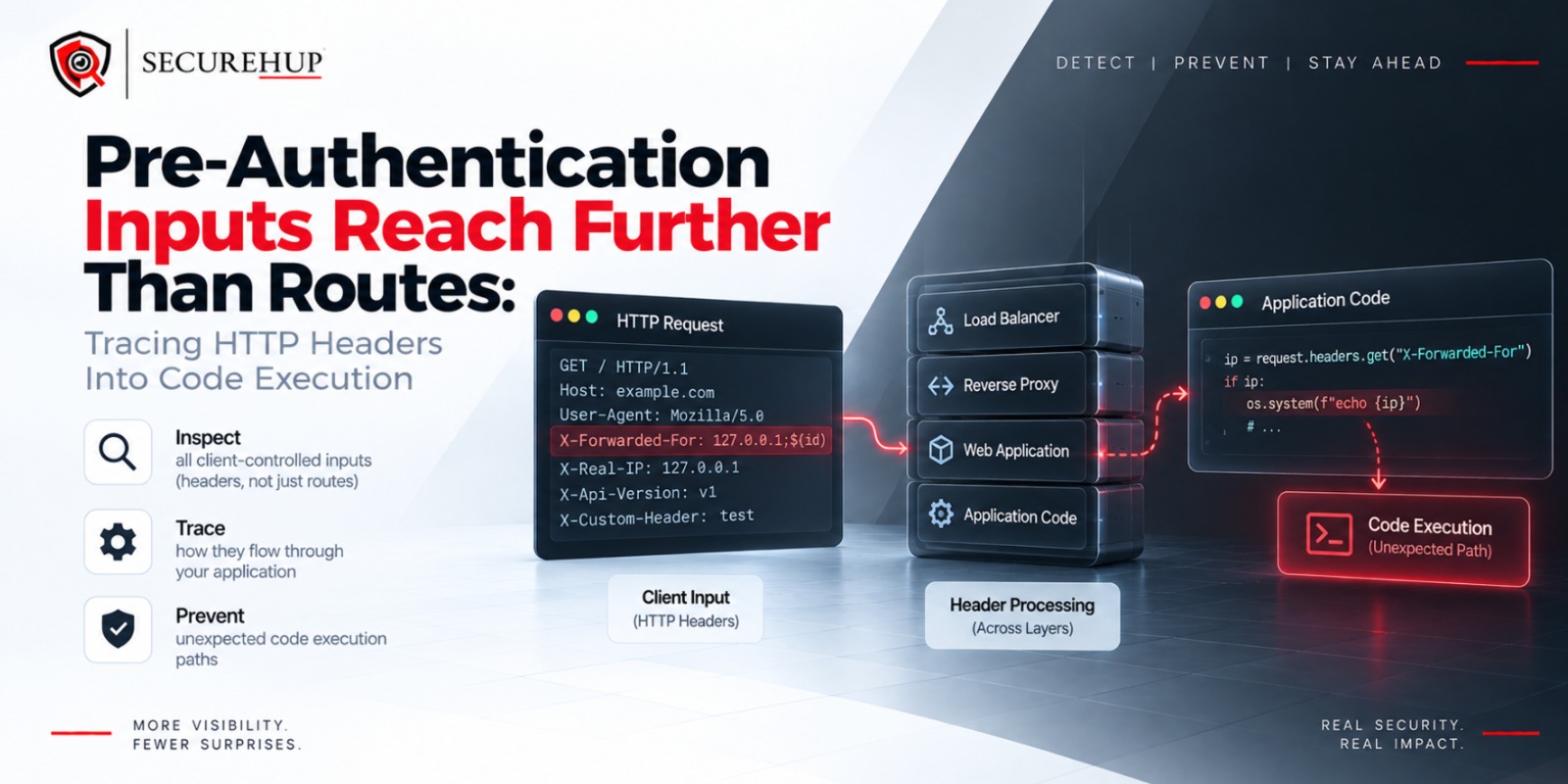
An unauthenticated request carries a localization header. Middleware copies it into a template-selection expression before route authentication runs. An error path evaluates that expression while rendering the login response. The request never reaches a public business controller, yet attacker-controlled metadata has already entered an interpreter.
A recent critical disclosure showed a pre-login header path reaching executable server behavior, with exploitation attempts observed while upgrades were still rolling out. The product-specific fix matters; the broader review lesson is that authentication is not the first code to process HTTP. Proxies, framework bootstrap, middleware, plugins, observability hooks, template engines, and error renderers all run earlier.
Inventory attacker-controlled fields by data flow rather than route alone. Trace headers through normalization, context construction, templates, expression languages, includes, command builders, and exception handling until a verified principal exists. Suspected execution should be validated with a harmless effect in an isolated deployment.
Key Takeaways
- Every client-supplied HTTP field is untrusted input, including headers that look internal, conventional, or framework-specific.
- Authentication middleware is not necessarily the first consumer of a request; parsing, routing, templating, plugins, and error handling may run earlier.
- Validation for HTTP syntax does not make a value safe for a second grammar such as a template, expression, shell, query, or generated source language.
- A reliable test traces one value from network entry to a security-sensitive sink and proves a harmless protected effect in an isolated environment.
- Proxy stripping and WAF rules can reduce exposure, but the durable fix removes the interpreter path or applies context-specific structured construction.
- Regression coverage must test direct, proxied, alternate-method, error, cache, and authentication-state paths because pre-auth behavior often drifts between adapters.
Authentication Is a Mid-Pipeline Control
Web architecture diagrams often draw authentication immediately after the internet boundary. Real request processing is more complicated:
client bytes
  -> CDN or load balancer
  -> reverse proxy
  -> HTTP parser
  -> framework request object
  -> host and route selection
  -> global middleware
  -> localization, cache, or template setup
  -> authentication
  -> authorization
  -> route handler
  -> response and error rendering
The order varies, and some arrows loop. An exception before authentication may invoke a global error template. A cache lookup may evaluate vary keys derived from headers. A plugin can register middleware ahead of the application's identity layer. An internal subrequest can re-enter routing with a modified header set. A server-side rendering system may create template context before the route handler runs.
This makes "pre-authentication" a dataflow property rather than a URL property. A route can require login while still allowing untrusted data to reach vulnerable code before the login decision. Conversely, a public route may safely handle input if its parser and sink boundaries are well designed.
Build a Pre-Auth Execution Map
For each externally reachable listener, document the components that run before a principal is established. Include more than application middleware:
- CDN transformations and edge functions.
- Load-balancer and proxy header normalization.
- Virtual-host and tenant selection.
- Framework bootstrap and global request hooks.
- Session loading and cookie parsing.
- Localization and content negotiation.
- Template or theme selection.
- Plugin and extension dispatch.
- Logging, tracing, and error rendering.
- Cache key construction and cache-hit response generation.
Then record the first point at which the application has an authenticated, integrity-protected principal. Everything before that point must be safe under fully attacker-controlled input. It is not enough that the eventual route has an authentication annotation.
Header Names Do Not Create Trust
Headers are only key-value fields in an HTTP message. Their names can communicate convention, but convention is not provenance. A client can normally send a field that looks like it came from a proxy, framework, monitoring system, or internal feature. Trust exists only when the application can prove that a trusted intermediary removed any client-supplied copy and generated the authoritative value over a protected hop.
This principle applies to several header families:
| Header role | Common use | Security failure if client-controlled | Required trust decision |
|---|---|---|---|
| Forwarding metadata | Client IP, host, scheme | Authentication, rate-limit, or URL-generation bypass | Which proxy generated it, and was the inbound copy removed? |
| Identity context | User, role, tenant | Principal spoofing or cross-tenant access | Is it cryptographically or transport-bound to a trusted identity provider? |
| Routing hints | Rewrite, original path, host | Hidden handler reachability or policy mismatch | Which component may set it, and does routing reauthorize? |
| Rendering controls | Locale, template, filter, format | Template or expression injection | Is the value selected from a fixed server-side set? |
| Cache controls | Variant, surrogate key | Cache poisoning or private response confusion | Is the field part of an authenticated cache contract? |
| Observability metadata | Trace, debug, correlation | Log injection, unsafe debug paths, data exposure | Is it treated only as bounded data? |
| Feature switches | Preview, experiment, mode | Activation of privileged or unfinished behavior | Is entitlement checked independently of the header? |
A custom prefix such as X-Internal- does not make a field internal. A reverse proxy configuration that usually overwrites a field does not prove that every deployment path does so. Direct service access, alternate ingress, local development, health endpoints, WebSocket upgrades, or misordered proxy directives can change the result.
Model Provenance Explicitly
Instead of passing raw header strings deep into the application, translate trusted transport claims into typed server-derived context at one boundary. For example:
raw request header
  -> trusted proxy verification
  -> canonical value parsing
  -> source and hop validation
  -> immutable RequestContext field
  -> authorization or routing consumer
The raw namespace and trusted namespace should remain separate. If downstream code can read either with the same helper, a later refactor can accidentally substitute client input for server-derived state.
The Dangerous Step Is the Grammar Transition
An HTTP parser decides whether a field is syntactically valid as HTTP. That validation says nothing about how the value behaves in another language. The vulnerability appears when code converts data from one grammar into source for a second parser.
Common transitions include:
- Header value into a template expression.
- Header value into a dynamically selected include or function name.
- Header value into an expression evaluator or filter language.
- Header value into a shell or process argument string.
- Header value into SQL, LDAP, XPath, or another query language.
- Header value into generated source code or an
eval-like function. - Header value into a logging format later interpreted by an operator console.
- Header value into an internal subrequest path or proxy directive.
The same bytes can be harmless in the first grammar and executable in the second. Rejecting carriage returns, for example, may prevent HTTP response splitting but does not neutralize template delimiters. Escaping for HTML does not make a value safe inside JavaScript. Quoting for a shell does not make it safe as a database identifier. Security must match the final parser and the exact syntactic position.
Prefer Structured Selection to String Construction
If a request selects behavior, map it to a fixed server-side implementation:
client value: "compact"
validated enum: RenderMode.COMPACT
server mapping: templates/compact.html
Do not construct an executable expression or file path from the raw value. A strict allowlist should operate on a canonical representation and return a typed value. Unknown input should fail closed before any interpreter is invoked.
When dynamic expressions are truly a product feature, isolate the language. Use a parser with a constrained grammar, build an abstract syntax tree, validate allowed operations, enforce time and resource limits, provide a capability-limited environment, and never expose general host-language evaluation as a convenience shortcut.
Trace Source to Sink, Not Header to Handler
Traditional endpoint testing sends payloads and observes responses. That can detect obvious injection, but it often misses pre-auth paths whose effects appear only in logs, generated files, internal requests, or secondary rendering. Code-aware analysis provides the missing map.
Step 1: Enumerate Sources
Inventory every API used to read request fields. Frameworks may expose headers through normalized maps, environment variables, global helper functions, server variables, request attributes, or convenience methods. Include aliases and transformed forms:
- Original and lowercase names.
- Combined duplicate values.
- Proxy-generated copies.
- Parsed tokens or lists.
- Environment-style names.
- Values copied into session, template, or global context.
Search for dynamic lookups where a header name itself is constructed. Plugins can also read fields outside the main repository, so dependency and extension code may be part of the trace.
Step 2: Enumerate Sinks
Look for operations that create authority or reinterpret data:
- Dynamic evaluation and compilation.
- Template compilation, filters, and dynamic includes.
- Process creation and command execution.
- Database or directory queries built from strings.
- File reads, writes, and path resolution.
- Internal HTTP clients and redirects.
- Deserialization into executable object types.
- Plugin dispatch and reflection.
- Response header generation and error templates.
A sink is not automatically vulnerable. The question is whether untrusted data can reach it without a non-bypassable policy transformation.
Step 3: Record Transformations and Guards
For each path, record decoding, normalization, concatenation, validation, escaping, type conversion, and authorization. Security review frequently discovers that a guard protects one source but not an alias, or one route but not a global helper. The trace should make these differences visible.
Step 4: Find the Earliest Reachable Consumer
Determine whether the sink can run before authentication, on authentication failure, during a redirect, on a cache hit, or while rendering an error. Test startup and fallback behavior too. A security plugin that fails to load may cause a route to use a default template path with different processing.
Step 5: Define a Protected-Effect Oracle
Do not use an error message alone as proof of code execution. Define a harmless effect that ordinary input cannot cause, such as creating a marker inside a disposable container, invoking a controlled local callback, or selecting a synthetic server-side branch. The oracle must distinguish parsing, reflection, and actual interpreter execution.
Safe Validation Without Publishing a Weaponized Recipe
Pre-authentication code execution is high impact, so validation must be deliberate. The goal is to establish reachability and effect with minimal consequence, not to demonstrate post-exploitation.
Use a Disposable, Representative Target
Reproduce the exact application version, plugins, configuration, proxy chain, and runtime in an isolated environment. Remove real data and credentials. Disable general outbound network access. Run as an unprivileged identity with a read-only filesystem except for one test directory. Apply CPU, memory, process, and time limits.
Progress Through Evidence Levels
| Level | Question | Safe evidence | Stop condition |
|---|---|---|---|
| 1. Reachability | Is the field consumed before authentication? | Instrumented dataflow or branch trace | Source never reaches relevant code |
| 2. Parser influence | Does it alter the second grammar? | Controlled parse-tree or template output change | Input remains data after encoding |
| 3. Interpreter entry | Is dynamic evaluation invoked? | Function hook, stack trace, or sandbox event | Guard rejects before sink |
| 4. Harmless effect | Can untrusted input cause a protected action? | Disposable marker or controlled callback | Minimal proof achieved |
| 5. Regression | Does the fix prevent the same effect on all paths? | Negative replay plus valid controls | Any alternate path still succeeds |
There is no security value in moving from a harmless marker to data theft, persistence, or arbitrary external command execution. Stop when the authorization or interpreter boundary is proven.
Include Negative and Positive Controls
A valid test needs context. Send a normal request proving the application works, a malformed request proving the general error path, a candidate input proving the special path, and a post-fix replay proving the candidate is inert. Monitor the protected effect directly. A 500 response can mean the parser crashed before execution, while a 200 response can hide a server-side effect.
Coordinate with Operations
Even a harmless expression can trigger alerts, create logs containing sensitive test strings, or destabilize a vulnerable parser. Define scope, rate, allowed payload classes, kill conditions, evidence retention, and cleanup. Never test a third-party target without explicit authorization.
Why Perimeter Mitigations Do Not Finish the Fix
Emergency controls can buy time. A reverse proxy can drop a risky field, a WAF can block a narrow pattern, and network policy can reduce reachable instances. These are useful containment measures, especially during active exploitation. They are not equivalent to correcting the application.
Alternate Paths Bypass Assumptions
An application may be reachable through multiple ingress controllers, an internal load balancer, a service mesh, a direct cluster address, a preview environment, or a local administrative listener. A rule deployed to one edge does not protect all paths. Header names can also be normalized differently across HTTP versions and intermediaries.
Pattern Rules Target Examples, Not Languages
Blocking one token does not make dynamic evaluation safe. Encodings, alternate syntax, parser normalization, concatenation, or a different expression primitive may preserve the underlying injection path. The application must ensure untrusted data is not treated as source.
Security Screens May Run Too Late
A plugin or virtual patch can protect familiar controller paths while the vulnerable operation occurs during bootstrap, template compilation, or another earlier phase. Verify control ordering in the running configuration. "Installed" is not the same as "executed before the sink."
The durable remediation is usually one of these:
- Remove dynamic evaluation entirely.
- Replace raw construction with a structured, typed API.
- Map untrusted choices to fixed server-side behavior.
- Apply context-specific encoding at the final output boundary.
- Move authentication and authorization before the privileged operation.
- Reduce the capability of the interpreter so input cannot reach host effects.
Defense in depth remains valuable after the code fix because it limits unknown paths and future regressions.
Test the Deployment, Not Just the Function
A unit test can prove a helper rejects a dangerous value. It cannot prove that every deployment route uses that helper. Pre-authentication testing needs a matrix across adapters and states.
| Dimension | Cases to cover | Security invariant |
|---|---|---|
| Identity state | No session, invalid session, expired session, valid low privilege | No unverified caller reaches a privileged sink |
| Network path | Primary proxy, alternate ingress, direct service test, preview | Trusted header provenance is consistent |
| HTTP form | Supported methods, error methods, duplicate fields, HTTP versions | Parsing differences do not bypass policy |
| Application path | Normal route, missing route, redirect, cache hit, exception | Error and fallback paths remain non-executable |
| Encoding | Canonical form and permitted alternate encodings | One canonical validation decision governs the sink |
| Extension state | Core only, enabled plugins, disabled security plugin | Optional components cannot move the sink ahead of controls |
| Lifecycle | Cold start, reload, cache warm, configuration failure | Failures do not enable unsafe defaults |
The expected result should be effect-based. "Returned 401" is useful but insufficient. Assert that the interpreter was not invoked, no marker appeared, no internal call occurred, no file changed, and no privileged audit event was emitted.
Continuous, Code-Aware Validation
Header-to-sink bugs are ideal candidates for continuous validation because small refactors can reopen them. A developer may move middleware, adopt a helper, add a plugin, or reuse a template utility in an earlier path. Static analysis can identify a new flow, while dynamic testing can determine whether the flow is reachable and produces a protected effect.
A practical pipeline is:
request-handling diff
  -> identify new or changed header sources
  -> trace data into interpreter and authority sinks
  -> rank paths reachable before verified identity
  -> deploy the change to an isolated test target
  -> replay harmless source-to-effect probes
  -> attach request trace, code path, and observed effect
  -> block only a proven boundary crossing
This is also where SecureHup's approach can add value without turning the workflow into another broad scanner. Code-aware review can connect a changed request helper or middleware order to a risky sink, while sandboxed autonomous testing can verify the result through a harmless proof and retain the HTTP trace for remediation. Replaying that proof on later pull requests gives developers a concrete guarantee: the original pre-authentication path remains closed even as routing and framework code evolve.
Remediation and Release Checklist
Before declaring a fix complete, verify all of the following:
- The affected software is upgraded to a fixed, supported release.
- Every exposed instance, including preview and internal deployments, is inventoried.
- Raw client headers cannot populate trusted identity or server-control context.
- The vulnerable grammar transition has been removed or protected at the final sink.
- Authentication and authorization occur before privileged behavior on normal and error paths.
- Proxy stripping rules are consistent across every ingress as defense in depth.
- Runtime identity has minimal filesystem, process, and network capability.
- Logs and telemetry are reviewed for evidence of earlier exploitation.
- Credentials and artifacts are rotated or rebuilt if execution may have occurred.
- Regression tests cover unauthenticated, malformed, proxied, fallback, and plugin-enabled paths.
- The test asserts absence of protected effects, not only a response code.
If exploitation attempts are known to have occurred, patching should trigger incident response. A code execution flaw creates uncertainty about server state, credentials, stored content, and downstream systems. Recovery may require credential rotation, image replacement, integrity checks, and restoration from a known-good boundary.
FAQ
Can an HTTP header cause remote code execution?
Yes, if application or framework code uses the header value to construct input for an executable interpreter or another unsafe grammar. HTTP itself does not execute the value. The vulnerability comes from the downstream dataflow, such as dynamic template evaluation, expression compilation, command construction, unsafe deserialization, or generated source. The risk can exist before authentication because global middleware and rendering code run before route access decisions.
Does requiring authentication on the route prevent pre-authentication injection?
Not necessarily. Authentication may run after request parsing, global hooks, template setup, cache processing, or plugin middleware. Error handling can also execute when authentication fails. Review the actual order in the deployed application and trace the input to the sink. A route annotation proves an intended policy, not that no earlier code consumed the request.
Is stripping a dangerous header at the reverse proxy enough?
It is a useful emergency mitigation when applied correctly, but it should not be the final fix. Alternate ingress paths, direct service access, configuration drift, and normalization differences can reintroduce the field. Correct the unsafe application dataflow, then keep proxy stripping as an additional layer. Test every reachable path to confirm the assumption.
How should teams test suspected pre-authentication code execution safely?
Use a representative but disposable environment with synthetic data, no production credentials, restricted egress, low privileges, and hard resource limits. Progress from dataflow reachability to interpreter entry and then to one harmless protected effect. Use a local marker or controlled callback and stop once execution is proven. Preserve the request, response, trace, code path, and effect as a regression artifact.
What is the best long-term prevention strategy?
Eliminate string-built executable behavior wherever possible. Convert raw inputs into typed values, map choices to fixed server-side implementations, enforce trusted provenance for proxy-derived context, and authorize immediately before protected effects. Add code-aware source-to-sink review and dynamic negative tests to pull requests that change middleware, parsers, templates, plugins, or request helpers.
Unauthenticated Reachability Starts Before the Router
The real pre-authentication sequence may include edge logic, framework bootstrap, middleware, plugins, logging, localization, and error rendering. Keeping raw headers separate from trusted context and identifying every transition into another grammar makes that sequence easier to review. Dynamic evaluation is often avoidable; where it remains, its isolation becomes part of the boundary.
We would replay a harmless canary through normal, error, plugin, proxy, and partial-authentication paths and retain the source-to-effect path as a regression. A public route list describes only one kind of reachability. The data flow shows which code actually interprets attacker-controlled input before identity exists.
#ApplicationSecurity #HTTPHeaders #CodeInjection #PreAuthentication #SecureCoding #AutonomousPentesting
Find issues like this in your own codebase
SecureHup runs this exact exploit chain — discovery, enumeration and cross-tenant validation — on every deployment, automatically.