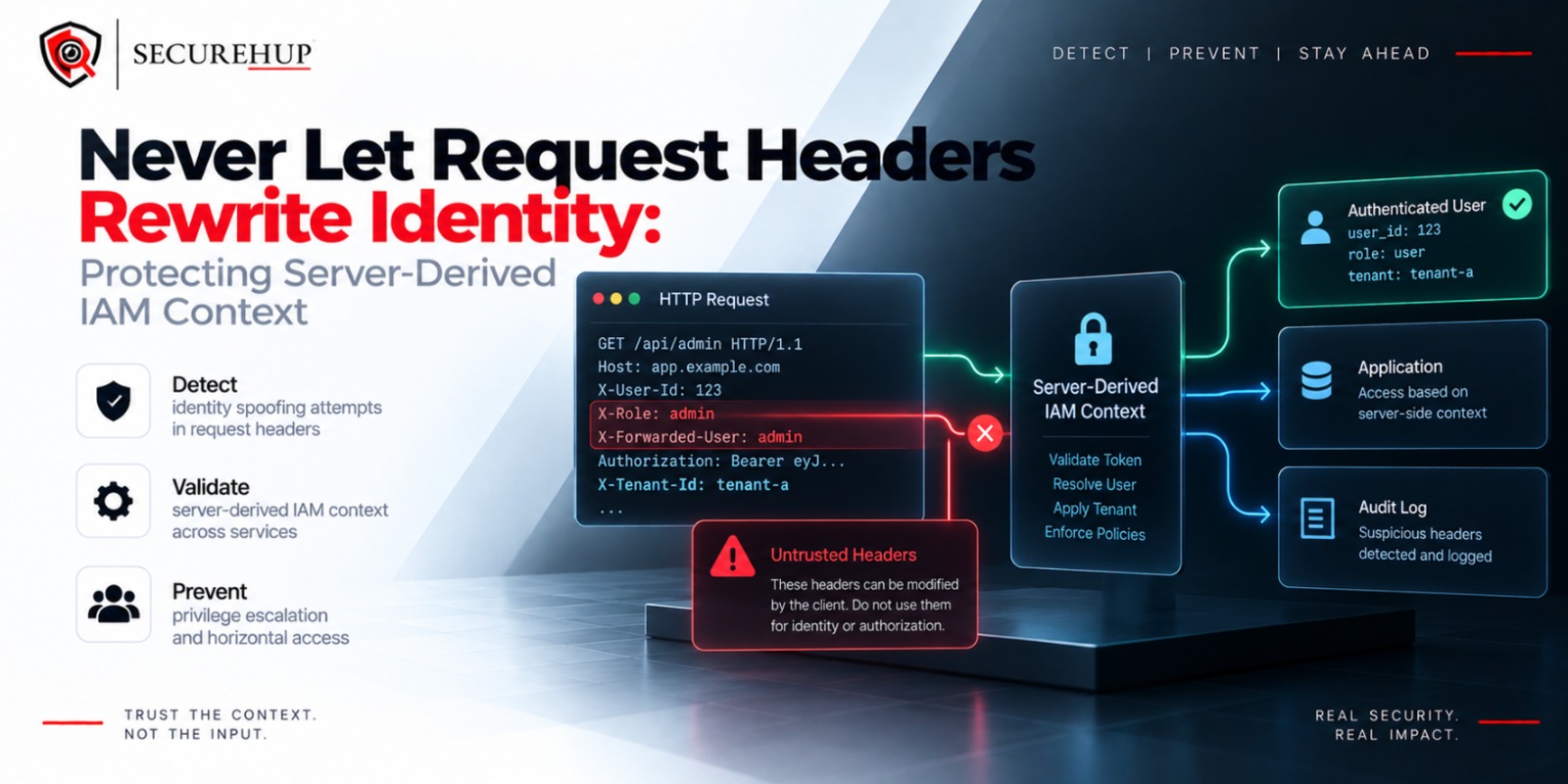
An ordinary user's token resolves to role viewer. The same request includes X-Role: admin. A helper canonicalizes both sources into one map and appends duplicate values; the policy engine authorizes when any role matches. Audit output still prints the verified viewer identity, but the injected value is the one that opens the protected operation.
The defect is provenance loss. Authentication produced a trusted claim, network input produced untrusted metadata, and a generic container made them indistinguishable to policy. Case folding, alias headers, list semantics, and first-wins or append behavior can each create a collision even when the expected server-derived value remains visible.
Testing should trace the raw header through canonicalization, context construction, policy evaluation, and the protected effect. The assertion concerns influence: no value controlled by the request may create, replace, append to, or suppress identity context derived by the server.
Key Takeaways
- Authentication can be correct while authorization is wrong if untrusted request metadata enters the trusted policy context.
- HTTP field names are case-insensitive, so case normalization can create collisions that are invisible in source-code string comparisons.
- Appending an attacker value to a trusted multi-value claim can bypass conditions that succeed when any element matches.
- Missing claims are especially dangerous when generic headers are allowed to fill absent context keys or suppress later derivation.
- Trusted identity, proxy-asserted context, application metadata, and arbitrary client headers need separate namespaces and provenance.
- Strong testing verifies the final policy input and protected effect, not merely the authenticated username shown in logs.
Authorization Uses More Than a Principal ID
Modern policy engines rarely decide from a username alone. They evaluate a context:
principal
  + groups and roles
  + credential issuer and assurance
  + tenant and organization
  + requested action
  + target resource and tags
  + network and transport properties
  + request metadata
  + current system state
  = authorization decision
Some values are derived from verified credentials. Some come from authoritative databases. Some are supplied by a trusted reverse proxy. Others come directly from the caller. All can be represented as strings, but they do not have equal authority.
The design mistake is flattening them into one generic Map<String, List<String>> without preserving origin. Once flattened, a policy cannot tell whether groups=finance-admin came from a signed token, a directory lookup, an internal gateway, or a raw header written by the requester.
Identity Is a Provenance Property
A claim is trustworthy because of how it was produced and verified, not because its key has a familiar name. userId, subject, groups, role, and tenant are just strings when accepted from an untrusted channel. Naming a header X-Authenticated-User does not authenticate it.
Every policy value should have an implicit or explicit provenance class:
- Credential-derived: Verified from a token, certificate, session, or signed assertion.
- Directory-derived: Loaded from an authoritative identity or membership store.
- Resource-derived: Loaded from protected object metadata.
- Proxy-asserted: Accepted only from an authenticated, designated intermediary after inbound sanitization.
- Application-derived: Computed from trusted server state.
- Client-supplied: Arbitrary request data with no identity authority.
Security-sensitive conditions should declare which classes they accept.
How Header Collisions Become Identity Injection
HTTP field names are case-insensitive. Frameworks typically lowercase or canonicalize them. An application may use lowercase keys for its policy map. These individually reasonable choices create a collision surface.
Consider this sequence:
1. Credential verifies ordinary-user.
2. Server inserts policy key "userid" = ["ordinary-user"].
3. Request contains header "UserId: admin".
4. Framework normalizes it to "userid".
5. Generic header merge finds an existing key and appends "admin".
6. Policy asks whether userid equals "admin".
7. Multi-value equality succeeds because one element matches.
Authentication never failed. The trusted value was not deleted. The bug is that the attacker was allowed to add another candidate to a security decision.
Append Is Not Harmless
Developers may prefer append because it avoids overwriting trusted data. In a policy engine, append can be equivalent to override. The effect depends on operator semantics:
any(values == expected)lets one injected value satisfy an allow.all(values == expected)may cause denial instead.not any(values == blocked)can be changed by injected values in surprising ways.- First-value substitution may preserve the trusted value while set membership does not.
- Empty or missing values may activate fallback behavior.
The merge algorithm and the policy operator form one security boundary and deserve to be reviewed together.
Replacement Through Presence Checks
Another pattern is indirect replacement:
copy request metadata into context

if "groups" not in context:
    context["groups"] = groups_from_credential
An attacker-provided groups header causes the trusted derivation to be skipped. The attacker did not overwrite a value; they prevented it from being created. This is why reserved-key rejection must cover both collisions with present trusted values and names that are expected to be derived later.
Namespace Confusion Is the Root Cause
Policy systems often need legitimate request-header conditions. Content type, conditional request fields, signed object metadata, or service-specific x-* headers can affect access. The solution is not to ban every header from policy evaluation. It is to separate namespaces.
A safe context might look conceptually like:
identity.subject
identity.groups
identity.issuer
identity.assurance

resource.owner
resource.tags
resource.tenant

transport.source_ip
transport.tls
transport.proxy_id

request.headers.content-type
request.headers.x-object-tag
request.query.version
Raw headers cannot become identity.* because there is no generic merge between those trees. A policy that wants a client header must reference request.headers.* explicitly and accept its untrusted provenance.
Prefixes Alone Are Not Enough
String prefixes help readability but can still collide after canonicalization, aliasing, or legacy compatibility mapping. Separate types or maps provide a structural namespace. Where a flat policy language is unavoidable, a closed registry of reserved keys can stop an inbound field before it merges into trusted context.
The registry must include future-derived keys, aliases, case variants after normalization, federated claim prefixes, and proxy-reserved fields. Generate it from the policy context schema where possible so new identity keys cannot be added without collision protection.
Trusted Proxy Headers Need a Real Trust Boundary
Some deployments intentionally use headers to carry authenticated identity from a gateway to an application. That can be secure only when the application can distinguish gateway traffic from direct client traffic.
Required properties include:
- The gateway removes all inbound copies of reserved headers.
- The gateway authenticates the user or workload before adding assertions.
- The application authenticates the gateway, for example through mutually authenticated transport or a protected network identity.
- No alternate route can reach the application without the same sanitization.
- The assertion is integrity protected or confined to the authenticated channel.
- Header size, multiplicity, and syntax are constrained.
- The application maps assertions into typed identity fields, not a generic request map.
- Audit records both original principal and asserting gateway.
An IP allowlist alone is a weak basis when proxies, sidecars, containers, or cloud networking can change source addresses. A header secret is also fragile if it is static, logged, or readable by neighboring workloads.
Direct Reachability Breaks the Model
A perfect gateway configuration provides no protection if the backend also listens on a service, node port, alternate hostname, development port, or internal load balancer reachable by an attacker. Security testing therefore has to cover every reachable network path. “Traffic normally goes through the proxy” is an architectural intention, not an enforcement result.
Canonicalization Must Be Identical
Security checks fail when components compare different names or values. Header processing can involve:
- Case folding.
- Underscore-to-hyphen conversion.
- Duplicate-line combination.
- Comma splitting.
- Whitespace trimming.
- Proxy prefix stripping.
- HTTP version conversion.
- Framework-specific aliases.
- Unicode rejection or normalization.
One canonicalization algorithm, applied before reserved-key comparison, makes alias handling predictable. Ambiguous spellings are generally safer to reject, and testing through production-equivalent proxies and HTTP versions captures transformations a direct unit test may not reproduce.
Duplicate Values Are a Policy Decision
For security-sensitive fields, duplicate values should usually be rejected. Selecting first or last creates parser-differential opportunities when the gateway and application choose differently. Combining values is safe only when the field grammar explicitly permits it and the policy interprets the combination correctly.
Policy Operators Change the Collision Impact
The same poisoned context can allow, deny, or silently change fallback behavior depending on the operator. Testing one equality rule is therefore insufficient; the relevant inventory is the set of operators actually used with each injectable key.
| Operator pattern | Trusted plus injected values | Possible result |
|---|---|---|
| Any value equals privileged ID | [ordinary, privileged] |
Injected value satisfies allow |
| All values belong to approved set | [ordinary, privileged] |
Request may deny rather than escalate |
| No value equals blocked group | [ordinary, blocked] |
Injected value can trigger denial of service |
| Key must be absent | Attacker creates key | Fallback or deny branch changes |
| First value is substituted | Ordering differs by adapter | Gateway and service can authorize differently |
| Last value wins | Duplicate header appended | Attacker may replace effective value |
| Empty value means default | Attacker sends empty field | Trusted lookup may be skipped |
| Negated set match | Multiple values | De Morgan and quantifier mistakes can invert policy |
This matters during severity analysis. A collision primitive is not automatically privilege escalation for every deployment. It becomes escalation when a reachable policy consumes the poisoned key with semantics that grant additional action or resource access. In another policy it may produce targeted denial, cross-tenant confusion, or only incorrect audit data.
Operator-aware fixtures can include an allow rule, deny rule, missing-key fallback, and multi-value rule for each relevant key. Holding the authenticated principal and target constant while changing only the untrusted field reveals which value the policy engine selected and whether its quantifier evaluated one element or all of them. That distinction separates a general context-construction defect from its concrete policy consequence.
Design a Typed Authorization Context
A strong design makes illegal provenance mixing difficult in code.
AuthorizationContext {
  principal: VerifiedPrincipal
  memberships: AuthoritativeMemberships
  tenant: VerifiedTenant
  resource: ProtectedResourceContext
  transport: TrustedTransportContext
  request: UntrustedRequestAttributes
}
The policy adapter exposes explicit getters. principal.groups() cannot read request headers. A policy condition for a raw field must call request.header("x-purpose"), making its provenance visible during review.
Freeze Trusted Context Before Request Mapping
The trusted identity context is easiest to protect when it is built and frozen after authentication and authoritative lookups. Permitted client attributes can occupy a separate structure, avoiding a mutable shared map that later middleware may append to or replace.
Where enrichment is required, constructors that carry a source type and allowed destination preserve provenance. Debug telemetry may record the enrichment decision without retaining token contents or sensitive claims.
A Code-Aware Testing Workflow
1. Inventory Policy Inputs
An inventory of context keys used by identity, resource, and condition policies should include source, type, multiplicity, canonical name, and whether absence has meaning.
2. Trace Context Construction
The data-flow review follows authentication middleware, proxy adapters, header loops, claim mapping, directory lookups, resource loading, and policy serialization. Generic operations such as extend, merge, putAll, spread syntax, and map concatenation are useful landmarks.
3. Model Collision Classes
For each reserved key, derive case variants, hyphen/underscore variants, prefixed aliases, duplicates, empty values, comma-separated values, and values arriving through proxy-specific fields. Do not send sensitive real identities; use synthetic roles and tenants.
4. Establish Authorized and Denied Baselines
Create an ordinary principal and a privileged synthetic principal. Confirm the ordinary principal is denied a canary action while the privileged principal is allowed. The canary should modify or read disposable state only.
5. Inject Metadata Without Changing Credentials
Keep the ordinary credential fixed and vary only request metadata. Observe the final policy input, decision trace, audit actor, and protected effect. A changed display name or echoed header is not sufficient; the authorization result must change.
6. Test Every Network and Protocol Path
Run through the production proxy, direct backend in an isolated environment, HTTP/1.1, HTTP/2 translation, service mesh, internal API, and background message adapter where relevant.
7. Replay After Fix
Verify reserved fields are stripped or rejected, trusted values remain singular and authoritative, legitimate request-header policy still works, and privileged baseline behavior remains intact.
Identity-Context Boundary Tests
| Caller | Metadata variation | Expected result | Evidence |
|---|---|---|---|
| Ordinary user | No injected fields | Deny privileged canary | Baseline policy trace |
| Privileged user | No injected fields | Allow canary | Positive control |
| Ordinary user | Exact reserved key | Reject or ignore before policy | Trusted context unchanged |
| Ordinary user | Case variant | Same as exact key | Canonical collision blocked |
| Ordinary user | Hyphen/underscore variant | Same policy | Alias cannot enter identity |
| Ordinary user | Duplicate reserved fields | Reject ambiguity | No first/last disagreement |
| Ordinary user | Comma-separated privileged value | Deny | No list injection |
| Ordinary user | Empty reserved field | Deny | Trusted derivation not suppressed |
| Ordinary user | Claim absent in credential | Inject matching header | Missing claim remains absent |
| Ordinary user | Trusted and injected values | Deny | Append cannot satisfy any |
| Ordinary user | Proxy assertion on direct path | Deny | Gateway authentication required |
| Ordinary user | Legitimate gateway assertion | Policy-defined behavior | Gateway and user attributed |
| Anonymous caller | Identity-like header | Authentication required | No header-created principal |
| Cross-tenant user | Tenant-like header | Deny foreign object | Tenant derived authoritatively |
| Revoked member | Stale group header | Deny | Current membership wins |
| Alternate protocol | Same semantic headers | Same decision | Adapter parity |
Tests should avoid real administrator identifiers and production objects. Synthetic names are enough to prove whether untrusted values enter the decision.
Evidence of a Caller-Identity Mismatch
A high-quality finding records:
- Authentication mechanism and verified ordinary principal.
- Reserved context key and its authoritative source.
- Raw field name and canonicalized name.
- Merge order and collision behavior.
- Final policy value set, with sensitive data redacted.
- Condition operator that changed the decision.
- Baseline deny and injected allow.
- Protected synthetic object or action reached.
- Tenant and role prerequisites.
- Proxy and direct-backend topology.
- Audit attribution before and after injection.
- Patched-build replay and privileged positive control.
Do not claim account takeover merely because a policy context contains an injected string. Prove a protected read, write, role-dependent operation, or policy bypass. Severity depends on which keys are injectable, which policies use them, caller prerequisites, and the authority of reachable resources.
If exploitation may have occurred, patching is not the full response. The investigation may need access logs for reserved header names and unusual duplicates, policy decisions, actions authorized through affected conditions, exposed credentials, and alternate paths to the backend.
Repair the Server-Derived Context
- Upgrade affected policy or storage components when a fixed release exists.
- Separate trusted identity/resource context from untrusted request attributes.
- Maintain a canonical reserved-key registry.
- Reject or strip inbound collisions before context construction.
- Derive identity and groups before processing optional metadata.
- Prevent generic append, merge, or first/last selection for reserved keys.
- Require authenticated proxy identity for proxy assertions.
- Remove direct backend reachability that bypasses sanitization.
- Make policy accessors provenance-aware and typed.
- Add decision traces that identify value source without exposing secrets.
- Preserve collision and alternate-path regression tests.
The reported key is one instance of a generic namespace collision. Regression coverage should therefore include identity, tenant, role, group, issuer, assurance, and resource-ownership keys rather than stopping at the original name.
Release Controls for Identity Context
Changes to authentication middleware, proxy configuration, HTTP libraries, header adapters, policy schemas, claim mappings, identity providers, group lookups, or condition operators are natural triggers for a focused regression.
Useful controls and metrics include:
- Requests containing reserved identity-like fields.
- Duplicate security-sensitive headers.
- Direct backend requests bypassing the gateway.
- Policy values with mixed provenance.
- Multi-valued principal, tenant, or assurance keys.
- Missing authoritative claims filled from request metadata.
- Decision differences across HTTP versions or adapters.
- Denied collision attempts by principal and route.
- Time to revoke a compromised proxy identity.
- Coverage of policy keys by provenance tests.
Metrics should record names and classes rather than raw credentials or sensitive group membership. Bounded samples may still be appropriate where incident policy explicitly permits them.
Release Acceptance Criteria
A release passes when an ordinary synthetic principal remains denied under every reserved-key spelling, duplicate form, proxy path, and missing-claim state; a legitimate privileged principal remains allowed; and approved non-security request metadata still reaches its intended policy namespace. The evidence must include the final canonical policy context and protected effect, not only middleware logs.
Header-to-Identity Review Questions
- Does every policy value have a documented authoritative source?
- Are identity, resource, transport, and request attributes structurally separate?
- Can raw headers collide after case or alias normalization?
- Can duplicate values append to trusted claims?
- Can an untrusted key suppress later trusted derivation?
- Do policy operators use any-value semantics?
- Are proxy assertions accepted only from authenticated proxies?
- Can clients reach the backend without sanitization?
- Are HTTP version and intermediary transformations tested?
- Are missing, empty, duplicate, and multi-value claims covered?
- Does audit identify both principal and assertion source?
- Are all reserved keys covered by regression tests?
Frequently Asked Questions
Can a signed request still exploit header-based identity injection?
Yes. A caller can usually choose and sign their own request headers. Signature validity proves who sent the request and that signed data was not altered. It does not make caller-selected identity claims authoritative.
Is stripping identity headers at the reverse proxy sufficient?
It is an important layer, but only if every request reaches the backend through that proxy and the backend authenticates the proxy. The application should still separate trusted identity from generic request metadata.
Why is appending a value as dangerous as overwriting one?
Many policy conditions succeed when any value in a list matches. Adding a privileged value can therefore satisfy an allow even while the correct ordinary identity remains present.
Should applications ban all request headers from policy decisions?
No. Some request attributes legitimately affect policy. Put them in an explicitly untrusted request namespace and allow only conditions designed for those attributes. Never let them populate identity or ownership fields.
What is the best test oracle?
The strongest proof combines the final authorization decision, a harmless protected effect, and a trace of canonical policy inputs with their provenance. An echoed header or changed log field alone does not establish privilege impact.
Provenance Needs More Than a Field Name
Verified principal data and request metadata benefit from different types and construction paths because a string key named role cannot express where its value came from. Canonical header handling, authenticated identity-asserting proxies, and an immutable principal passed to policy near the resource preserve that distinction through ordinary application code.
One fixed synthetic credential, paired with variations in case, aliases, duplicate headers, list values, and proxy metadata, provides a compact proof. We care about both policy inputs and the protected effect. Untrusted fields may remain useful as low-risk request context, but they should never acquire the provenance of server-derived identity merely by choosing the right name.
#IdentitySecurity #IAM #Authorization #APISecurity #ZeroTrust #SecureCoding
Find issues like this in your own codebase
SecureHup runs this exact exploit chain — discovery, enumeration and cross-tenant validation — on every deployment, automatically.