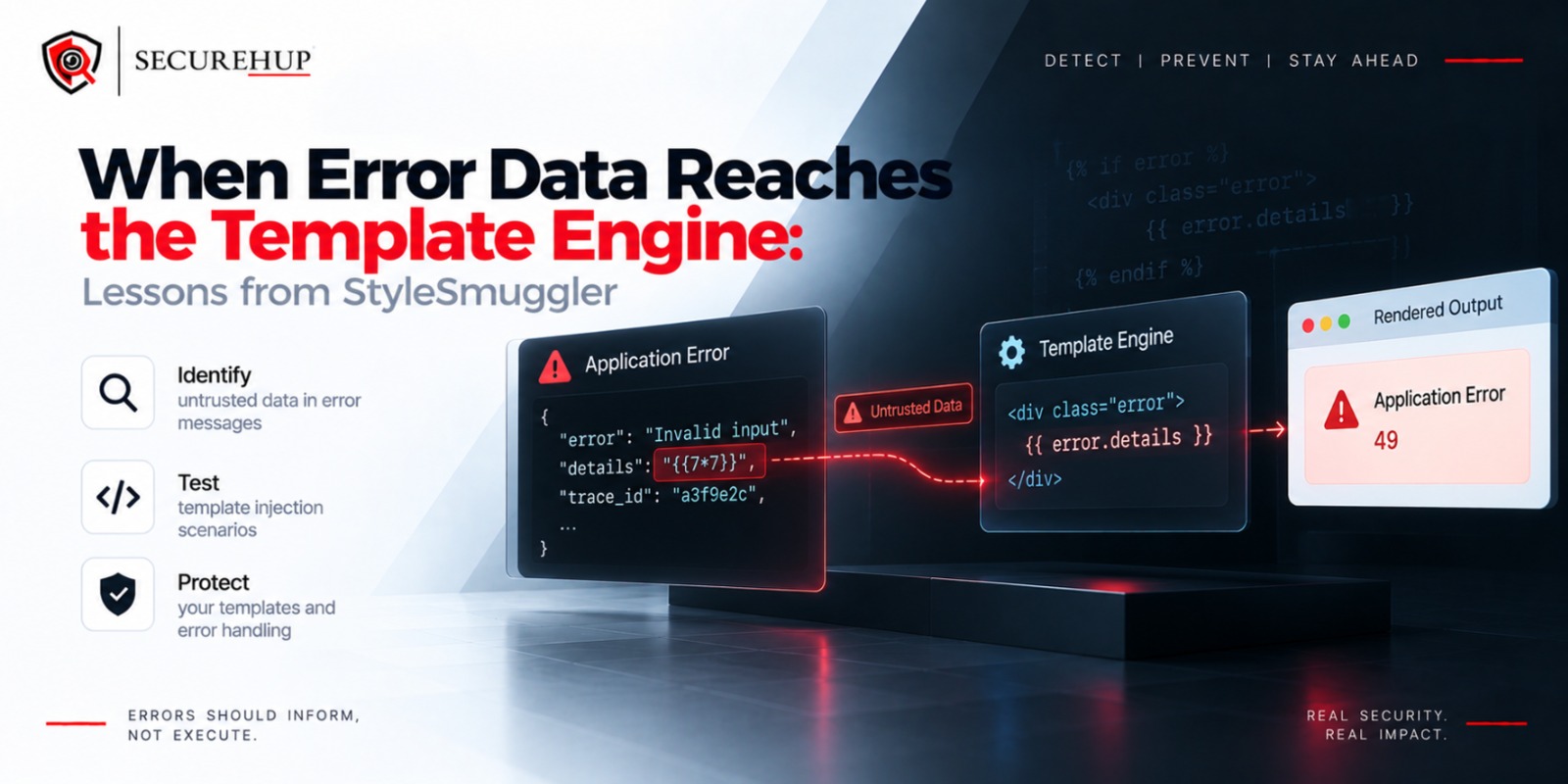
A failed payment can leave a surprisingly long trail inside an online store. The checkout handles the failure, diagnostic information gets recorded, and another part of the application prepares a notification. Reviewing only the customer-facing response misses that continuing work. StyleSmuggler brings this overlooked territory into focus: information that appears harmless in an error-handling workflow can become dangerous when a later component interprets it with different privileges.
For application-security teams, the useful lesson concerns the lifetime of data. Rejecting a request does not necessarily end its influence. The more interesting review follows what the application keeps, which services consume it, and whether any of those services can turn stored content into instructions. We will examine that problem through the available evidence and relevant Magento source code, while keeping the undisclosed parts of the attack separate from our analysis.
Key Takeaways
- Error handling deserves its own security review because a rejected business operation can still trigger storage, rendering, and other side effects.
- A renderer's variable restrictions and the trustworthiness of its template source are separate questions. Evidence about one does not settle the other.
- Source inspection can confirm an execution-capable operation without proving that an unauthenticated request can reach it.
- Temporary filtering needs a defined scope, compatibility checks, and an owner. Its presence alone does not establish that the application is fixed.
- A useful validation result records both the attempted path and the observed effect, including the limits of the test environment.
The Evidence We Can Use
The original investigation reports unauthenticated code execution, reproduced on Magento Open Source 2.4.7, 2.4.8, and 2.4.9, with attacks observed from September 4, 2026. It links the attack to poisoned application data and failed-payment email rendering; opening the email is unnecessary. Its September 7 update adds another observed attacker. The complete gadget chain remains unpublished in that report. These are researcher findings, not tests we performed. Original investigation.
We checked Adobe's public Commerce security-bulletin index on September 7. The latest listed entry was dated August 11; we could not verify a StyleSmuggler-specific vendor fix from that index. This is a bounded observation about the public material checked, not proof that every private support channel has the same information. A fixed version or release deadline would be premature here. Adobe Commerce security bulletins.
The version information also deserves care. Reproduction on named Open Source releases does not establish identical exposure across every deployment bearing the broader Commerce name. Extensions, deployment models, and configuration can affect the available paths. Conversely, an installation should not be marked unaffected merely because its exact patch suffix is absent from a researcher's test list. For an operator, that uncertainty calls for a deployment-specific assessment, not an invented version range.
This article therefore has two layers: a current vulnerability that establishes the relevance of the problem, and an engineering analysis of the boundaries it raises. The source-code references below describe identifiable behavior in the 2.4.8 tag. They are not a reconstructed exploit, a vendor patch analysis, or evidence that we reproduced the reported chain.
A Failed Business Operation Can Still Do Work
Consider a hypothetical store that records the submitted delivery reference when a transaction fails. A support notification later includes that reference so staff can connect the failure to a customer conversation. Both features are reasonable. The security question emerges in the handoff: does the notification service receive a value to display, or does some part of that value become text for a template interpreter to process?
The distinction can disappear in code that deals mostly with strings. A variable named message might represent a customer's words, a formatted diagnostic summary, or a trusted template fragment. Those objects have very different authority even if the language assigns all of them the same type. Concatenating them into one string discards information that the next component may need to make a safe decision.
Persistence makes the relationship harder to see. The engineer reviewing a renderer may encounter a database row or a local file and reasonably assume another component has already validated it. The engineer reviewing the original request may see rejection and consider the business operation complete. Between those perspectives, no one has necessarily reviewed the stored value as externally influenced input to a later interpreter.
Logging guidance explicitly treats information from other trust zones as potentially hostile and calls for encoding appropriate to the logging format. That provides a useful baseline for storing an event, but storing it correctly does not establish that it is suitable for a template, a browser, or an executable file loader. Each consumer brings its own interpretation. Application logging guidance.
In our hypothetical store, a sound review would retain the connection between the submitted reference and the notification field. It would also ask what happens if formatting fails, if the record is replayed, or if a different support template is selected. These are variations of one business flow, not a demand to test every possible string everywhere. Following a concrete value is usually more productive than adding another broad rule that says input should be sanitized.
Where Templates Change the Meaning of Text
Commerce email customization is a real application feature, not an incidental implementation detail. Adobe documents file-based and administrative template overrides, variables, and theme-specific presentation. A store can therefore have materially different notification behavior from an otherwise similar installation, even when the application version matches. Email template documentation.
The 2.4.8 implementation of AbstractTemplate::getProcessedTemplate() prepares the filter, configures rendering context, supplies variables, and passes template text to the filter. That is a concrete place where an investigation can distinguish the document being interpreted from the values provided to it. The method's existence does not identify an unauthenticated entry point. Magento email model, 2.4.8.
A useful design question follows: which application decisions are allowed to supply that document? An administrator selecting an approved template, a module loading a packaged template, and an external caller supplying a diagnostic value should not acquire the same ability simply because they all eventually produce text. This is a provenance problem as much as an escaping problem.
What Strict Mode Does and Does Not Establish
Adobe's migration guidance describes restrictions on direct method calls through custom email variables and the move to strict-mode resolution. Those documented restrictions concern a particular part of template behavior. They do not, by themselves, demonstrate that every way of selecting, constructing, or processing template content is safe. Custom email migration guidance.
That is not an argument against strict mode. Narrowing the operations available to variables can be valuable. It is an argument for naming the property a control actually enforces. If a test establishes that a variable cannot invoke an arbitrary method, the evidence supports that result. It does not automatically answer whether another input can influence the template source or select a different processing path.
The framework filter also deserves more precise language than its name suggests. In the inspected tag, filter() processes directives, applies their results, handles deferred processing, and runs callbacks. Calling this method is more consequential than passing a string through a generic text-cleaning function. Magento framework template filter, 2.4.8.
For a reviewer, this changes the search strategy. Finding a call to a method named filter is not evidence that the caller sanitized anything. Its contract and implementation decide that. We would follow the value into the specific implementation, identify the interpretation it receives, and then work backward to the authority of the component that supplied it.
An Execution-Capable Method Is Not a Complete Attack Path
Separate incident-response field notes identify a file-loading operation as relevant to their analysis. Those notes also acknowledge uncertainty around the complete unauthenticated entry path. We treat that proposed connection as a research lead, rather than using an unofficial mitigation document to fill every missing step. Responder field notes and limitations.
The independently inspectable part is specific: in Magento's 2.4.8 ArrayScanner::collectEntities(), existing files supplied to the method are included, and the resulting data is merged. That behavior can be read directly in the source. It does not show who controls the supplied paths in a particular runtime call. Magento ArrayScanner, 2.4.8.
PHP's include evaluates a file; it is not merely a way to read its bytes. The manual also explains that a successful include can return a value and otherwise ordinarily returns 1. A subsequent operation can therefore fail after evaluation has already happened. An error later in the call sequence does not reverse that earlier effect. PHP include semantics.
This is why a stack trace needs interpretation. An exception may reveal that a path stopped early, or that it progressed far enough to perform a sensitive action before failing. Without knowing the order, either explanation is possible. The same caution applies to an HTTP error response: it describes the request's eventual outcome, not a complete history of work performed on the server.
We would distinguish three findings in a review. First, an operation can execute file content. Second, externally influenced data can reach the arguments of that operation. Third, a particular caller can drive the complete sequence under the relevant deployment conditions. Those findings demand different evidence. Collapsing them into a single vulnerability label makes both remediation and communication less reliable.
The first finding can come from source inspection. The second may require data-flow analysis, configuration review, or instrumentation. The third often needs a controlled integration test. That progression leaves room for uncertainty without dismissing a serious report, and prevents an isolated dangerous-looking method from becoming a claim that every installation is remotely exploitable.
What a Deployment Assessment Would Actually Cover
A version inventory is a starting point. The more useful picture includes which application handles public requests, which extensions alter notifications, where templates originate, and what resources the rendering process can access. These details help explain both reachable behavior and possible consequences without assuming that one store represents every other store.
Imagine two hypothetical deployments on the same application release. One uses packaged templates with a small number of reviewed overrides. The other has several payment extensions and an administrative customization accumulated over years. This comparison does not prove the first is safe or the second compromised. It shows why reproducing a notification workflow in a generic clean installation may leave compatibility and coverage questions unanswered for a particular merchant.
A practical assessment can organize those questions around the following handoffs. This table is an editorial review aid, not a published reconstruction of the exploit.
| Handoff | Evidence worth collecting | What that evidence does not establish |
|---|---|---|
| External input to an error record | Field origin, transformation, storage location, correlation identifier | That the stored content will later execute |
| Record to notification data | Selected fields, formatting logic, consuming component | That every notification or extension behaves identically |
| Template selection to rendering | Template identity, override source, renderer and configuration | That variable restrictions protect template-source selection |
| Renderer to a sensitive operation | Call trace, arguments, runtime identity, affected resource | That an unauthenticated caller can reach the complete path |
| Mitigation to deployed behavior | Effective configuration, relevant blocked path, legitimate-flow results | That historical compromise has been removed |
Runtime authority matters because code execution occurs somewhere specific. A process may have access to application configuration, writable storage, database credentials, or network services. The actual permissions determine which consequences are plausible. A headline about remote code execution does not by itself demonstrate operating-system root access, access to every payment system, or confirmed extraction of customer data.
Adobe's production permissions guidance recommends separating relevant operating-system responsibilities and reducing write access to application code. That is useful deployment context, not a StyleSmuggler fix. A process unable to alter code may still read data needed for normal operation, so file-write restrictions address only part of the exposure. Commerce filesystem permissions.
The assessment also has a temporal dimension. A restriction introduced this afternoon says little about what was reachable yesterday. Recording the deployed configuration and its activation time allows incident responders to reason about the earlier window. Without that history, teams can mistake an effective current control for evidence that the same control protected the system throughout the incident.
Choosing Temporary Controls Without Losing the Store
When a vendor fix cannot yet be verified, operators still have decisions to make. Restricting a relevant public interface may be reasonable containment, but the consequences depend on the application. Adobe documents GraphQL as part of its storefront and mobile application ecosystem; disabling it can affect ordinary customer journeys. That dependency deserves a functional assessment alongside the security decision. Commerce GraphQL overview.
For a hypothetical headless storefront that relies on the interface for shopping, a restriction could amount to a deliberate service interruption. For another deployment, the same interface might have little legitimate use. We would document those situations differently. In both cases, the decision needs a clear operational owner, an understood customer impact, and a condition for reassessment as better evidence becomes available.
Request filtering can provide an intermediate option. Its value depends on whether it recognizes the dangerous behavior and is enforced on the traffic that reaches the application. The virtual-patching guidance warns about controls tied too narrowly to one exploit example and includes validation as part of deployment. Virtual-patching guidance.
Our practical concern would be the gap between a configured rule and its effective coverage. A rule can exist in a management interface while some origin route remains outside it, or it can block a test request without covering the application's relevant parsing behavior. Those are questions to investigate in the authorized environment, not claims about a particular commercial filter's performance.
An unofficial code mitigation introduces a different tradeoff. It may reduce an urgent exposure, but it also becomes part of the deployed application and can interact with extensions. The review would include the exact changed files, supported releases, ordinary notification behavior, deployment persistence, and the eventual transition to a vendor-supported correction. Describing a patch as small is not evidence that its compatibility cost is zero.
Runtime restrictions can reduce some consequences, too. PHP documents limitations for disable_functions, including a warning against treating it as a sufficient security measure in shared hosting. Preventing selected process-launch functions does not establish that an attacker has lost every useful action inside an already compromised interpreter. PHP runtime configuration.
The common thread is scope. Each temporary control should have a sentence that explains what it is expected to prevent and what remains outside that expectation. That modest piece of documentation is valuable during a hurried handover: the next engineer can distinguish a blocked entry path, reduced process privileges, and an application-level correction without interpreting a single ambiguous status called protected.
A Validation Plan That Can Produce Useful Evidence
We have not executed StyleSmuggler against an installation. The following is a proposed defensive validation design for an authorized, isolated environment. It aims to make the reviewed boundaries observable without installing a backdoor, contacting attacker infrastructure, or using production customer data.
The environment would mirror the relevant application release, template overrides, extensions, and configuration. Payment and mail integrations would use test substitutes, and external network access would be limited to approved test dependencies. A plain diagnostic marker could then help follow a value through the notification workflow without itself being executable code.
A marker has an important limitation: it demonstrates where data travels, not whether an adversary can achieve code execution. That result can still narrow the review considerably. If the marker reaches a renderer as ordinary variable data, the next investigation differs from one in which it is incorporated into the template source. Evidence of the actual boundary is more useful than an undifferentiated pass or fail.
The following cases describe expected observations, not completed tests or universal assertions about Magento.
| Proposed case | Observation to capture | Interpretation |
|---|---|---|
| Normal declined transaction | Expected notification and application behavior | Establishes a functional baseline |
| Same flow with a plain unique marker | Where the marker is stored and supplied to rendering | Establishes data movement, not exploitability |
| Relevant malformed field in the isolated test | Rejection point and any subsequent work | Shows whether error handling continues beyond the response |
| Failed notification delivery | Whether rendering occurred before transport failed | Separates renderer behavior from message delivery |
| Candidate mitigation enabled | Targeted boundary behavior plus ordinary-flow results | Supports a scoped effectiveness and compatibility assessment |
| Rebuild from the deployment pipeline | Same effective control and test outcomes | Checks that the change survives deployment |
A security test also benefits from a positive control. If the test harness is supposed to observe a renderer call, a known legitimate notification can confirm that instrumentation is working. Otherwise, an empty trace might mean the control prevented the call, the selected workflow never reached it, or the observer was attached to the wrong process.
For a team using agent-assisted testing, this is a useful role for automation: following approved workflows, collecting repeatable observations, and highlighting changes after a patch. The agent still needs an explicit scope and stopping conditions. Missing public exploit details are not permission to generate increasingly invasive guesses against a live shop. We would treat a well-supported inconclusive result as more valuable than an unsupported claim of safety.
Recovery and Regression Ask Different Questions
A corrected code path changes future behavior. An incident investigation examines what may already have happened. Those activities can inform one another, but they do not share the same completion criterion. Passing the targeted regression test cannot establish that an earlier intruder left no additional access behind.
If compromise is suspected, preservation and containment need coordination. Restarting a process or deleting an unexpected file may remove useful evidence even when the action is understandable operationally. A response team can decide which volatile information to collect, what isolation is proportionate, and how to preserve artifacts without delaying necessary containment indefinitely. The appropriate sequence depends on business impact and the available evidence.
Credential decisions likewise depend on exposure. Secrets readable by the affected runtime deserve attention, but a useful plan identifies those secrets and their consumers rather than indiscriminately changing unrelated credentials. New credentials introduced into an environment still under attacker control may be exposed again. Recovery needs enough confidence in the destination environment to make replacement meaningful.
For engineering, the lasting artifact is a narrowly explained regression case tied to the repaired boundary. A future payment-extension update, template customization, or rendering change can then trigger the relevant checks. The case should record which source established the original concern, which local behavior was tested, and what limitation remains. This preserves technical memory without pretending that a single test covers the whole application.
FAQ
Is StyleSmuggler simply a malicious email problem?
The important distinction is where interpretation happens. Reviewing a server-side notification workflow means examining the application that produces the message, not only the recipient's mail client. A mail-security control should be evaluated against the stage it actually observes; it cannot be assumed to cover earlier application processing.
Does an application error prove an exploitation attempt failed?
No. An error describes a failure somewhere in the sequence. The investigation still needs to establish whether a sensitive operation happened before that failure. Correlated traces and controlled side-effect observations are more informative than the final HTTP status alone.
What would justify calling a deployment unaffected?
A defensible conclusion needs evidence about the actual release, relevant configuration, reachable paths, and the conditions stated by authoritative guidance. When important parts remain unresolved, a qualified assessment is more accurate than inferring safety from a missing version entry or an unsuccessful generic probe.
Can automated pentesting replace the source review here?
Automation can help exercise workflows and gather repeatable evidence, while source review helps explain why a result occurred and which paths remain untested. Combining them is particularly useful when an error-handling flow continues outside the initial response. Neither approach alone guarantees complete coverage.
Bringing the Review Back to the Application
The durable lesson is to keep following externally influenced data after the original business operation fails. A record, a notification, and a template may belong to different teams while still forming one security-relevant path. For an engineering team beginning this review, one well-understood failure workflow, traced from input to its final consumer, is a more useful first step than a broad declaration that error handling has been checked.
#ApplicationSecurity #StyleSmuggler #Magento #AdobeCommerce #SecureCoding #SecurityValidation
Find issues like this in your own codebase
SecureHup runs this exact exploit chain — discovery, enumeration and cross-tenant validation — on every deployment, automatically.